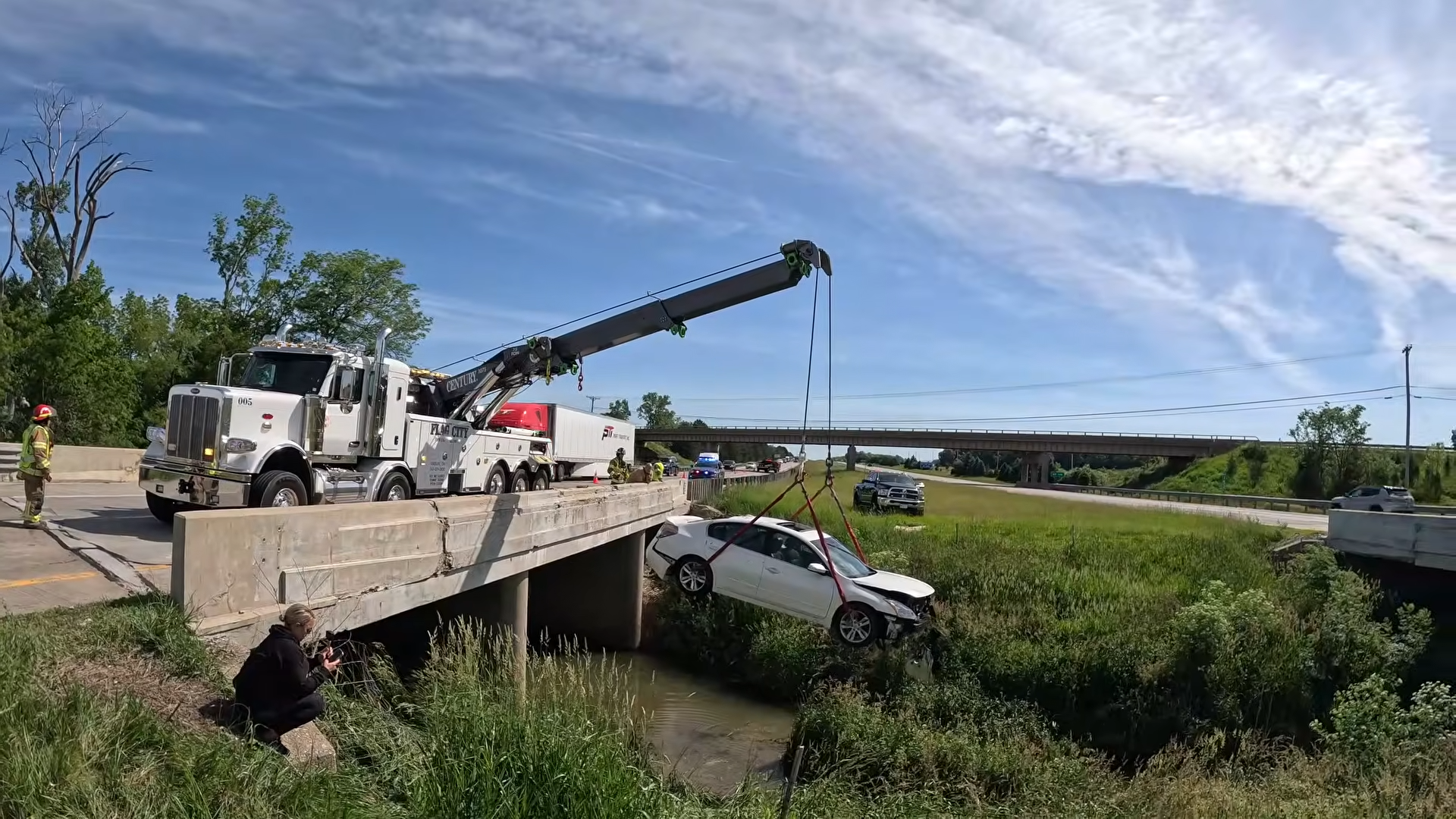
A routine interstate drive turned into a full-scale recovery operation after a Nissan left the road, crossed the median on I-75, and settled into a creek below a bridge. The driver and a young child were both inside when it happened, and while the outcome could have been far worse, neither sustained serious injuries. That alone made it a good day by any measure.
What followed was the part that caught people’s attention online. Flag City Towing and Recovery out of Findlay, Ohio was called to the scene, and operator Kriss Stafford documented the roughly 30-minute recovery on YouTube. The vehicle had come to rest in a grassy area below the bridge, far enough down that a standard wrecker wasn’t going to cut it. This was a job for heavier iron.
Flag City runs a serious fleet, including two Century 1150 Rotators and a Century 1075 Rotator. These aren’t the tow trucks you see hooking up a dead battery on a surface street. They’re purpose-built for exactly this kind of situation, where geography makes a straightforward pull physically impossible.
The recovery footage shows the crew using rigging to secure the Nissan and lift it back up to bridge level, a process that looks deceptively simple on video but involves real planning, load calculation, and precision. It’s the kind of work that doesn’t get much coverage, which is probably why the clip found an audience.
When a Standard Wrecker Just Won’t Do
Most people picture a tow truck as the flatbed or hook-and-chain rig that shows up when your car won’t start. Rotator trucks are a different category entirely. The defining feature is a boom that can swing a full 360 degrees, meaning the crew doesn’t have to position the truck directly in line with the vehicle.
That flexibility matters enormously when a car is wedged into a creek bed or sitting at the base of an embankment.
What the Recovery Process Actually Looks Like
Before any rigging goes on the vehicle, the crew assesses terrain stability, looks for fuel leaks, and determines the safest angle of lift. Getting that wrong doesn’t just damage the vehicle further, it puts the operators at risk. Rigging points are selected carefully, load is distributed, and the boom does the work gradually.
The bungee-style rigging used in the Flag City recovery served to absorb shock during the lift, reducing the chance of sudden shifts as the Nissan came up.
The Century 1150 and 1075: What These Machines Are Built For
The Century 1150 is one of the more capable rotators in the industry, rated for heavy recoveries well beyond what passenger cars demand. Pairing two of them with a 1075 gives a company like Flag City the kind of redundancy and flexibility that complex recoveries sometimes require.
For a job like this one, where ground access below the bridge was limited, having a boom that could reach and lift from the bridge deck was the whole ballgame.
I-75 and the Median Crossover Problem
Median crossover crashes are among the more dangerous accident types on divided highways. The physics aren’t complicated: a vehicle that leaves its lane, crosses a grassy or paved median, and enters opposing traffic or goes over an edge has almost no time for driver correction.
The fact that this particular Nissan ended up in a creek rather than oncoming lanes was, in a grim way, a better outcome than some alternatives.
Recovery work of this kind rarely makes headlines, but it’s a reminder that getting a vehicle back onto solid ground after a bad crash is its own specialized discipline, one that takes the right equipment, the right crew, and a clear head under pressure. Flag City handled it cleanly, and the footage is worth a watch if you’ve never seen a rotator earn its keep.