
Mazda is still chasing one of the strangest and most ambitious emissions-reduction ideas in the auto industry. Instead of relying only on batteries, hybrids, or alternative fuels, the company is developing technology that captures carbon dioxide from a car’s exhaust while it is being driven.
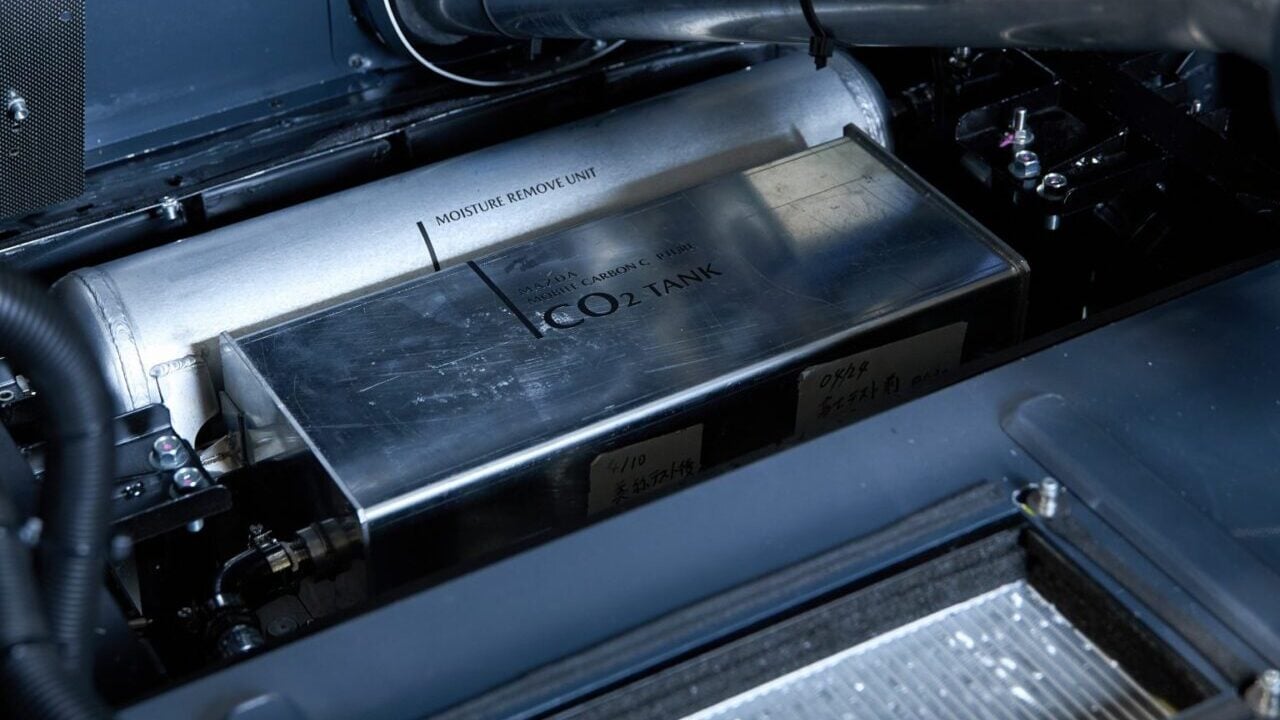
The system is called Mazda Mobile Carbon Capture, and it recently took another step forward during Japan’s Super Taikyu endurance racing series. Mazda says it successfully demonstrated onboard CO2 capture, release, compression, and storage as one complete operating system.
That’s a huge leap from the earlier version of the technology, which could capture CO2, but did not store it onboard during running. This latest test shows Mazda is moving beyond concept-stage experimentation and toward a more complete technical solution.
Mazda’s long-term goal is to support carbon-neutral driving by 2035. It is an unconventional route, but it fits the brand’s belief that combustion engines, alternative fuels, and clever engineering may still have a role in reducing emissions.
The Latest Test Captured Far More CO2
Mazda tested the system in its Mazda Spirit Racing 3 Future Concept race car during Round 3 of the 2026 Super Taikyu Series. The car runs on hydrotreated vegetable oil, or HVO, a renewable fuel that can offer lower lifecycle CO2 emissions than conventional fossil fuels depending on how it is produced.
During Mazda’s first test in November 2025, the system captured 84 grams of CO2. In the latest 24-hour endurance race demonstration, Mazda says the updated system captured 804 grams.
That represents a 9.6-fold improvement over the previous result. It also marks the first time Mazda has demonstrated the entire process of capturing CO2, releasing it from the filter material, compressing it, and storing it onboard.
Mazda also says the combined effect of HVO fuel and the onboard capture system temporarily exceeded the recovery level it assumes for typical future production-car use. The company cautions, however, that a full lifecycle carbon balance has not yet been established.
How Mazda’s Carbon Capture System Works
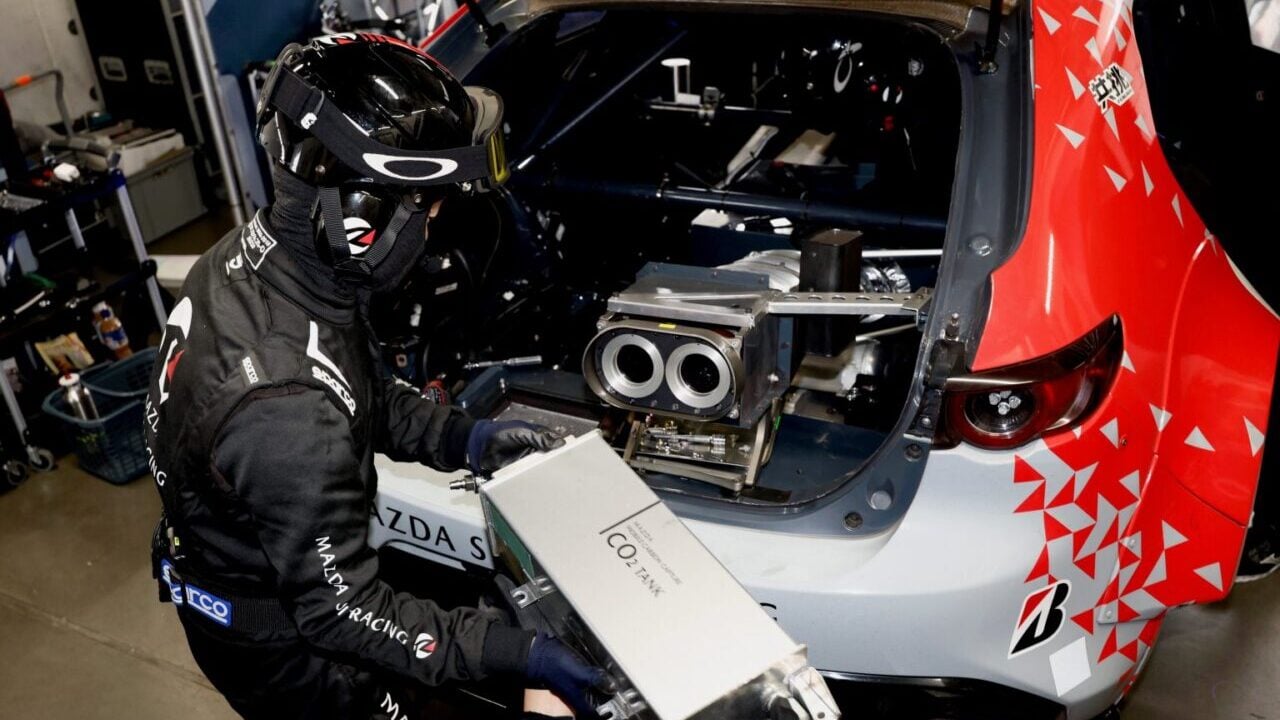
The technology relies on zeolite, a porous material that acts somewhat like a sponge for carbon dioxide. As exhaust gases pass through the system, the zeolite captures CO2 molecules.
Once the material becomes saturated, Mazda uses exhaust heat generated during driving to release the trapped CO2. That process is known as desorption.
The released gas is then compressed using an electric compressor. From there, it is stored in a dedicated onboard tank rather than being released back into the atmosphere.
In theory, this could allow a combustion-powered vehicle using carbon-neutral fuel to reduce its net CO2 output while still delivering the driving feel many enthusiasts associate with internal-combustion engines.
Racing Is Mazda’s Test Laboratory
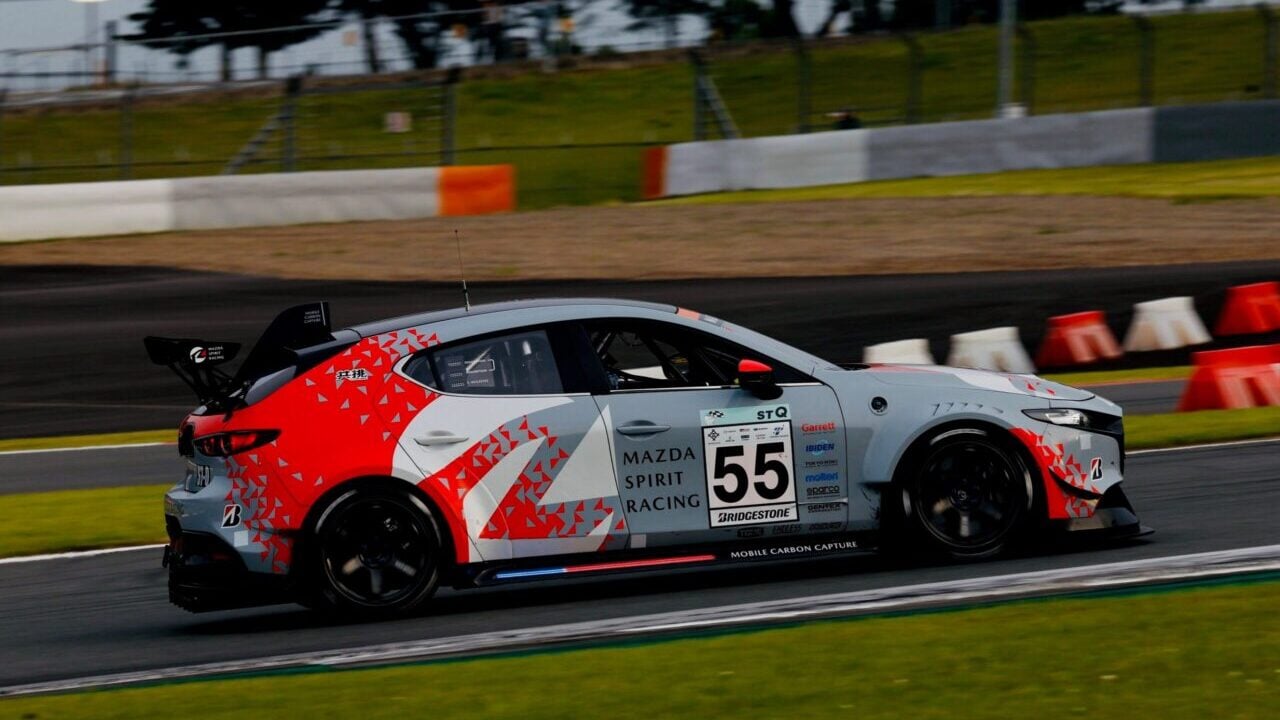
Mazda is testing the system in endurance racing because the environment is demanding. Race cars operate under high loads for long periods, creating a useful proving ground for durability, heat management, and system efficiency.
The company plans to continue refining the setup during future Super Taikyu events. Mazda specifically says it aims to conduct additional evaluation during Round 7 of the 2026 season in November.
That next phase will focus on improving efficiency, durability, and packaging. Those areas will be critical if Mazda ever wants to adapt the technology for normal production vehicles.
Right now, the system remains experimental. Mazda still needs to prove it can work affordably, reliably, and compactly enough for everyday cars.
A Different Path From Most Automakers
Most automakers are focusing almost entirely on EVs, hybrids, and plug-in hybrids to reduce emissions. Mazda’s approach is different because it is also trying to preserve combustion engines through cleaner fuels and emissions-capture technology.
That does not mean Mazda is ignoring electrification. The company is developing EVs and hybrids as well, but it clearly wants multiple solutions rather than betting everything on one technology.
The big unanswered question is what happens to the captured CO2 after the vehicle stores it. Mazda will eventually need a practical system for collecting, recycling, or permanently storing that carbon after driving.
Still, the latest test is an important step. Capturing 804 grams in a race environment will not change the world by itself, but it shows Mazda’s carbon-capturing car idea is becoming less like an auto-show fantasy and more like a serious engineering experiment.
For a brand that still cares deeply about driving enjoyment, that makes this one of the more interesting sustainability projects in the industry.