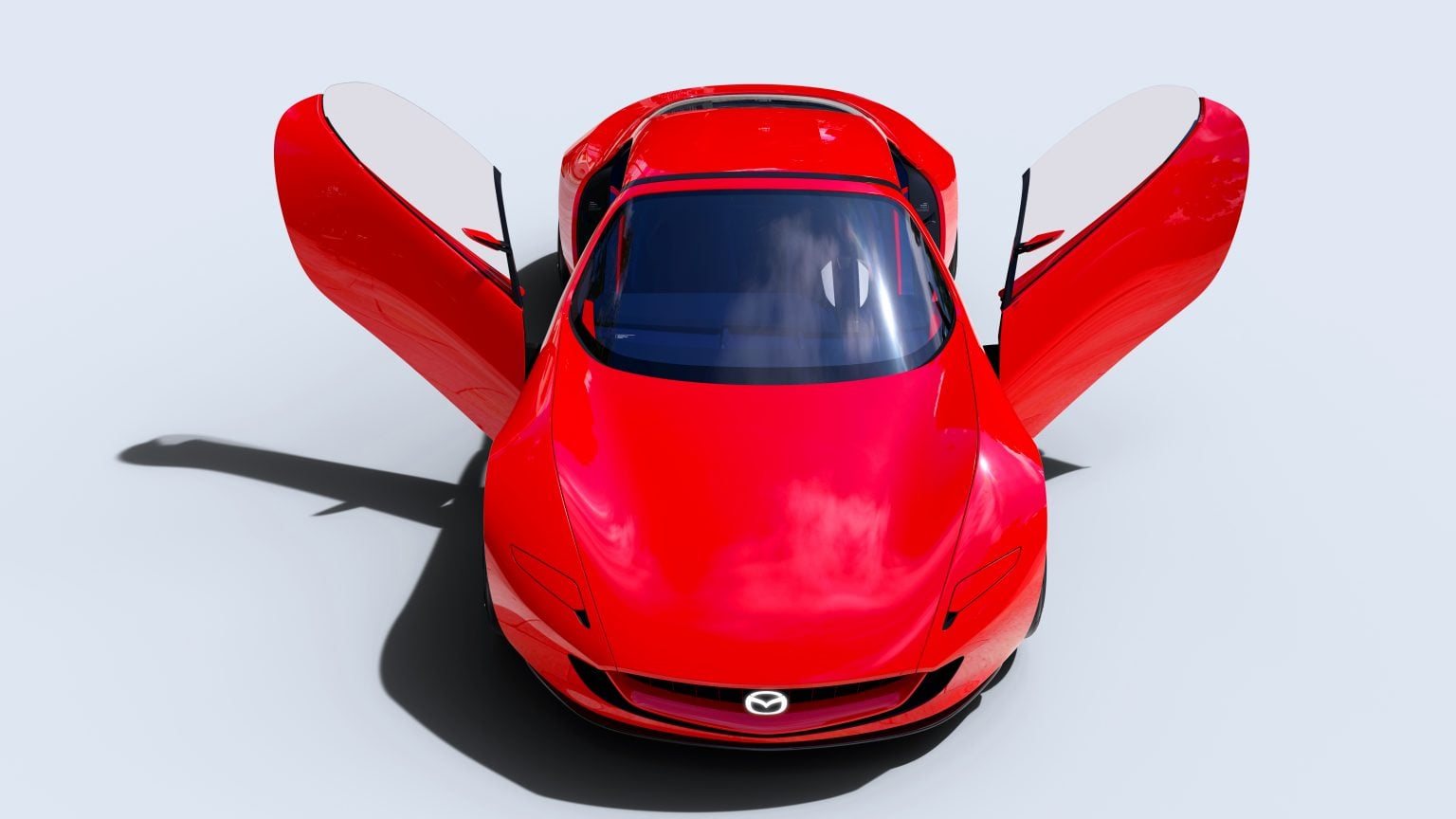
Mazda has spent the past few years dropping increasingly tantalizing hints about its sports car future. Now, newly surfaced patent filings may offer another piece of the puzzle, although they also raise some intriguing questions about exactly what the Japanese automaker is developing.
The patents depict a compact, front-engined, rear-wheel-drive convertible with an unusual feature for Mazda: butterfly-style doors. Under the hood, however, the drawings appear to show a longitudinally mounted four-cylinder engine rather than the rotary-based electrified powertrain enthusiasts might expect from Mazda’s recent concepts.
Mazda hasn’t identified the vehicle shown in the documents, so there is no confirmation that these drawings preview a specific production model. The obvious possibilities include engineering work connected to the next-generation MX-5 Miata, a future production interpretation of the Iconic SP concept, or potentially an architecture that could underpin multiple sports cars.
Whatever Mazda is planning, the patents suggest the company is continuing to invest engineering resources into lightweight, rear-wheel-drive performance cars. That alone should be encouraging for enthusiasts, even if the rotary engine appears to be missing from this particular set of drawings.
Mazda Is Exploring Butterfly Doors
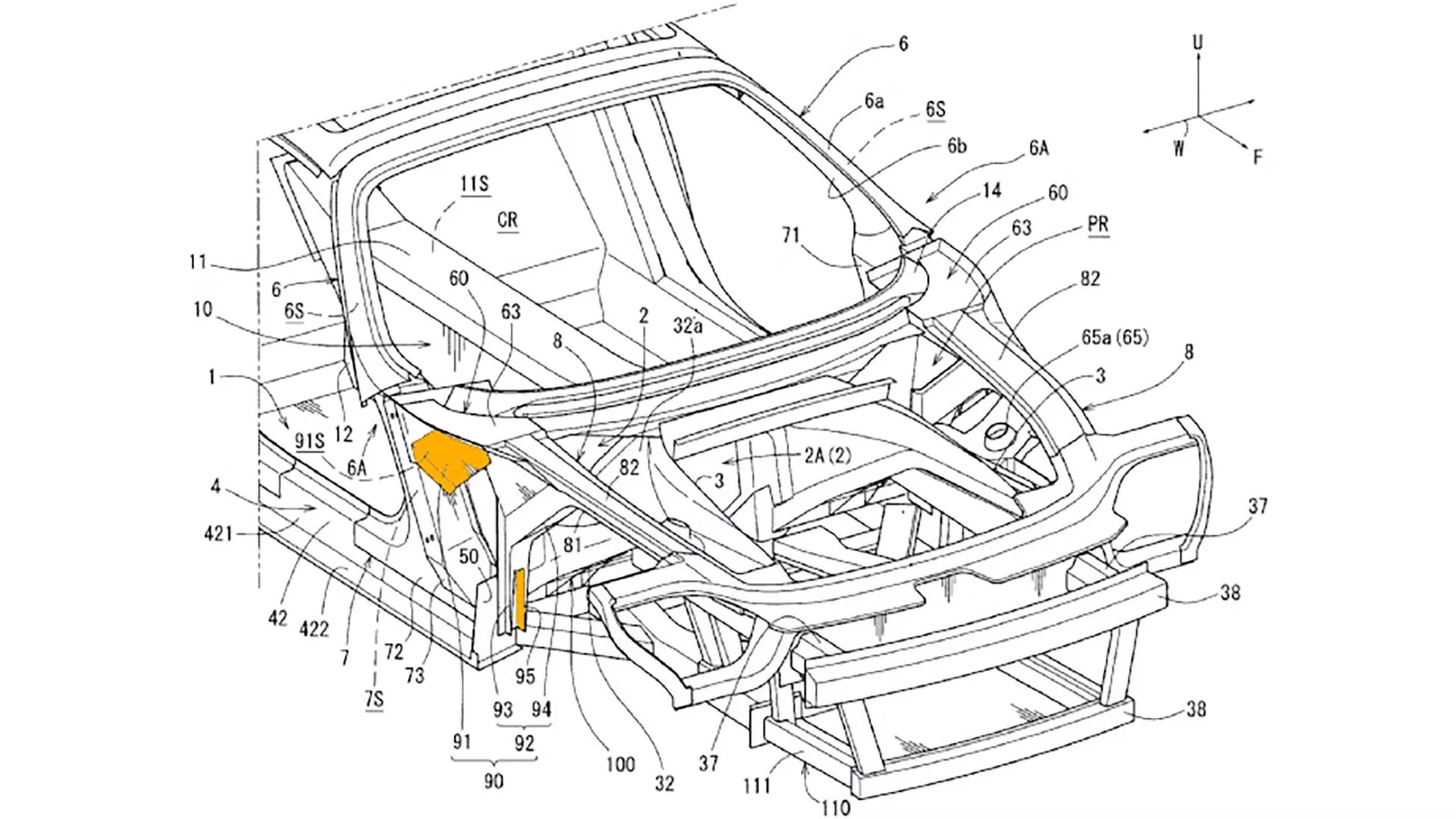
One of the patents focuses on the vehicle’s hinge-pillar structure and describes a flip-up side door arrangement. The design would allow the rear portion of the door to move outward and upward, creating an opening mechanism similar to butterfly or scissor doors.
That would be unfamiliar territory for a production Mazda. The automaker has experimented with unconventional door designs before, most famously with the RX-8’s rear-hinged auxiliary doors, but dramatic upward-opening doors have never reached one of its production models.
The filing also details structural measures designed to maintain chassis rigidity. Mazda describes positioning the A-pillars closer to the shock towers, along with additional bracing intended to transfer suspension loads through reinforced areas of the body.
Another element described in the patent is an apron frame connecting portions of the front structure to the firewall. The apparent objective is to increase stiffness while controlling weight, an especially important consideration if the vehicle is indeed a convertible without a fixed roof contributing to structural rigidity.
The Engine Raises Even More Questions
Perhaps the most interesting detail isn’t the doors at all. Patent illustrations appear to show a conventional four-cylinder engine mounted longitudinally ahead of the passenger compartment, along with what looks like a traditional transmission tunnel.
That layout immediately invites comparisons with the MX-5. Mazda has already indicated that the next generation of its roadster will preserve the fundamental formula that has defined the Miata for decades: low weight, compact dimensions, and an internal-combustion engine.
Fancy butterfly doors, however, would seem like an unusual addition to a car famous for simplicity and affordability. Such hardware could add cost and complexity to a model whose appeal has traditionally come from avoiding exactly those things.
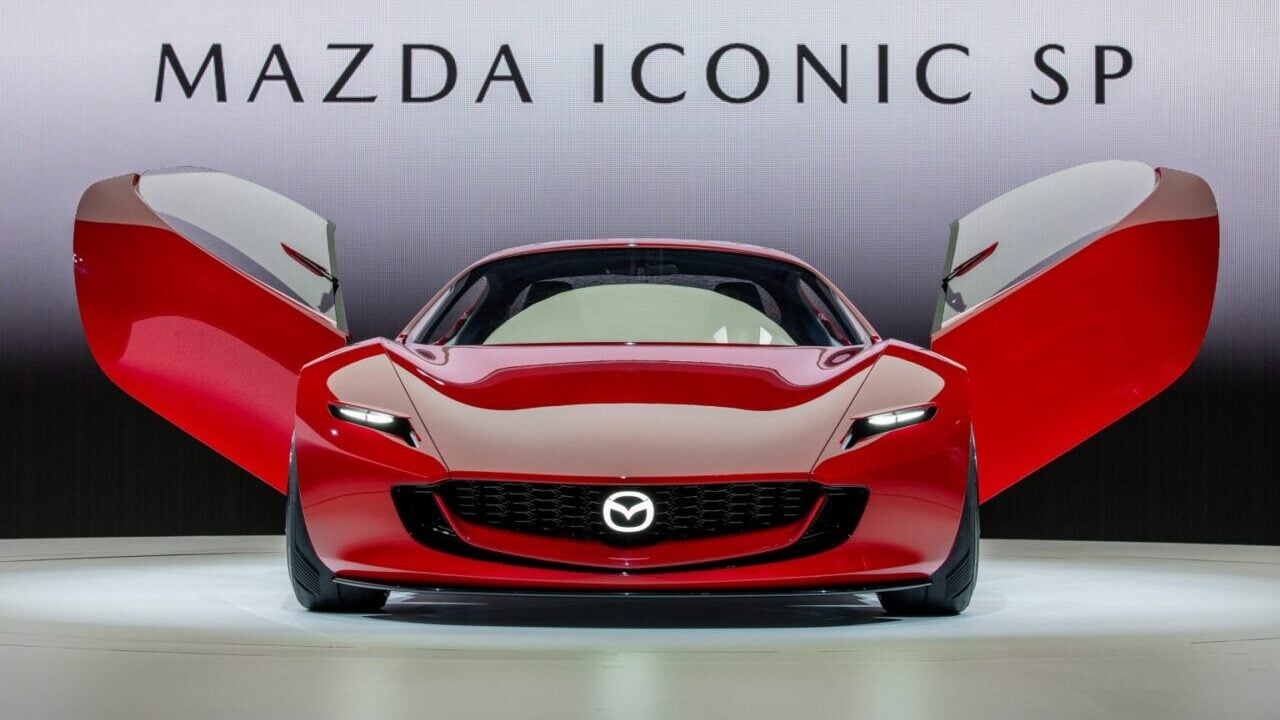
The Iconic SP presents another possibility. Revealed as a sleek sports car concept with butterfly doors, it was originally presented with a two-rotor rotary engine serving as a generator within an electrified powertrain.
The architecture depicted in these patents appears considerably different, at least on the surface. That raises the possibility that Mazda could be investigating alternative powertrains for a production sports car inspired by the Iconic SP, although the patents alone aren’t enough to establish that conclusion.
Could Mazda Be Developing One Platform For Two Sports Cars?
There is another intriguing possibility: Mazda could be developing a flexible sports car architecture capable of supporting different models and powertrains. In that scenario, the patent drawings might represent underlying engineering solutions rather than an exact preview of one future vehicle.
A shared architecture could theoretically help Mazda spread development costs while preserving distinct identities for the MX-5 and a higher-performance sports car. The Miata could remain relatively simple and accessible, while another model could adopt more exotic styling, greater performance, and features such as butterfly doors.
That remains speculation for now. Automakers regularly patent technologies and engineering concepts that never reach production, while patent illustrations are often simplified and shouldn’t necessarily be interpreted as accurate previews of finished vehicles.
Still, the combination shown here is difficult to ignore. A compact Mazda sports car with rear-wheel drive, a longitudinal engine, and butterfly doors sounds like an enthusiast’s wish list.
The surprising part is what isn’t visible. After years of anticipation surrounding Mazda’s potential rotary-powered sports car revival, these latest patents suggest the company’s next performance machine could take a very different route.