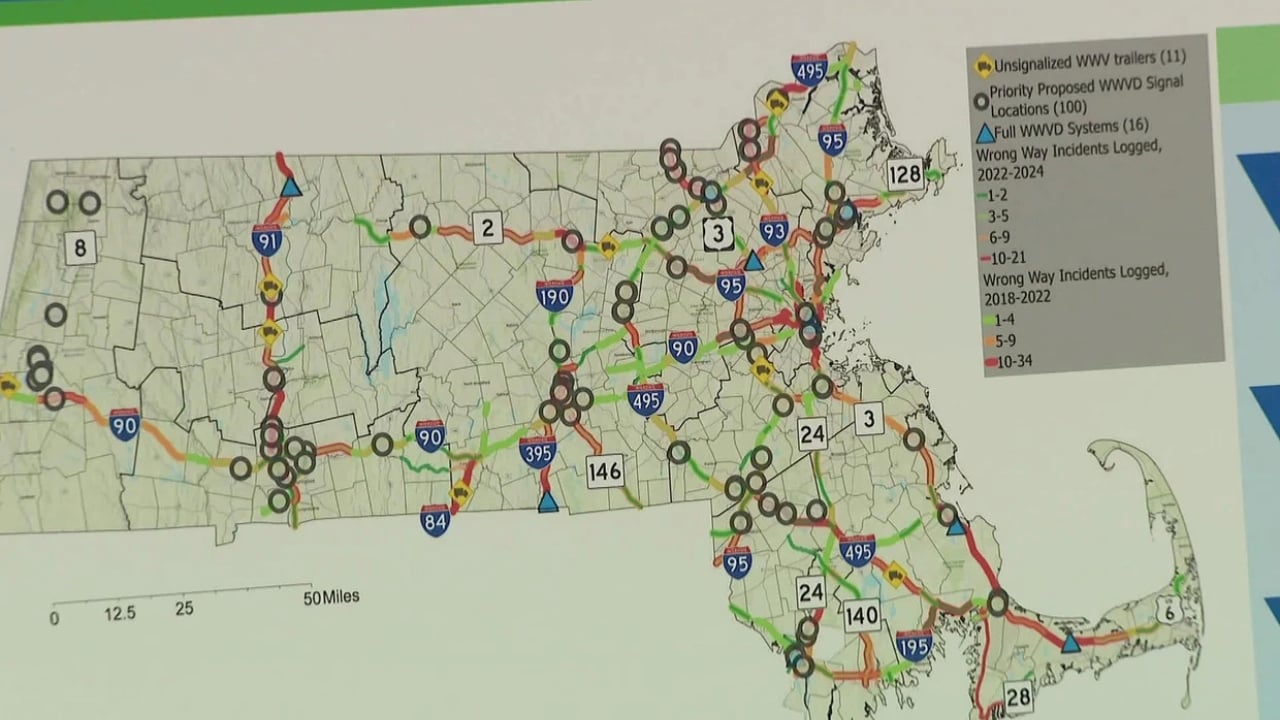
Massachusetts is preparing a major overhaul of its road safety infrastructure, committing between $50 million and $75 million to combat one of the deadliest types of traffic accidents, wrong-way driving.
The ambitious initiative will target more than 400 locations across the state, making it one of the largest wrong-way driver detection programs in the United States.
Officials hope a combination of advanced sensors, flashing warning signs, and redesigned roadways will dramatically reduce the number of catastrophic head on crashes.
The expanded effort follows several fatal incidents, including the death of Massachusetts State Trooper Kevin Trainor, who was killed while responding to a wrong way driver.
Although these crashes are relatively uncommon, authorities say they often result in severe injuries or fatalities because of the high speeds involved.
State officials believe many incidents are caused not only by impaired drivers, but also by motorists who become confused by poorly designed intersections and highway ramps.
Thermal Sensors and Instant Alerts Form the Backbone of the System

The centerpiece of the new safety initiative is a network of thermal sensors and automated warning systems designed to detect vehicles entering highways incorrectly.
When a driver heads the wrong way up an exit ramp, sensors immediately activate bright flashing signs warning the motorist to turn around. At the same time, real-time notifications are sent to transportation officials and law enforcement agencies, allowing emergency responders to react quickly if the driver fails to correct the mistake.
According to state officials, the technology has already proven effective. A recently activated system in Danvers reportedly alerted a motorist who entered a ramp incorrectly, prompting the driver to turn around safely before an accident occurred.
CBS News reports that authorities say rapid intervention could save lives by preventing dangerous encounters with oncoming traffic and reducing the time emergency services need to respond.
Infrastructure Upgrades Will Complement the Technology
Massachusetts is not relying solely on sensors and cameras. Officials are also investing in lower-tech improvements that could prevent drivers from becoming disoriented in the first place.
Planned upgrades include additional Wrong Way and Do Not Enter signs, clearer pavement markings, directional arrows, enhanced lighting, and redesigned traffic islands. Some problematic ramps and interchanges may also be reconfigured to make navigation more intuitive.
Transportation experts have long argued that road design plays a critical role in driver behavior. In many cases, confusion caused by complex or poorly marked intersections can lead to mistakes, especially at night or during bad weather.
By combining engineering changes with modern detection systems, Massachusetts hopes to create multiple layers of protection against wrong-way incidents.
Other States Have Already Seen Encouraging Results
Massachusetts is not the first state to tackle the problem. Rhode Island has implemented similar technology and reportedly experienced a decline in wrong-way driving incidents.
Connecticut has also deployed hundreds of detection cameras and has credited the system with helping motorists correct their mistakes before causing crashes.
Officials expect the Massachusetts rollout to take months and possibly years to complete, with installations continuing through 2026 and 2027.
Safety advocates say the program could become a model for other states facing similar challenges. Rather than simply responding after a driver enters traffic in the wrong direction, the focus is shifting toward prevention and smarter infrastructure.
If successful, Massachusetts’ investment could demonstrate that combining technology with better roadway design offers one of the most effective ways to reduce deadly crashes.
In the long run, officials hope the project will not only save lives but also provide lessons for transportation agencies nationwide seeking to make highways safer for everyone.