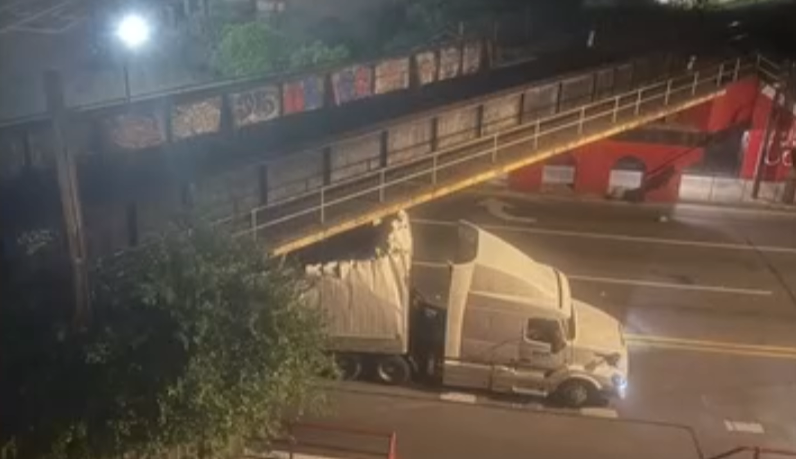
Louisville, Kentucky, has no shortage of traffic headaches on a normal day, but the city’s two-month closure of Interstate 65 has turned one particular stretch of South Third Street into something of a recurring disaster. Despite nearly 30 warning signs directing drivers away from a low-clearance railroad underpass near Winkler Avenue and Eastern Parkway, at least a dozen semi-trucks have collided with the structure since the closure began on June 1.
Locals call the bridge “the Can Opener,” a nickname earned the hard way. Footage captured by local news crews shows the roof of at least one semi-trailer peeled back after the driver attempted to squeeze beneath a bridge that is simply too low for standard truck traffic.
A popular Facebook group, Louisville Can Opener, has nearly 30,000 members, and countless Reddit posts track the bridge’s latest victims. The structure has become a local celebrity, but the recent I-65 closure has introduced a new wave of out-of-town truck drivers to one of Louisville’s most infamous landmarks.
The closure affects a corridor that normally carries around 125,000 vehicles per day. With I-65 shut down between Jefferson Street and the Watterson Expressway (I-264), a significant portion of that traffic is being pushed onto surrounding streets. Truck drivers unfamiliar with Louisville and relying on GPS navigation are wandering directly into the Can Opener’s territory in numbers the city has rarely seen before.
Crews are replacing three elevated bridge sections built in the late 1950s and rated in poor to serious condition. Officials say the full closure, which runs through approximately August 1, will shorten the overall construction timeline and that the new structures should last up to 75 years.
That is welcome news for Louisville’s long-term infrastructure, though it offers little comfort to the trucking companies currently paying to have their vehicles de-roofed and towed.
Why I-65 Is Closed and Where the Traffic Went
The $150 million I-65 Central Corridor project will replace three aging bridges in Louisville, including one over Kentucky and Brook streets, one over Hill Street, a CSX rail line and Burnett Avenue, and one over Bradley Avenue.
Officials opted for a full closure rather than phased lane reductions, citing that a complete shutdown saves at least a year of additional restrictions and construction delays. Partial southbound reopening is expected around July 1, with a broader reopening targeted for August 1.
The signed detour routes through-traffic via I-264, the Georgia Davis Powers Expressway, on the west side of Louisville. That is the official route.
Many truck drivers, however, are not taking it. Whether through unfamiliarity with the city, aggressive GPS rerouting, or simple inattention, a steady stream of commercial vehicles has been threading into residential streets around the University of Louisville campus, right where the Can Opener sits and waits.
The Bridge, the Nickname, and the Long Track Record
The 3rd Street underpass carries clearances of 11 feet, 8 inches on one side and exactly 12 feet on the other, both well short of the 13-foot, 6-inch standard height for most commercial semi-trucks.
Flashing lights and signage have warned drivers for years, and yet trucks continue to get stuck and damaged after missing or ignoring those warnings.
It is worth noting that the Can Opener is not alone. There are actually four low-clearance railroad bridges in the area that regularly catch oversized vehicles. The Third Street underpass simply has the most name recognition.
Local tow operators, who are perhaps the most qualified people in Louisville to weigh in on the subject, have a more businesslike relationship with the location.
One veteran tow operator noted that dispatchers do not actually use the “Can Opener” nickname on the radio. They refer to it by intersection: Third and Winkler, or Third and Eastern.
When you are rolling out to your fourth call of the week at the same bridge, the novelty of the nickname probably fades.
Thirty Signs and Counting
At the start of the I-65 closure, city officials noted there were already 29 warning signs in the area directing drivers to the low clearance.
That did not prevent five trucks from striking the bridge within the first two days alone. By Wednesday of that week, the count had climbed to at least six, with four crashes occurring on Monday and another in the early hours of Tuesday morning.
By Friday, the Kentucky Transportation Cabinet had responded by adding more signage. Officials announced there were now more than 30 signs in place on South Third Street, Eastern Parkway, and Winkler Avenue.
The agency also issued a pointed message to truck drivers: “Check your height, know it’s right to clear the bridge. Don’t become the next cautionary tale.”
The phrasing suggests the state has run out of diplomatic language on the subject.
GPS, Detours, and Driver Accountability
A local tow operator who has responded to countless bridge strikes over the years believes the core problem is a combination of unfamiliarity with Louisville’s streets and over-reliance on navigation apps.
Most of the drivers involved are from out of town and are simply following whatever route their GPS provides. That is understandable for someone navigating an unfamiliar city under the added stress of a major interstate closure. It does not, however, make the outcome any less expensive.
Beyond the physical damage to the trucks themselves, the financial consequences can be significant. If a bridge is damaged in the collision, the trucking company can be held liable for repair costs. Drivers may also face fines.
A missed sign can quickly translate into a very bad quarter for a small carrier.
The state’s advice remains straightforward: truck drivers should avoid the area entirely and follow the signed detour.
With two months of closure still ahead, and a bridge that has demonstrated considerable patience and zero mercy, that recommendation is worth taking seriously.