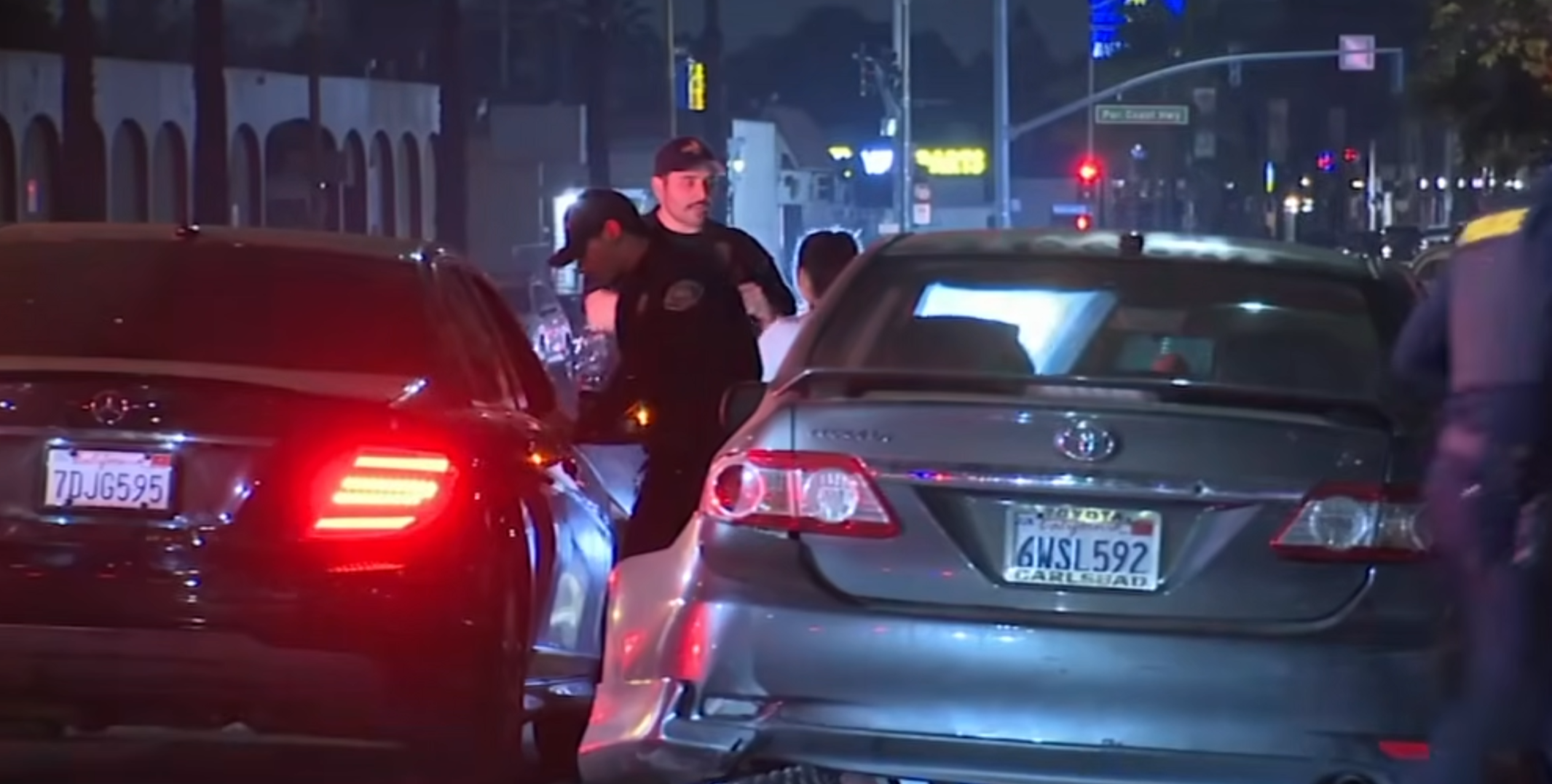
There is a reason motor officers in Los Angeles look vaguely like they are running a speed chess clock in their heads while sitting at intersections. Every driver who fumbles a phone at a red light, every e-scooter that blows a stop sign, every pedestrian who trusts their luck on a sidewalk that has somehow been annexed by electric micromobility users is a violation waiting to be written up. The LAPD does not have unlimited patience, and lately, it really does not have unlimited patience.
Serious traffic crashes resulting in injury or death are climbing in Los Angeles this year, with the LAPD reporting 750 such crashes so far, a 5% increase over the same period last year. That number does not arrive in a vacuum. It lands against a backdrop of what police are now openly calling a distracted driving epidemic, and it is backed up by enforcement action that is about as targeted as a surgical strike on a city grid.
The officers doing this work are not randomly trolling the 405. They are hitting specific intersections with documented crash histories, pulling over drivers who are still making the apparently controversial decision to hold a phone while operating a multi-ton vehicle. According to the 2025 California Statewide Public Opinion Survey, more than 71% of motorists said distracted driving caused by texting or checking a phone notification was a high-alert safety concern, which means drivers overwhelmingly know the problem exists and a meaningful number of them continue doing it anyway.
Adding a new wrinkle to the usual car-versus-car calculus are e-bikes and e-scooters, which have moved from novelty to genuine public safety variable in a relatively short window. Police report 54 crashes already this year involving a car and an e-bike in the city alone, with officers also warning pedestrians to stay alert as riders increasingly operate illegally on sidewalks. There has been at least one case in which an e-scooter struck and killed a pedestrian on a sidewalk. The infrastructure has not kept pace with the adoption curve, and that gap is showing up in crash data.
The Intersections LAPD Is Watching Right Now
If you drive through these spots regularly, consider this a heads-up. Officers are concentrating enforcement at Figueroa Street and 7th Street in downtown Los Angeles, which has logged 11 crashes so far in 2026. Highland Avenue and Pat Moore Way near the Hollywood Bowl has seen six crashes, and there have been five apiece at Century Boulevard and Main Street in South L.A. and at Sherman Way near a freeway entrance in the Valley. These are not arbitrary patrol zones. They are the intersections where the data keeps pointing.
Enforcement at these specific chokepoints is intentional. Sgt. Ryan Klepper, who supervises the motor unit conducting the targeted stops, described the exercise in terms that any serious driver would recognize: you are always looking, always tracking, always cataloging which behaviors are about to produce consequences. Running a red light is not an abstract offense when you are stationed at an intersection that has already produced eleven crashes in a single calendar year.
The E-Bike and E-Scooter Problem Nobody Wants to Talk About Plainly
The elephant in the bike lane is that electric two-wheelers exist in a regulatory gray zone that has real consequences. Police note that many younger e-scooter riders do not have a driver’s license, are not stopping at stop signs, and are running red lights. That description fits a substantial portion of the micromobility population on any given day in Los Angeles.
This is not an argument against the existence of e-bikes or e-scooters. It is an argument for treating them as vehicles, which they functionally are. When something can travel at 20 to 28 miles per hour and its operator has never passed a driving test or studied traffic law, the statistical outcome is not hard to predict. The LAPD’s rising crash count is, in part, that prediction coming true.
What the Numbers Actually Mean
Los Angeles County recorded 526 traffic deaths in 2025, roughly one to two fatalities every single day of the year. Statewide, California recorded 158 deaths attributed to distracted driving in 2023 alone, a figure officials acknowledge is almost certainly an undercount because distraction is not always determinable at the scene. The trend line is not bending in a favorable direction.
For the car enthusiast who actually understands vehicle dynamics and situational awareness, the frustrating part of these numbers is how preventable they are. A driver who is looking at a phone in traffic is not just a liability to themselves. They are an unpredictable variable that every competent driver around them now has to anticipate and absorb. The buffer distance you leave, the extra half-second you give a green light before moving through an intersection, the way you watch hands in adjacent vehicles at stops: this is what driving in Los Angeles has become for anyone paying attention.
What LAPD Is Doing About It
The current enforcement model combines targeted geographic deployment with active motor patrols designed to catch hands-on-phone violations. In 2022 alone, LAPD issued more than 5,000 citations specifically for distracted driving violations, and the department has been expanding its use of technology to identify high-risk corridors. The specific intersection-focused campaigns represent a more surgical version of that approach, betting that concentrated enforcement in crash-heavy spots will change driver behavior at the locations where it matters most.
Whether citations alone move the needle is a fair question. Enforcement can reduce violations in the immediate vicinity when officers are visible, but the phone goes back to the center console the moment the motor officer is out of sight. The longer-term fix likely involves infrastructure, better micromobility regulation, and a cultural recalibration that treats distracted driving with the same social weight as drunk driving. Los Angeles is still working on all three.