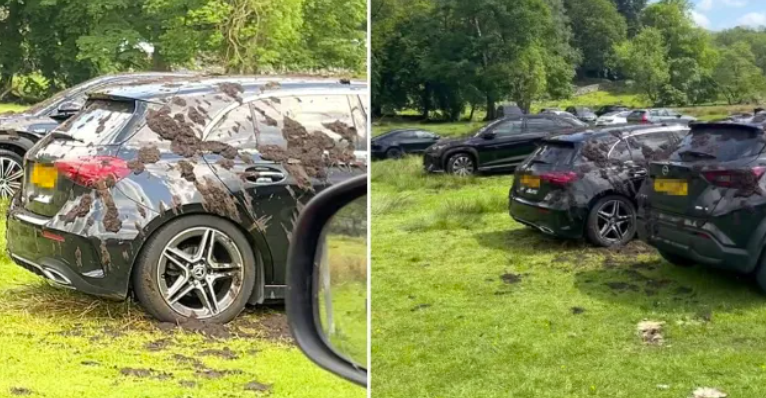
In England’s Lake District, sheep farmer Hogg Hodgson had posted signs, placed rocks, and asked nicely. None of it worked. So he reached for the slurry spreader.
During the late May Bank Holiday heatwave, more than 20 vehicles pulled off the A591 near Rydal Water in Cumbria and parked themselves directly onto Hodgson’s private farmland.
According to reports from BBC News and The Telegraph, illegal parking has been a recurring issue in the area during busy holiday weekends. The field was clearly marked with a “Polite Notice: DO NOT PARK IN THE FIELD” sign. There was a second sign warning that sheep were present. Visitors apparently read both signs, considered the situation, and parked anyway. Some even moved rocks that Hodgson had placed to block access, which at that point stops being a parking problem and starts being a statement of intent.
What happened next quickly went viral across the UK and beyond. Hodgson brought out his slurry spreader and methodically coated the vehicles in liquid cow manure. A black Mercedes appeared to have taken the worst of it. Jaguars and BMWs were also among the casualties. The footage, captured on a bystander’s phone, shows car owners returning to assess the situation with the particular expression people reserve for moments when they know, deep down, that they brought this on themselves.
Cumbria Police confirmed they were made aware of the incident around 10 p.m. on May 25 and said their Neighbourhood Policing Teams are conducting inquiries into the circumstances. They also noted, perhaps pointedly, that it appeared the cars had been parked on the farm owner’s land without permission.
Why Were People Parking in a Farmer’s Field?
Rydal Water sits in England’s Lake District, one of the country’s most visited outdoor destinations. The area attracts hikers, walkers, and day-trippers throughout the year, with visitor numbers surging during holidays and warm-weather weekends.
Parking has been a long-standing issue in the area, according to the BBC, and The Telegraph reported that a nearby car park was already full by 9 a.m. during the holiday weekend.
That does not mean the field was available for public parking. Multiple signs warned motorists not to enter, and reports indicate some visitors may have even moved rocks placed at the entrance to prevent vehicles from accessing the land. To many locals, that is why the slurry incident generated less sympathy than outsiders might expect.
Embedded video follows. Please allow a moment for it to load.
Hodgson Is Not Celebrating
For all the online applause, the farmer himself has been notably measured about the whole thing. Speaking to the Daily Mail, Hodgson said he was not proud of what he did and did not set out to make a scene. His frustration, he explained, was with the broader pattern of behavior he has endured from tourists who treat working farmland as overflow parking.
“I am sick of being abused by people when I ask them not to park on our land,” he said. He also noted that everything he did took place within his own field boundary, and that he did not spray anything onto the public road, which is a legally significant distinction.
Spreading slurry on agricultural land is routine and perfectly legal. Hodgson was, in effect, fertilizing his own field. The fact that several expensive German and British cars happened to be sitting on that field at the time is, from a legal standpoint, a consequence of the owners’ decision to park there without permission. Whether that shielded him entirely from liability remains to be seen as police continue their inquiries, but the legal picture is considerably more complicated for the car owners than it might initially appear.
This Is Not the First Time a Slurry Spreader Has Settled a Dispute
It would be easy to treat this as a one-off bit of countryside theater, but the slurry spreader has a longer history as a tool of last resort for farmers pushed to the edge. In Tavistock, Devon, a farmer named Jack Bellamy used the same approach on a trespasser who had pitched a tent on his land without permission, soaking the camper’s tent and bicycle in waste while noting that perfectly good commercial campsites were available nearby.
The tactic went even more high-profile in 2016 when actress Emma Thompson and a group of anti-fracking protesters occupied farmland in Lancashire. The farmer, unhappy with the unauthorized use of his property, drove a muck spreader around the group mid-demonstration and applied a generous coating of slurry. The protesters dodged as best they could. The farmer made his point.
In France, groups of farmers have used the same method to clear squatter encampments from fields ahead of harvest season, with tractors mounted with slurry tanks circling caravans after local authorities proved unable or unwilling to act. Spreading manure on farmland being entirely routine gave the act enough legal cover to proceed.
A Wider Problem That Has Real Consequences
The Lake District has been managing an overcrowding and illegal parking problem for years, and it is not merely an inconvenience. As BBC News recently reported, local farmer John Atkinson said parking problems around the Lake District have become a recurring issue during busy weekends and holidays. Atkinson also recalled being stabbed while confronting a motorist who was causing an obstruction several years ago, underscoring how quickly disputes over access and parking can escalate.
The consequences for working farmers have at times been severe. A farmer near Dovestone Reservoir in Saddleworth found her access to lambing fields blocked by illegally parked cars on Easter Sunday. She could not reach her flock in time, and one of her pregnant ewes died.
During a 2023 heatwave in Bournemouth, more than 1,300 parking fines were issued over a single weekend as visitors left cars on roundabouts, double yellow lines, and pavements. The Lake District National Park Authority has pursued enforcement actions against unauthorized car parks, including one near Coniston that was removed by order after being constructed without planning permission.
None of these measures has fully resolved the underlying tension between the volume of visitors and the reality that much of the landscape people come to enjoy is active, working farmland.
What the Cars Can Expect From Here
Slurry is not pleasant to deal with on a cool Tuesday morning in a professional car wash, let alone baked onto paintwork by a heatwave. It is corrosive, it is pungent, and it has a particular talent for working itself into every gap a vehicle has to offer.
Whether insurance claims will cover the damage is a legitimate question, and the answer likely depends on whether insurers consider parking on private land without permission to be a contributing factor, which some policies do treat as grounds for reducing or denying payouts.
The broader lesson, if one is needed, is that a sign saying “Do Not Park Here” on a working farm is not a suggestion open to individual interpretation. Farmers deal with very real pressures on their land, their livestock, and their operations every time the weather turns and the countryside fills up with day-trippers looking for a free spot.
Hogg Hodgson may not consider himself a hero, and he is probably right to be cautious about that framing. But he did post the signs, place the rocks, and ask people directly. Whether people view his response as justified, excessive, or somewhere in between, the incident has reignited a debate that surfaces in the Lake District almost every summer about overcrowding, access, and respect for private farmland.
I agree 100% with the farmer. We drivers have a duty of care to follow the rules. You can’t park where you want just because. You decide to.
There are parking lots, if they are full find closer to or in town. then get public transport of taxi to where you want to hike, walk swim.
Same here in Ireland people assume by putting on your emergency lights, you can park where ever you want. You have your emergency lights on. NO if your car is towed not clamped not a ticket but towed. You now have to get to the tow yard spend a lot of money getting your car out. You’ll think twice before breaking the rules causing frustration to other drivers
Those car owners will probably go to the Lake District again but may think twice before ignoring signs saying private property.
Agreed