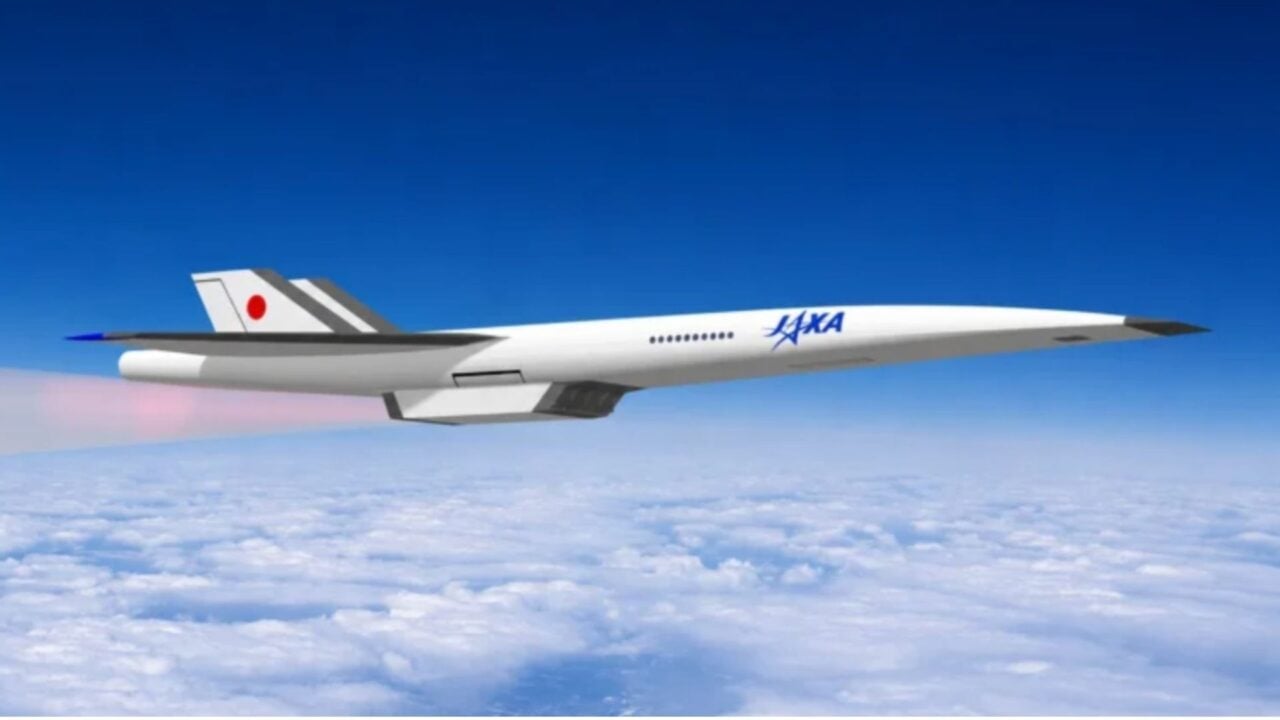
Japan has taken another major step toward the future of hypersonic air travel, successfully testing a ramjet engine system designed for an experimental aircraft capable of reaching Mach 5 speeds.
The project, led by the Japan Aerospace Exploration Agency (JAXA) alongside several major universities, is part of an effort to develop ultra-high-speed aircraft that could dramatically reduce long-distance travel times. At Mach 5, the aircraft would theoretically travel at roughly 3,800 mph, which is fast enough to fly from Tokyo to New York City in just under two hours.
That speed would place it far beyond even the next generation of planned supersonic passenger jets currently under development elsewhere in the world.
The recent test focused on one of the biggest challenges in hypersonic aviation: maintaining stable propulsion and structural integrity while operating in temperatures hot enough to melt many conventional aerospace materials.
Japan Successfully Simulated Mach 5 Flight Conditions
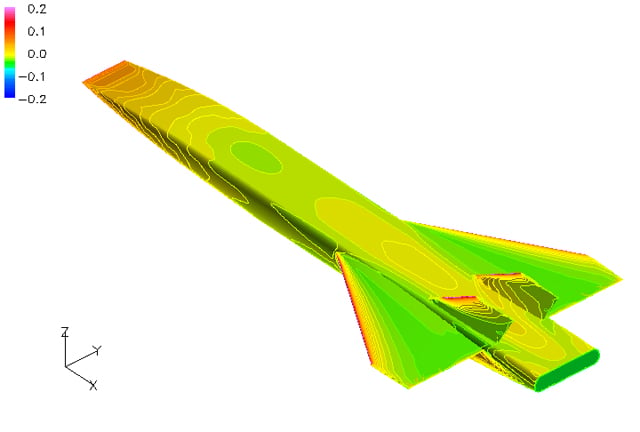
The test took place at JAXA’s Kakuda Space Center in Miyagi Prefecture using a specialized ramjet engine testing facility designed to simulate hypersonic flight environments.
Researchers subjected the experimental aircraft to Mach 5 conditions while analyzing how the vehicle’s propulsion system, thermal protection structure, and control surfaces behaved under extreme stress. At those speeds, temperatures around the aircraft can reportedly climb to roughly 1,832 degrees Fahrenheit.
According to JAXA, the aircraft’s heat shielding system successfully maintained near-normal temperatures inside critical sections of the vehicle, allowing onboard electronics and avionics to continue functioning properly during the test.
That thermal protection is absolutely essential for any future hypersonic passenger aircraft. At Mach 5 velocities, aerodynamic heating becomes one of the single largest engineering obstacles.
The Aircraft Uses Hydrogen-Fueled Ramjet Technology
Unlike traditional jet engines, ramjets operate using the aircraft’s own high-speed forward motion to compress incoming air before combustion. That design becomes increasingly efficient at extremely high velocities, making ramjets and scramjets central technologies in modern hypersonic research.
The experimental aircraft tested by JAXA uses a hydrogen-fueled ramjet engine. Researchers measured exhaust temperature distribution and airflow behavior during testing to better understand how the propulsion system interacts with the aircraft’s structure at hypersonic speed. That interaction is much more complicated than in conventional aircraft.
At Mach 5, airflow, shock waves, thrust output, and vehicle stability all become deeply interconnected. Engineers can no longer treat the engine and airframe as separate systems because changes in one directly affect the other. That is why JAXA’s program focuses heavily on integrated airframe and propulsion control.
Japan Wants to Shrink International Flights Dramatically
The long-term vision behind the program is ambitious. JAXA says future hypersonic aircraft could potentially reduce flights between Japan and the United States to around two hours. A Tokyo-to-New York journey could theoretically take less than two hours under ideal conditions.
For comparison, the retired Concorde cruised at roughly Mach 2, while Boom Supersonic’s upcoming Overture aims for speeds around Mach 1.7. A Mach 5 passenger aircraft would operate in an entirely different category of performance.
Japan’s work also extends beyond commercial aviation. The same technologies could eventually contribute to reusable spaceplanes capable of approaching the edge of space at altitudes near 62 miles.
The Next Step Could Be an Actual Flight Test
Researchers now appear to be preparing for the next major milestone: a real-world flight demonstration. According to project details, the experimental aircraft could eventually be mounted to a sounding rocket or another launch system to validate the integrated propulsion and control systems during actual hypersonic flight. That would represent a significant advancement beyond ground simulation testing.
The program itself is a collaboration between JAXA, Waseda University, The University of Tokyo, and Keio University, with additional support from the Japan Society for the Promotion of Science.
Hypersonic Aviation Is Becoming a Global Race
Japan is far from alone in chasing hypersonic transportation technology. Governments and aerospace companies around the world are increasingly investing in high-speed propulsion systems for military applications, commercial aviation, and next-generation launch vehicles.
NASA continues developing the X-59 as part of its supersonic research program, while companies like Boom Supersonic are attempting to bring faster passenger travel back after the retirement of Concorde in 2003. Japan’s Mach 5 ambitions push even further.
Of course, enormous challenges remain before hypersonic passenger aircraft become commercially realistic. Thermal management, fuel efficiency, noise reduction, safety certification, and operating costs all remain major hurdles.
Still, successful testing at these speeds demonstrates meaningful progress toward a future where crossing the Pacific could take less time than many current domestic flights.