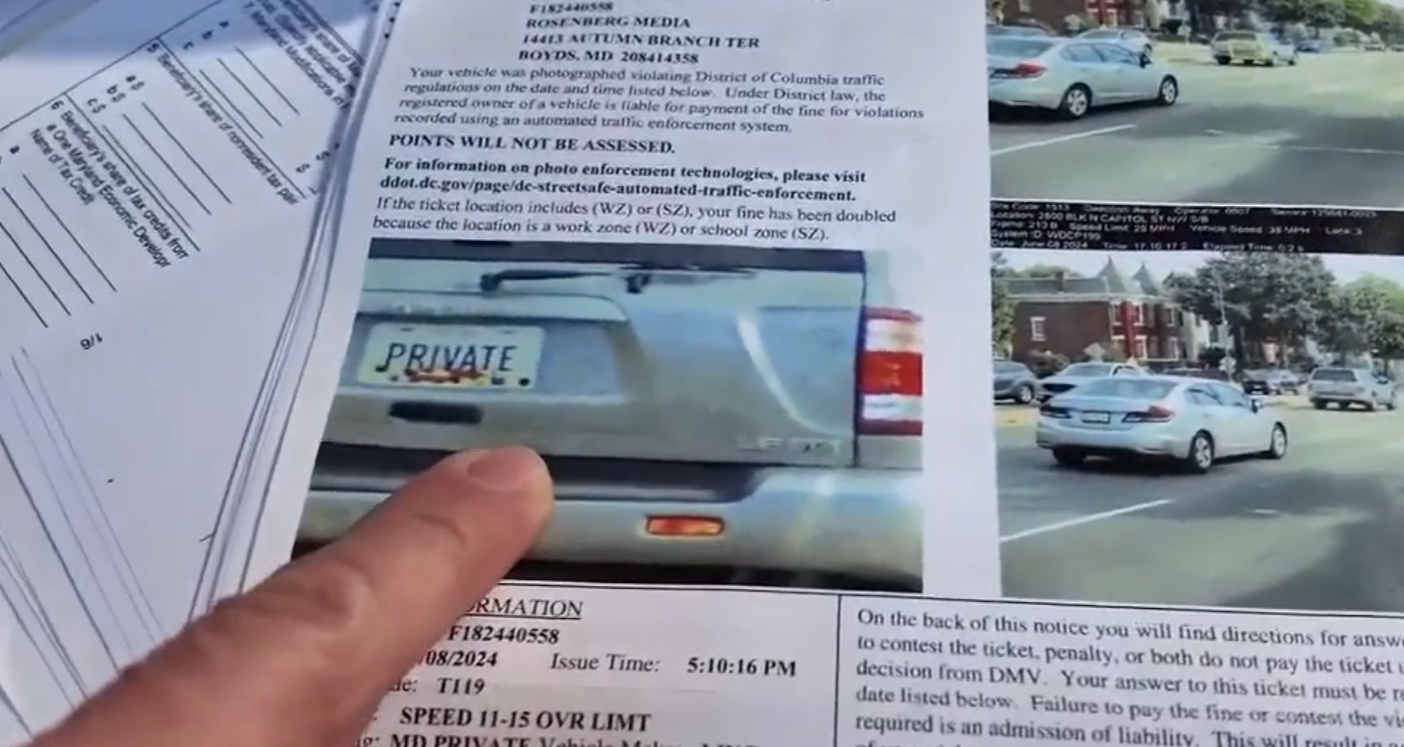
A Northern Virginia man spent years disputing traffic citations issued to vehicles he had never owned, driven, or even seen, all because someone apparently found it worthwhile to duplicate his personalized license plate and slap it on other cars. What sounds like a clerical oddity turned into a years-long paper war with two separate jurisdictions, and Jay Rosenberg of Vienna, Virginia, is now raising questions that go well beyond his own front porch.
Rosenberg, who recently relocated from Montgomery County, Maryland, held a Maryland vanity plate that read “PRIVATE.” Simple enough, distinguishable enough, and apparently attractive enough for someone to reproduce it.
According to Rosenberg, cloned versions of that plate were linked to at least 20 traffic violations, the bulk of them issued by camera systems in Washington, D.C., and Prince George’s County. He showed FOX 5 DC a stack of citations at his Vienna home, and in at least one case, the vehicle photographed receiving the violation did not even have registration stickers that matched his legitimate plate. The cameras recorded the letters; nobody apparently looked much further than that.
The situation only ended, Rosenberg says, once he sold the vehicle and changed his plate number entirely. That is a workaround that raises its own uncomfortable question: in a system increasingly reliant on automated enforcement, the only exit available to an innocent driver was to become a different driver on paper. He also noted that a friend in New York dealt with a nearly identical situation, suggesting this is not an isolated quirk of the D.C. suburbs.
FOX 5 reached out to both Washington, D.C., and Prince George’s County for comment. Prince George’s County had not responded as of publication. The DC Department of Transportation issued a statement noting that automated camera citations go through a review process before being issued, and that vehicle owners have the right to contest violations they believe were incorrectly attributed.
That is a fair enough policy on paper, but Rosenberg’s experience suggests the burden of that contest lands squarely on the person who did nothing wrong.
What License Plate Cloning Actually Is

License plate cloning, sometimes called car cloning, involves copying a legitimate plate number and reproducing it on another vehicle, often one of a similar make, model, or color to reduce the chance of a mismatch catching someone’s eye. The goal is straightforward: the cloned vehicle commits violations or evades tolls, and the citation follows the registered plate owner home.
What makes it easy is what makes it unsettling. Rosenberg pointed out directly that custom license plate blanks are available through online retailers. A buyer enters whatever alphanumeric combination they want, and the product arrives in a few days. There is no verification step, no cross-check against a DMV database, and no mechanism to flag that someone is ordering a plate that already exists on a registered vehicle. The barrier to cloning a plate is roughly equivalent to the barrier to ordering a phone case.
Victims typically discover the problem when unfamiliar tickets begin arriving, often for locations they have never visited or during times they were nowhere near the area. One San Antonio woman received multiple toll charges for roads she had never traveled, eventually tracing the source to a cloned version of her plate being used in another city.
In the United Kingdom, where the problem has been extensively documented, research found the number of cloning cases rose 64 percent over three years, climbing from roughly 22,450 incidents in 2021 to 36,794 in 2023. American data is harder to aggregate, but the legal complaints are piling up in a similar direction.
The Camera Enforcement Gap Nobody Is Talking About
Rosenberg put the core problem into plain language when he asked FOX 5: “Why is it not picking up through AI that this is not the right tag for this car?” It is a reasonable question. Automated license plate reader systems capture the plate characters.
Many do not cross-reference make, model, color, or registration stickers against what the camera actually photographed. A white sedan with a cloned plate belonging to a black pickup truck can sail through a speed camera with no flag raised, and the ticket goes to the pickup’s owner.
Automatic license plate readers have been installed at major intersections, bridges, and highway off-ramps in thousands of towns and cities across the U.S., capturing plate data along with vehicle images and timestamps. That coverage is expanding.
One leading vendor in the space claims more than 5,000 law enforcement agencies and over 6,000 communities across the country use their technology. The reach is impressive; the verification logic, in cloning cases, is clearly lagging behind.
The irony is not lost on observers who have followed the growth of this enforcement infrastructure. These systems are sold partly on the promise of removing human error from traffic enforcement. Yet when a cloned plate walks through the frame, the absence of human review is precisely what allows the error to compound, citation after citation, until the innocent registered owner fights their way out.
What Happens to Drivers Who Do Not Know to Fight Back
Rosenberg was persistent and knew how to navigate the dispute process. Not everyone does. He made that point himself, referencing the broader consequences for less-prepared victims: people who end up hiring attorneys, have their licenses suspended, or find themselves subject to proposed enforcement measures like speed-limiting devices on their vehicles simply because they accumulated violations they never earned.
License plate cloning is recognized as a form of identity theft because it involves using a vehicle’s registered identity to impersonate the owner. The consequences for victims can extend well beyond the fines themselves. Multiple fines and penalties tied to a cloned plate can affect an owner’s insurance record and potentially increase their premiums, even if every citation is eventually dismissed. The administrative trail lingers even when the legal outcome is favorable.
In New York, legislators and legal experts have taken note. Under New York law, a vehicle owner is not legally liable for tolls, speed camera violations, or school zone tickets tied to a cloned plate, once they have reported the fraud and can demonstrate their vehicle was not involved, but that protection requires knowing it exists, knowing how to invoke it, and having the time and documentation to do so. For many ordinary drivers, that is not a small ask.
A Vanity Plate Problem With a Very Common Application
There is a certain logic to why a vanity plate became the target here. A standard-issue state plate follows a format that, by design, is rarely duplicated. A vanity plate like “PRIVATE” is unique by definition on any given state’s registry, which means anyone who copies it has a ready-made, easy-to-remember string of characters to reproduce. It also means the legitimate owner is the only person in that state driving with those characters, making the citation trail easy to follow back to one address.
The solution, at least for now, remains largely on the victim to resolve. Contesting each citation individually, maintaining documentation, and ultimately changing the plate number are the tools available.
What Rosenberg’s case illustrates, as automated enforcement systems expand their footprint across American roads, is that the question of what happens when they get it wrong has not yet received the same attention as the question of how efficiently they can issue a ticket.