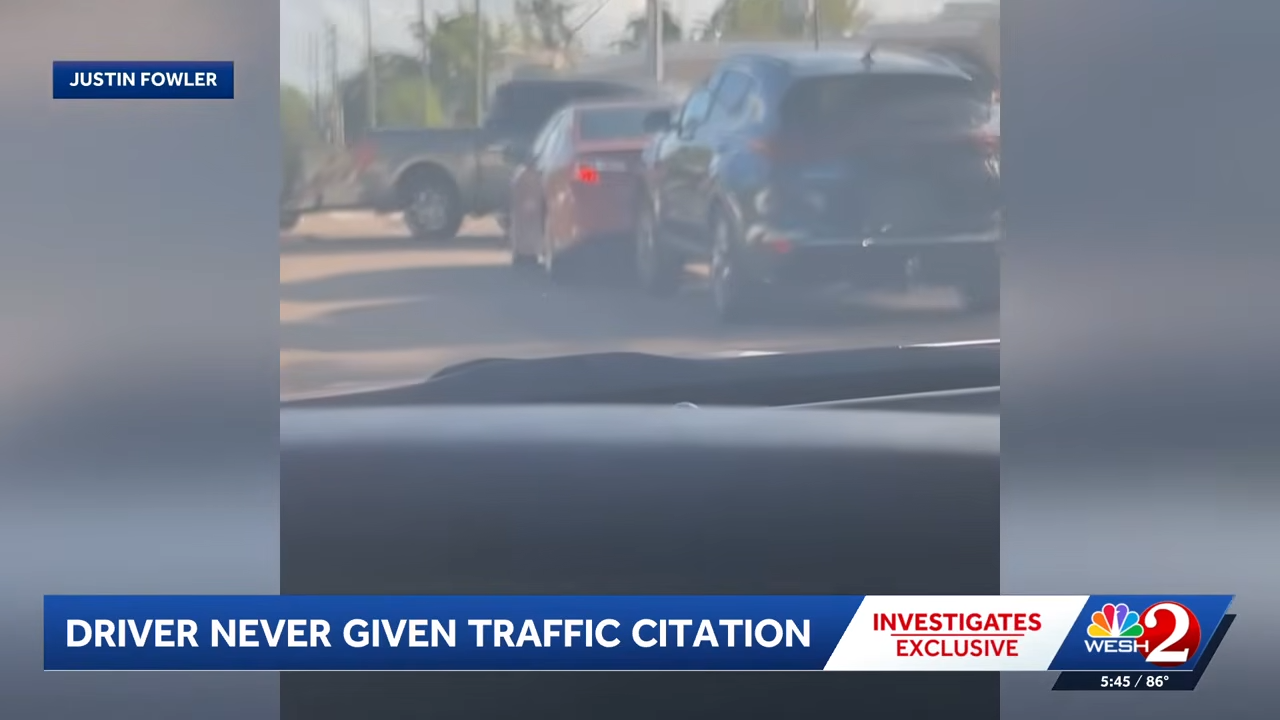
A girls’ night out to shop for a prom dress turned into a nightmare on April 3rd in Maitland, Florida, and the man behind the wheel of the offending vehicle walked away without so much as a ticket. The incident, captured on camera at the intersection of U.S. 1792 and Lake Avenue, shows a Kia Sportage repeatedly slamming into a red Toyota Camry carrying three women. Then the driver just kept going.
Sharon Hampton was in the backseat of that Camry. She described returning to that intersection as surreal, and honestly, it is hard to disagree. One moment her group was heading out to find a prom dress for her friend’s 18-year-old daughter. The next, they were being pushed through traffic by a driver who, according to police, claims he had no idea any of this was even happening.
The teenager behind the wheel of the Camry only had her learner’s permit. She has not driven since that day. Hampton, still recovering from a moderate concussion, says she was strapped into the back seat, helpless, watching the rear glass shatter as the Kia made contact again and again. The young driver reportedly had both feet locked on the brakes and was screaming. The Kia kept pushing.
Hampton reached out to WESH 2 Investigates after learning that the driver of the Kia was not cited at the scene and was not arrested for leaving after the crash. That combination of facts, given what the video clearly shows, is what sparked the investigation. And what reporters dug up next made the story a whole lot more complicated.
The Driver Said He Did Not Know He Was in an Accident
When a witness photographed the Kia’s license plate and police tracked down the registered owner, a 66-year-old man, the situation took an unusual turn. After being read his rights, the man asked for a lawyer and then told the officer he suffers from neurological issues. He even provided documentation from his neurological physician to support the claim.
The officer’s report noted fresh red paint transfer on the Kia’s bumper, physically confirming the collision. Yet the final line of the report reads that due to the driver’s medical issues, no citation was issued. The officer did, however, recommend that the man’s driver’s license be flagged for re-examination. That recommendation is not the same thing as taking his keys.
Hampton put it simply: if someone is that unwell behind the wheel, they should not be driving. She is right that the stakes here were enormous. The Camry was stopped at an intersection with no buffer on either side. A different outcome could have been catastrophic.
His Driving Record Tells a Different Story
Here is where things get harder to ignore. A review of Orange and Seminole County court records by WESH 2 Investigates found that this driver has accumulated 11 traffic citations going back to 2007. The violations include careless driving, failure to obey a traffic control device, and at one point driving through a dirt construction highway divider on I-4.
That is not the record of someone who occasionally has a bad day on the road. That is a pattern. And it raises legitimate questions about why someone with that kind of documented history was still behind the wheel without any additional scrutiny long before this crash occurred.
Florida, like most states, has a process for flagging drivers who may no longer be medically fit to operate a vehicle. The question of whether that process was ever triggered for this individual, and if not, why not, sits right at the center of this story.
Florida’s Driver Safety Review System Is Being Put Under the Microscope
WESH 2 Investigates contacted the Florida Department of Highway Safety and Motor Vehicles about this case. The agency’s deputy director of communications acknowledged the inquiry but had not provided a response by the time the story aired. That silence is doing a lot of heavy lifting.
Florida does have a Medical Advisory Board process that allows physicians, law enforcement, and even family members to flag a driver as potentially unsafe. The board can then recommend license suspension, re-examination, or other restrictions. But the system only works if someone actually uses it, and it requires follow-through at multiple levels. A police recommendation for re-examination is a starting point, not a finish line.
The fact that this driver’s record stretches back nearly two decades and still no formal action appears to have been taken is the kind of thing that deserves a genuine answer from state officials, not an email acknowledgment.
What This Incident Can Teach Us About Driver Safety and Accountability
There are a few threads worth pulling from this story beyond the immediate outrage. First, the tension between medical privacy and public safety is real and genuinely difficult. A driver with a neurological condition deserves compassion and appropriate support. But that compassion cannot come at the expense of everyone else sharing the road with them.
Second, traffic law enforcement discretion matters enormously. Officers have the authority not to issue citations in complex situations, and there are sometimes good reasons for that flexibility. But when that discretion is applied to someone with an extensive prior record who left the scene of an accident that injured someone, the public deserves a transparent explanation of how that call was made.
Third, bystanders who photograph license plates in moments like this are genuinely valuable. Without that witness, there may have been no paper trail at all. Dashcam footage and phone cameras increasingly serve as the documentation that official processes depend on.
And finally, learner’s permit drivers in stressful, sudden situations face pressures that experienced drivers do not. The young woman in that Camry handled an objectively terrifying scenario. The fact that she has not gotten back behind the wheel is understandable, and it is worth noting that she did not cause this. Someone else did, and that someone has still not faced any formal consequence.
Hampton said it best: you issue the citation, you get them into court, and you let a judge sort it out. That is not a complicated ask.