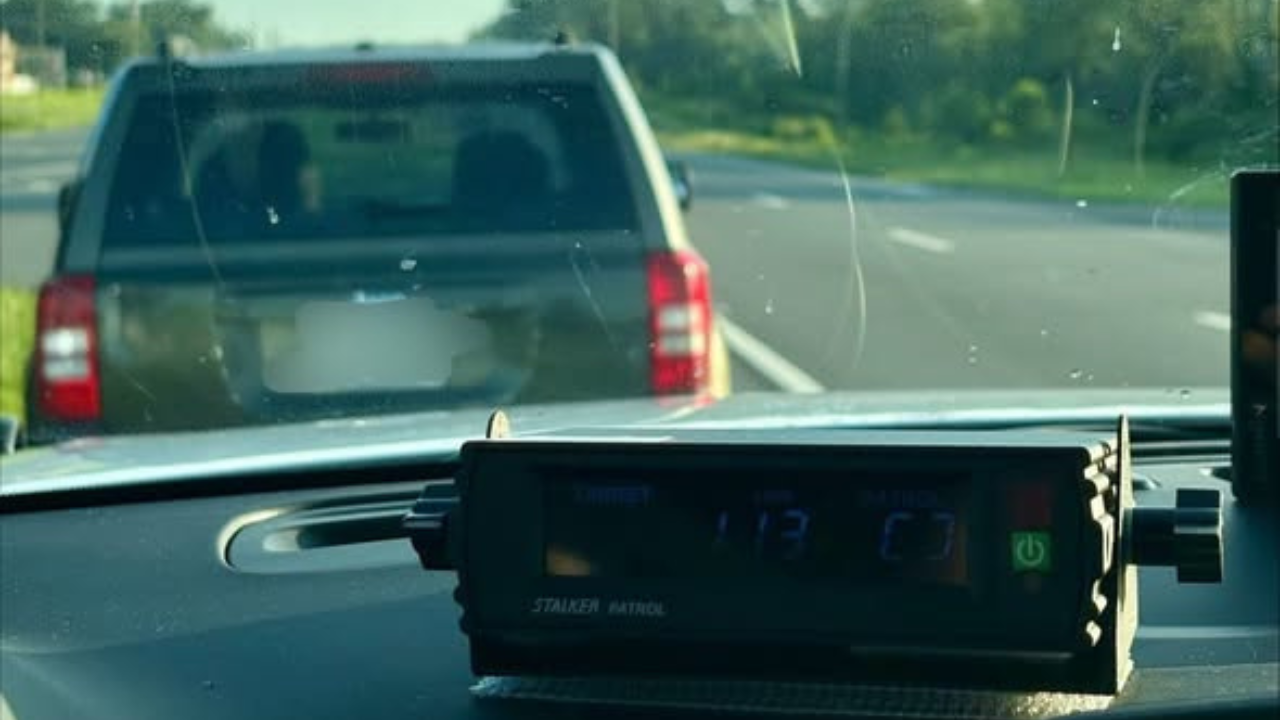
Some people are perpetually running late. Others just really enjoy the feeling of acceleration. Then there are those who treat a posted 65 MPH speed limit like a loose suggestion on their way to somewhere they apparently needed to be very urgently. Okaloosa County deputies recently encountered one of the latter.
A driver was stopped after being clocked at 113 MPH in a 65 MPH zone, which works out to 48 miles per hour over the limit. That’s the kind of gap that doesn’t just raise eyebrows — it triggers Florida’s relatively new Super Speeder law, which took effect on July 1, 2025. Whatever appointment this driver was keeping, it now comes with a court date attached.
The stop was announced by the Okaloosa County Sheriff’s Office, which noted the driver would be “spending some of it in court” — a fairly polite way of putting it. At nearly twice the posted speed limit, this wasn’t a case of a distracted glance at the speedometer. It was a sustained commitment to going very fast on a public road.
What makes this more than just a dramatic traffic stop is the legal framework now surrounding it. Florida’s Super Speeder law changed the game for drivers who cross certain thresholds — and 113 MPH in a 65 zone puts you squarely in that territory.
What Florida’s Super Speeder Law Actually Does
Florida’s Super Speeder law, passed through House Bill 351 and added as Florida Statute §316.1922, took effect July 1, 2025. It classifies “dangerous excessive speeding” as a criminal offense rather than a civil traffic infraction. Previously, a driver caught going 100-plus MPH could often walk away with a heavy fine. That’s no longer the case.
The law establishes two thresholds: driving 50 or more miles per hour over the posted speed limit on any road, or driving 100 MPH or faster regardless of the posted limit. Meeting either one is enough to face criminal misdemeanor charges. At 113 in a 65, this driver cleared both.
What the Penalties Look Like
This is where things get considerably less fun for the driver in question. A first offense is classified as a second-degree misdemeanor, which can include up to 30 days in jail and fines of up to $500. A court appearance is required — offenders cannot simply pay the ticket and move on.
For repeat offenders, penalties increase significantly. A second violation within five years can bring up to 90 days in jail and a $1,000 fine, and Florida courts are required to suspend the driver’s license for at least six months. Six points on the driving record and higher insurance rates round out the package. It’s a comprehensive consequence for what some might have previously considered a minor lapse in judgment.
Why Florida Changed the Law
The push for tougher penalties came from data compiled by the Florida Highway Patrol and safety groups. The Florida Highway Patrol reported that speeding was a factor in 369 traffic fatalities in 2023 alone, with a significant number involving speeds well beyond normal limits.
Lawmakers introduced this bill in response to increasing concerns about high-speed driving, particularly on highways like I-95, I-75, and the Florida Turnpike. Under the old system, unless reckless driving could be proven, officers had limited options beyond civil fines. The new statute fills that gap by establishing speed thresholds that trigger criminal charges even in the absence of a collision.
The Okaloosa stop is a fairly clean illustration of exactly what the law was designed to address: someone traveling at genuinely dangerous speeds on a public road, with no crash required to make it a serious legal matter. The speed alone is enough. Florida made sure of that.