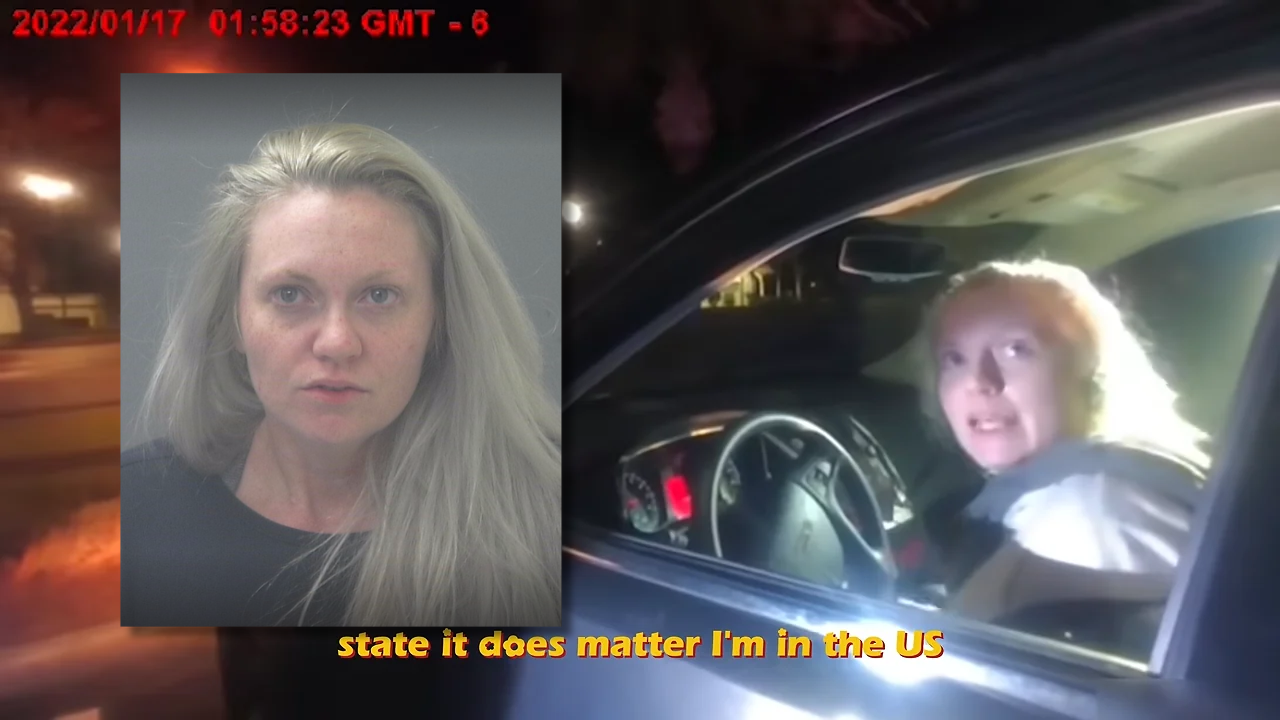
A Florida woman pulled over for speeding had some unfortunate news for the police officer who stopped her. He didn’t understand the law.
A driver’s license was only necessary for commercial driving, she explained, and since she was merely traveling in her personal GMC, the officer had no business demanding one. She even carried legal materials in her vehicle, ready to educate anyone who questioned her.
Gulf Breeze Police Officer Sean Banks wasn’t persuaded. According to the citation he issued, the woman had been traveling 54 mph in a 35 mph zone. When she refused to produce a license or leave the vehicle, she demanded a supervisor who could explain the law to him. Sergeant Turner arrived, heard her arguments about common law, natural law, and constitutional protections, and agreed with Banks. She was no more impressed with his understanding of the law.
The disagreement continued after officers removed the woman from her GMC and arrested her. She eventually offered to get a driver’s license the following day, a remarkable concession after spending several minutes explaining why she didn’t need one. Officers also discovered an outstanding warrant involving a missed court appearance. An inventory of her vehicle subsequently turned up ammunition and suspected narcotics, bringing additional criminal allegations into an encounter that began with a speeding ticket.
The stop happened on January 17, 2022, but a video published by the YouTube channel Bodycam Horizon in September 2026 has attracted more than 790,000 views. The footage is entertaining, although the channel’s legal analysis ends with a set of letter grades that feel plucked out of thin air, and its description acknowledges that the eventual court outcome was unknown.
Revisiting older bodycam footage gives us something a newly released arrest video cannot: an opportunity to examine how prosecutors and courts handled the allegations, whether probation and other penalties changed anything, and what subsequent encounters reveal about the effectiveness of the legal process. Guessing Headlights reviewed the court records to fill in those gaps.
A Traveling Constitutional Expert
The encounter began shortly after 2 a.m. near the Pensacola Bay Bridge in Santa Rosa County. The woman disputed Banks’ account of her speed, saying she believed she was traveling around 40 mph. The conversation soon turned to whether she needed a driver’s license at all.
“You don’t have to have a license to drive a car,” she told him.
“Yes, yes you do,” Banks replied.
The woman argued that licenses were required only for commercial vehicles and repeatedly demanded a supervisor. When Turner arrived, she continued presenting her interpretation of the Constitution, seemingly confident that someone with a higher rank would recognize what Banks had failed to understand.
Turner explained that Florida required a valid license to operate a vehicle on public roads, regardless of whether the driver was conducting business. He also asked why she had previously obtained a Mississippi license if she believed licenses were unnecessary. She acknowledged having one years earlier but remained convinced that the law was on her side.
This is the familiar sovereign-citizen argument that operating a private automobile constitutes traveling rather than driving. Florida law does not recognize that exemption, but the woman continued disputing the officers’ authority even after they removed her from the GMC and placed her under arrest.
Tomorrow’s License Will Have to Wait
Her position became more flexible when Turner explained that she was going to jail.
“I’ll go get a driver’s license tomorrow,” she offered.
Turner pointed out that she had spent the encounter arguing she didn’t need one. He also informed her of an outstanding Santa Rosa County warrant involving a missed court appearance for earlier licensing and registration matters. She asked whether she could address the warrant the next day, but Turner refused.
Court records identify a previous prosecution for driving with a license expired more than six months. That case was resolved on January 18, 2022, the day after the bodycam arrest, when the driver pleaded no contest and received a withheld adjudication. The docket also references a failure-to-appear matter, although the records reviewed do not conclusively establish that this was the warrant discussed in the video.
Meanwhile, officers preparing to tow the GMC discovered ammunition during a vehicle inventory. The woman said the corresponding gun was at a pawnshop. When officers subsequently reported finding suspected narcotics, she challenged their authority to search without her permission. An officer explained that police were conducting an inventory because the vehicle was being towed.
The Felony That Didn’t Stick
The Santa Rosa County Sheriff’s Office booking records show that the woman was taken into custody at 5:58 a.m. on January 17, 2022, on allegations involving cocaine possession, drug paraphernalia, DUI, and operating a motor vehicle without a valid license.
The final court outcome differed from those initial allegations. Prosecutors took no action on the unlicensed-driving charge in February 2022 and dropped the felony cocaine possession charge that November. The woman was adjudicated guilty of DUI and possessing drug paraphernalia.
The video’s narrator concludes that the narcotics discovered during the inventory were fully admissible. However, the available court records do not establish why the cocaine charge was dropped or whether the legality of the search was challenged. The dismissal does not prove the search was improper, just as the footage alone cannot establish that the evidence was necessarily admissible.
The speeding and expired-registration citations issued during the same stop remain listed as open in the clerk’s online records, with $429 in combined unpaid assessments. Suspension and collection notices also appear in the dockets, although they do not establish the driver’s current licensing status.
Her Next Lesson Came With Jail Time
Her involvement with the courts continued. In September 2023, she was arrested after another Gulf Breeze police encounter, and sheriff’s records also list a probation violation tied to her earlier criminal case.
The following month, she pleaded no contest to resisting an officer without violence and driving with a license expired more than six months. Judge Clifton Drake adjudicated her guilty on both counts and imposed reporting probation, including requirements to undergo drug and alcohol testing and demonstrate efforts to obtain a valid license.
Another probation-related arrest followed in October 2024. She remained in custody until December 3, when the court imposed 90 days in jail for the resisting conviction and 60 days for the licensing offense. She received credit for three months and nine days already served, satisfying both jail terms. The court restored probation on the resisting count and revoked it on the licensing count.
The docket includes further probation-related proceedings in 2025, including another affidavit and warrant filed in May. The available records do not establish whether that warrant remains active.
All parties are presumed innocent unless and until proven guilty in a court of law.