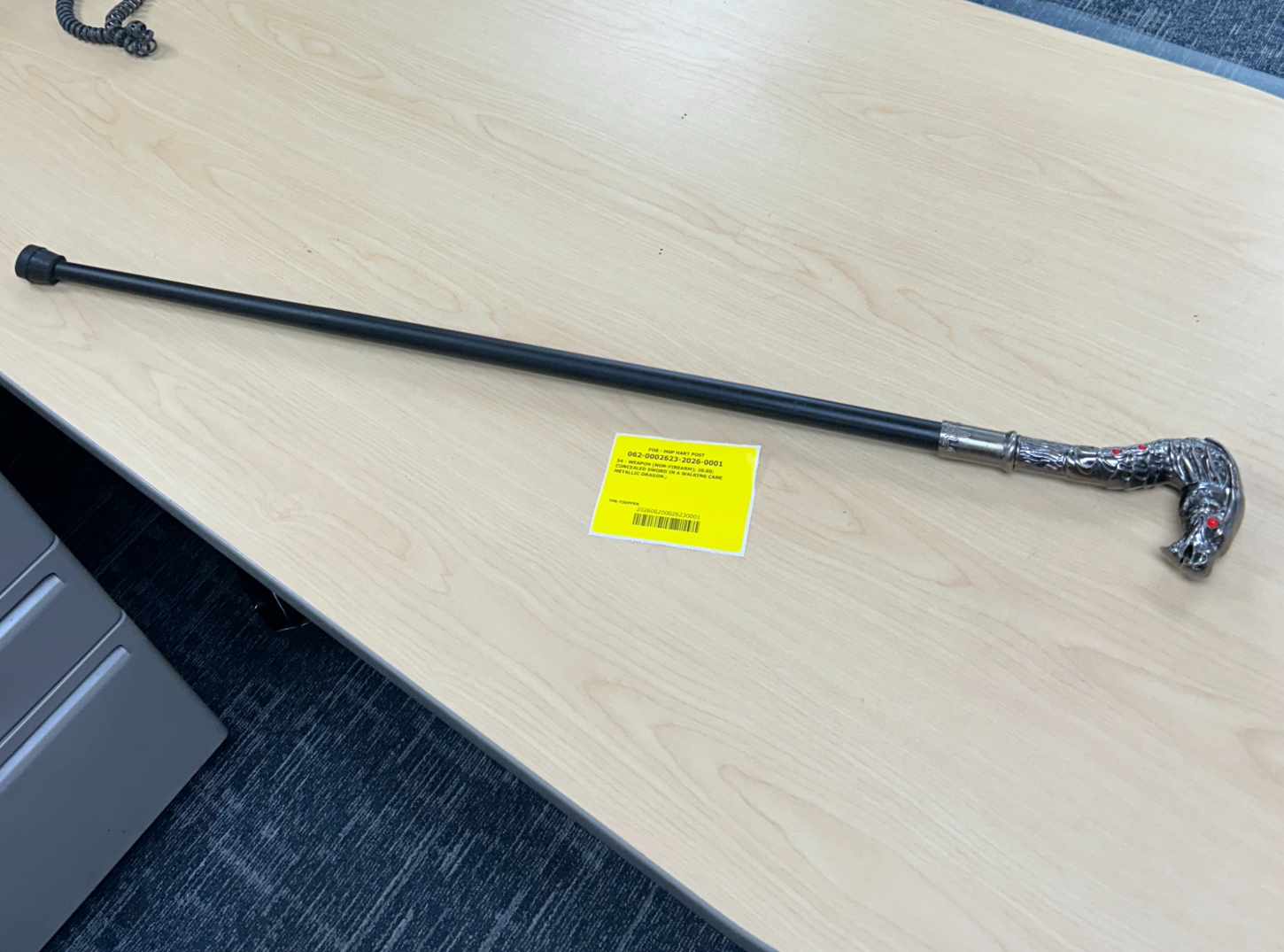
When Michigan State Police troopers stopped a 61-year-old man on US-31 near Winston Road in Grant Township, they were looking at what appeared to be a routine traffic violation. What they got instead was a reminder that roadside stops have a way of becoming considerably more interesting the longer they last.
The driver was found to be operating under the influence of drugs, which alone would have made for a full day’s work. But during the investigation, troopers discovered something a little harder to explain than a failed field sobriety test: a sword concealed inside his cane. The arrest was announced by Michigan State Police Sixth District via their official social media account, and it’s the kind of post that has a way of doing numbers for good reason.
The Hart Post troopers handled it professionally, of course. But there’s an unavoidable quality to a traffic stop that begins with impaired driving and ends with the discovery of a concealed medieval weapon. Whatever the driver had planned for his afternoon, it clearly hadn’t included this particular outcome.
Beyond the novelty factor, this stop raises some genuinely useful questions about Michigan’s weapons laws and what exactly the rules are when your walking stick doubles as an armory.
What Is OUID and Why Does It Matter
OUID stands for Operating Under the Influence of Drugs, and unlike alcohol impairment, there is no legal limit for the amount of drugs one can have in their system in Michigan. If any active drugs are present and impairment can be demonstrated, a charge of OUID applies. That’s a meaningful distinction from the familiar 0.08% BAC threshold most drivers are aware of.
Penalties for a first-time OUID conviction include up to 93 days in jail, fines ranging from $100 to $500, up to 360 hours of community service, and vehicle immobilization. A mandatory 30-day license suspension follows, with 150 days of restricted driving privileges after that. It is, in short, not a minor inconvenience. A third offense escalates to a felony, carrying a potential five-year prison term.
Prescription drugs fall under the same rules. Even lawfully prescribed medications can result in an OUID charge if they impair a driver’s ability to operate a vehicle safely. That’s worth noting for anyone who assumes a valid prescription is a legal shield behind the wheel.
The Sword Cane: Novelty Item or Actual Legal Problem
A Michigan State Police Trooper from the Hart Post initiated a traffic stop on US-31 near Winston Road in Grant Township for a vehicle violation.
The sole occupant and driver, a 61-year-old male, was determined to be operating under the influence of drugs (OUID). During the… pic.twitter.com/QHBwKbqGwy
— MSP Sixth District (@mspwestmi) June 12, 2026
Here’s where Michigan law gets genuinely layered. Cane swords are actually legal to own or possess in Michigan under state law. The state maintains a fairly broad list of permitted blade types for ownership on private property. The trouble, as it almost always is, comes down to context and concealment.
Michigan law pays particular attention to swords designed for concealment, and items like cane swords, which consist of a blade hidden inside a walking stick, are often explicitly illegal in certain circumstances. Under Michigan Penal Code 750.227, carrying a dagger, dirk, stiletto, double-edged non-folding stabbing instrument, or any other dangerous weapon concealed on one’s person or in any vehicle operated or occupied by the person is a felony punishable by up to five years in prison and a fine not to exceed $2,500.
In other words: the sword cane sitting at home in your den is a different matter from the one riding shotgun during a drug-impaired drive on US-31. The vehicle adds its own layer of exposure under Michigan statute, regardless of whether the blade is considered “accessible.”
Grant Township and the US-31 Corridor
US-31 runs through the western side of Michigan’s Lower Peninsula, cutting through Oceana County and the broader lakeshore region. It’s a major artery in that part of the state, handling a mix of local traffic, summer tourism, and commercial transit. Grant Township sits in Oceana County, an area where Michigan State Police Sixth District and the Hart Post hold primary jurisdiction over state highway patrol.
Traffic enforcement along that corridor is routine, and MSP Sixth District maintains an active social media presence logging stops, arrests, and impaired driving cases. The Hart Post covers a significant stretch of US-31 and the surrounding rural network, and drug-impaired driving cases have been a consistent focus of their enforcement activity.
What This Stop Actually Illustrates
The MSP reminded the public in their post that impaired driving of any kind puts everyone on the road at risk, and that’s the point worth taking seriously beyond the cane-sword headline. Drug-impaired driving is statistically harder to identify than alcohol impairment, which makes enforcement more dependent on officer training and roadside observation. Standard field sobriety tests have no proven correlation to drug impairment specifically, meaning the detection process is more complex than the alcohol equivalent.
As for the sword: it may or may not result in additional charges depending on how prosecutors evaluate the concealed weapon statute in this specific context. What it does do is turn what would have been a moderately notable impaired driving arrest into something rather more memorable. The driver is currently lodged pending charges. The cane, presumably, is in evidence.