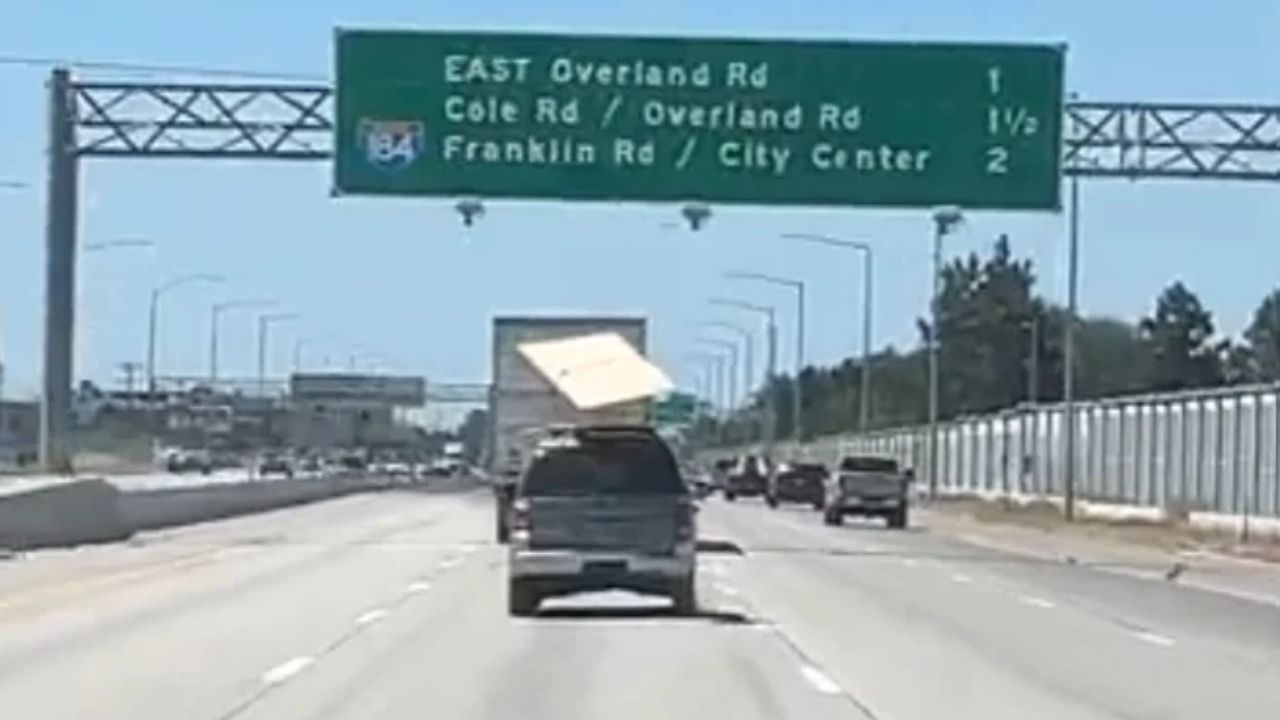
A sheet of plywood strapped to the roof of an SUV turned into an airborne spectacle on Interstate 84 near Boise, Idaho, after the driver hit highway speeds and the lumber caught enough wind to start flying like a full-sized kite. The whole thing was captured on video by Oscar “Moosie” Williamson, who happened to be driving alongside the oblivious motorist and couldn’t resist rolling the camera.
What makes the footage worth watching isn’t just the visual absurdity of plywood going airborne in traffic. It’s the slow-motion comedy of it all. Williamson and his son, Parker, spend several minutes debating whether to approach the driver, marveling at the bungee cords somehow holding everything together, watching other motorists give the SUV a wide berth, and at one point deciding to just follow along and see what happens.
According to Williamson, one piece of lumber had already fallen from the vehicle before filming began. By the time the camera was rolling, the remaining sheet of plywood had essentially become a sail, flexing and lifting dramatically each time the SUV picked up speed.
The driver, apparently locked into whatever was on his radio or GPS, showed no indication he had any idea what was happening on his roof. His blinker was on. He changed lanes without looking over. The load just kept flying.
No crashes were reported, and the plywood ultimately stayed attached. The driver eventually pulled over and, as Williamson approached to let him know, reportedly said he had just realized something was wrong. It’s a lucky outcome for a situation that, under different conditions, could have gone very differently for the drivers sharing the lane with him.
Bungee Cords and a Sheet of Plywood: A Recipe for Chaos
Please allow a moment for the video to load.
The strangest part of the video might be that the load held at all. Parker can be heard giving reluctant credit to the bungee cords keeping the plywood tethered to the roof, joking that at least the straps work.
Adding to the visual confusion was what appeared to be an actual bra hanging from the SUV’s side mirror. Whether it was decorative, accidental, or somehow involved in the cargo securement strategy was impossible to tell from the video. The plywood itself appeared to be held down primarily by a collection of bungee cords, an improvised setup that would make most experienced haulers wince. As questionable as the arrangement looked, it somehow managed to keep the plywood attached despite the sheet repeatedly lifting and flexing in the wind.
The problem with bungee cords as a primary load-securement method is that they’re designed for light bundling, not for aerodynamic loads at speed. A flat sheet of plywood oriented horizontally on a roof becomes a lifting surface the moment you exceed about 40 miles per hour. The faster you go, the more upward force is generated.
At freeway speeds, you’re not fighting gravity anymore. You’re fighting lift, and bungee cords weren’t built for that.
This isn’t the first time we’ve seen a load secured with pure optimism, but it is the first time we’ve seen a piece of plywood flying down the interstate like a giant kite.
We’ll also take a moment to thank Williamson for allowing us to share the footage. He recorded the clip while returning from work on his cabin with his son, Parker, and heading back toward Nampa. Beyond providing a few laughs, the video serves as a surprisingly effective reminder that cargo securement matters. If you’re planning a trip to the Boise area and looking for a quiet place to unplug, his cabin is worth checking out.
What the Law Actually Says About Securing Cargo
Cargo securement isn’t just a matter of common sense. It’s regulated. Under federal regulations, each commercial motor vehicle must be loaded and equipped to prevent cargo from leaking, spilling, blowing, or falling from the vehicle while traveling on public roads.
While that specific standard applies to commercial vehicles, most states mirror those requirements for private passenger vehicles as well. If something falls from your vehicle and causes an accident or injury, the driver of that vehicle can face civil liability and criminal charges, depending on the state.
Federal guidelines specify that cargo shorter than five feet and weighing under 1,100 pounds requires at least one tie-down, while cargo exceeding ten feet in length requires at least two, with additional tie-downs required for longer or heavier loads. A standard sheet of plywood measures four by eight feet and, while not particularly heavy, becomes a serious projectile at highway speed if it separates from a vehicle.
The consequences of a sheet of plywood departing a rooftop at 70 mph and landing on a windshield are not difficult to imagine.
Idaho, like most states, carries statutes that hold drivers responsible for unsecured loads. Fines vary, but more importantly, a load that separates and causes injury can result in charges well beyond a traffic citation.
Why Other Drivers Gave Him So Much Space
One detail the video captures that’s easy to miss is how other motorists responded. Nobody wanted to be anywhere near this SUV. Drivers backed off, changed lanes, and kept their distance in a way that tells you experienced highway drivers recognized the situation immediately, even if the person causing it didn’t.
That collective behavior, giving a wide berth to a vehicle with an unstable load, is actually the correct response and probably kept the incident from becoming something much worse.
The challenge with situations like this on a busy interstate is that there’s no clean way to alert a driver who isn’t looking. Honking often accomplishes little. Trying to pull alongside and wave is risky for everyone involved. Williamson ultimately pulled over and walked up to the driver on foot after the SUV exited the highway, which is about as reasonable a resolution as you could hope for in a scenario like this.
As for the plywood driver, he got lucky, and he probably knows it. The load stayed attached, nobody was hurt, and he now has a story he can tell at the lumber yard. Next time, though, maybe invest in actual ratchet straps.