Chinese automakers are no longer content with proving themselves through spec sheets and glossy showroom launches. Increasingly, brands are turning to dramatic viral stunts designed to demonstrate just how durable, over-engineered, and technologically advanced their latest luxury vehicles have become.
Over the last few years, social media has been flooded with videos of Chinese SUVs floating through deep water, crab-walking sideways, climbing impossible inclines, and spinning in place like tanks. Now the latest demonstrations are becoming even more extreme. One luxury SUV recently survived a giant palm tree crashing onto its roof multiple times, while another launched off a massive ramp and landed hard enough to shake apart its interior.
The spectacle may look outrageous at first glance, but the strategy behind it is due to the fact that Chinese brands are fighting for global recognition in an industry long dominated by European, Japanese, and American manufacturers. Wild engineering demonstrations create viral attention while also giving automakers a chance to showcase structural strength, battery protection, and chassis durability in ways traditional crash tests never could.
Whether these stunts genuinely prove long-term reliability is open to debate. Still, they undeniably highlight the growing confidence of Chinese automakers as they push deeper into international markets with increasingly ambitious luxury vehicles.
BYD’s YangWang U8 Survived A Falling Palm Tree
One of the most talked-about recent demonstrations came from BYD’s high-end YangWang division. The company released footage showing a massive royal palm tree repeatedly dropped onto the roof of the YangWang U8L luxury SUV.
This was not a lightweight prop or a carefully staged tap for the camera. Engineers raised the tree vertically and allowed it to slam onto the vehicle multiple times with increasing force. According to the company, the maximum impact generated more than 50 kilojoules of energy.
The results were dramatic. The SUV’s cant rails showed visible deformation after repeated impacts, but the cabin remained intact. The glass did not shatter, the suspension stayed functional, and the doors continued opening normally after the test.
Perhaps the most striking part of the demonstration came afterward. The U8L simply started up and drove away as if little had happened. The stunt was designed to reinforce YangWang’s growing reputation for building vehicles engineered far beyond standard safety requirements.
The U8 itself has already become famous online for its unusual capabilities. The luxury hybrid SUV features a quad-motor setup producing nearly 1,200 horsepower and can perform tank turns, water-floating demonstrations, and crab-walking maneuvers that few production vehicles can replicate.
Voyah Sends A Massive SUV Flying Through The Air
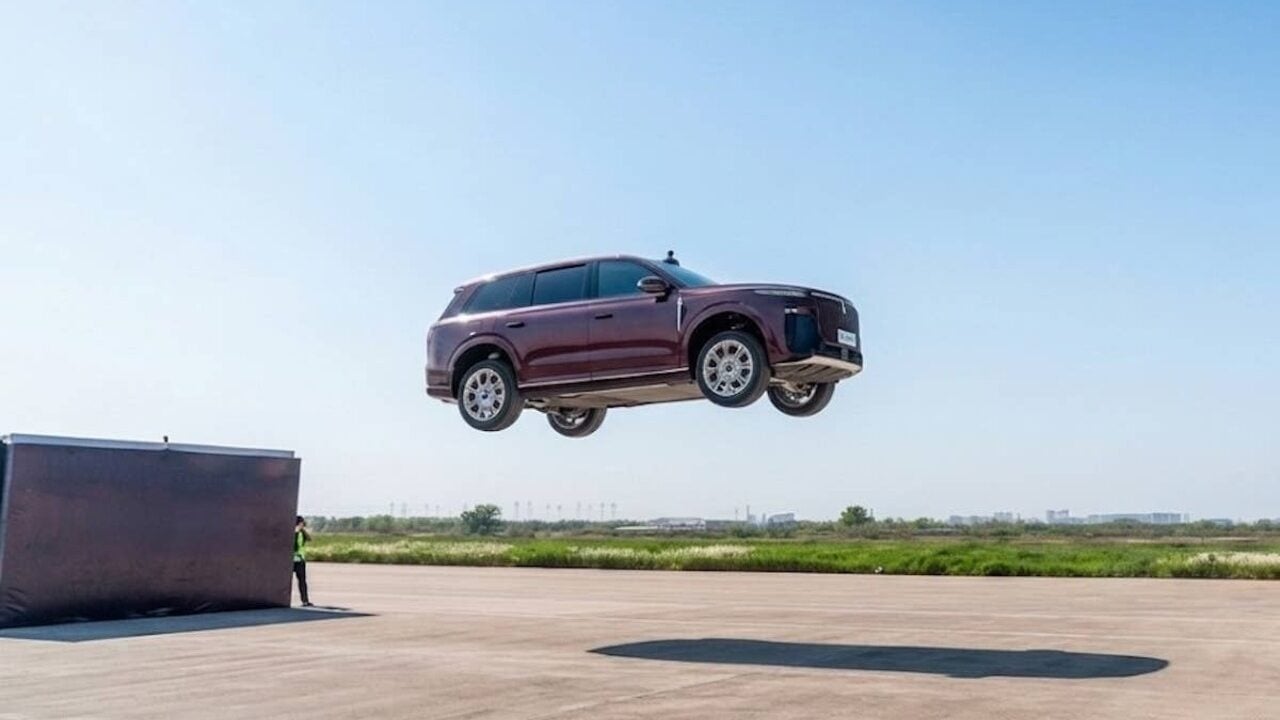
Another Chinese automaker recently took a very different approach to proving durability. Voyah, a premium brand backed by Dongfeng Motor, launched its upcoming Taishan X8 SUV off a giant ramp in what looked more like a Hollywood stunt sequence than a factory engineering test.
The heavyweight plug-in hybrid SUV reportedly weighed more than 6,100 pounds during the test. Engineers accelerated it to roughly 62 mph before sending it airborne off a ramp over eight feet tall.
The SUV traveled more than 66 feet through the air before slamming back onto the ground with enormous impact force. The landing violently compressed the suspension and sent interior trim pieces flying inside the cabin.
Despite the punishment, the vehicle’s core structure reportedly remained intact. Voyah claimed the battery pack survived without damage, the pillars maintained structural rigidity, and the doors still functioned properly after impact.
The company described the test as an evaluation of suspension behavior, battery safety, chassis geometry, and overall body strength under extreme stress. While no owner will realistically launch a luxury SUV off a giant ramp during daily driving, the stunt generated exactly the kind of viral attention Chinese brands are increasingly chasing.
Viral Engineering Has Become A Marketing Weapon
These dramatic tests reflect a major shift in how Chinese automakers market themselves to the world. Traditional advertising alone is no longer enough to break through in an industry crowded with established luxury brands.
Instead, companies are leaning heavily into social media spectacle. Extreme demonstrations create shareable content while reinforcing the idea that Chinese vehicles are technologically advanced and engineered with massive safety margins.
This approach also targets lingering skepticism surrounding Chinese-built vehicles in some international markets. By publicly subjecting their products to outrageous punishment, automakers hope to reshape perceptions about quality, durability, and engineering standards.
The strategy appears to be working. Chinese automakers continue expanding rapidly in Europe, Southeast Asia, South America, and parts of the Middle East. Brands like BYD are already outselling several established global manufacturers in key regions.
Chinese Luxury Vehicles Are Evolving Quickly
A few years ago, many Chinese cars were viewed primarily as low-cost alternatives to mainstream competitors. That perception is changing fast.
Modern Chinese luxury SUVs now combine enormous power figures, advanced battery systems, sophisticated driver-assistance technology, and bold engineering experimentation. Vehicles like the YangWang U8 and Voyah Taishan X8 are designed not only to compete with premium global brands but also to attract attention in ways traditional automakers rarely attempt.
Not every viral stunt will translate directly into real-world dependability. Some demonstrations are clearly engineered for maximum online impact rather than scientific rigor. Even so, the message from Chinese automakers is becoming impossible to ignore: They want the entire automotive world watching.