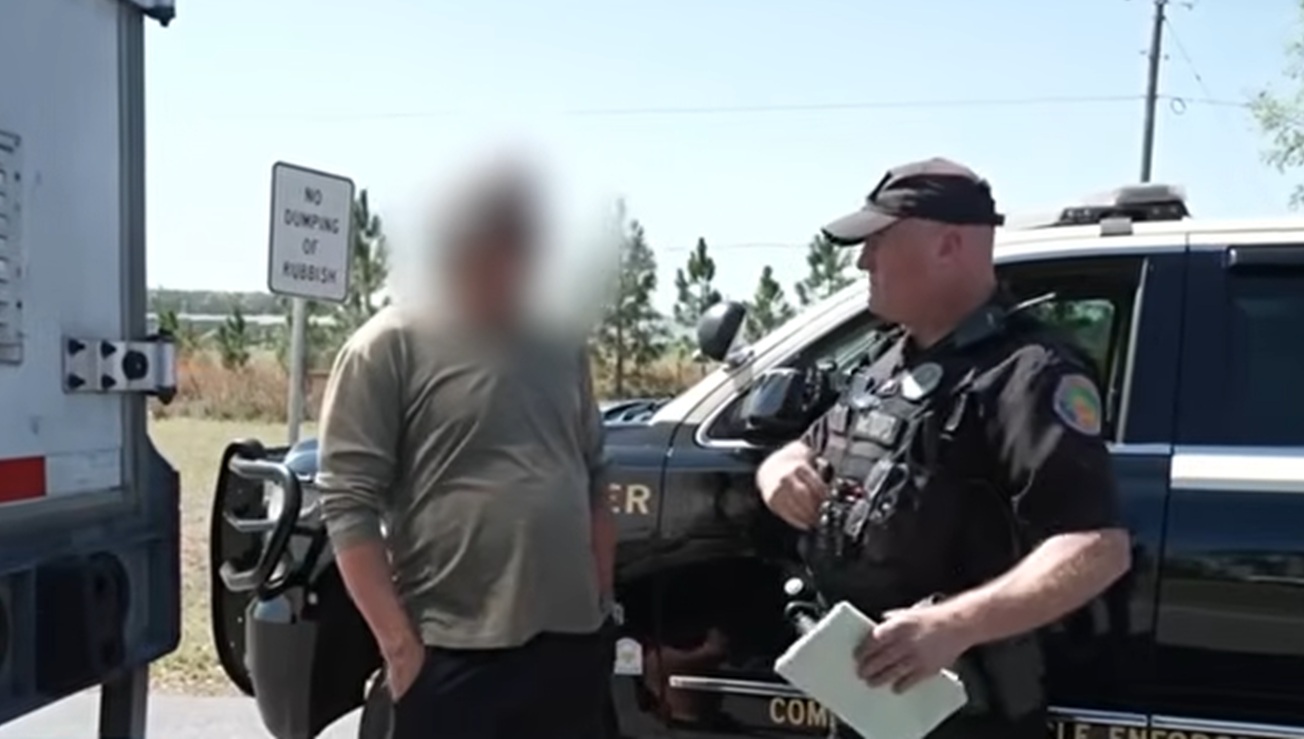
A recent roadside enforcement operation in Florida has drawn national attention after footage captured commercial truck drivers who could not speak English or correctly identify standard road signs during inspections conducted alongside federal safety officials.
Florida Highway Patrol troopers, joined by Federal Motor Carrier Safety Administration (FMCSA) Administrator Derek Barrs, were filmed by Fox News during a series of roadside stops. The video showed at least one driver responding to troopers almost entirely in Spanish and repeatedly answering “no” when asked basic questions about the meaning of common road signs.
The footage quickly circulated and reignited a long-standing debate about language requirements for commercial drivers operating on American highways.
What the Cameras Captured on Florida Roads
FHP Master Trooper Craig Lents, who took part in the inspections, broke down exactly why English literacy behind the wheel is not just a formality. “I try to concentrate on the signs they have to read,” he said. “If you are going down the road at 70 miles per hour, and you see that sign, you only see it for a split second.”
That observation carries real weight. At highway speeds, a driver has almost no time to process a warning, and if they cannot understand what a sign is telling them, the consequences can be severe for everyone on that road, not just the driver themselves.
FMCSA Administrator Barrs was equally direct, making clear that this is not a newly invented standard being selectively applied. “It’s been the law for a long period of time,” he said. “It’s a safety issue. If there was a crash or something like that, I would want to make sure that the driver would know how to respond, slow down for upcoming traffic, or a crash that has happened up ahead.”
Federal regulations under the FMCSA already require commercial vehicle operators to be able to read and speak English well enough to understand highway traffic signs, respond to official inquiries, and communicate during emergencies. The Florida operation was built around verifying whether drivers currently on state roads are actually living up to that standard, and the results raised serious questions.
A Broader Issue Facing the Trucking Industry
The enforcement action did not take place in a vacuum. The trucking industry has undergone significant demographic shifts in recent years, with a growing number of drivers coming from non-English-speaking backgrounds. That diversity is widely seen as a strength of the workforce, but it also creates compliance challenges that regulators are now taking more seriously.
Some trucking associations have responded to operations like this one by calling for more accessible language training programs, arguing that drivers should be given clearer pathways to meet federal requirements rather than simply being penalized for falling short. The Florida Trucking Association has previously noted that many drivers from diverse backgrounds contribute enormously to the supply chain and deserve support in meeting safety standards.
Safety advocates, on the other hand, have backed the crackdown firmly, pointing out that language barriers during an emergency situation can have life-or-death consequences. Miscommunication with law enforcement, an inability to follow verbal directions at an accident scene, or failure to understand a detour sign could all escalate an already dangerous situation.
Florida officials have indicated that operations like this one could pave the way for broader policy discussions, including whether language education should be woven more directly into the commercial driver licensing process. For now, the footage from this crackdown serves as a stark reminder that road safety depends on more than just technical driving ability. Clear communication is part of the job, and federal law has required it for decades.