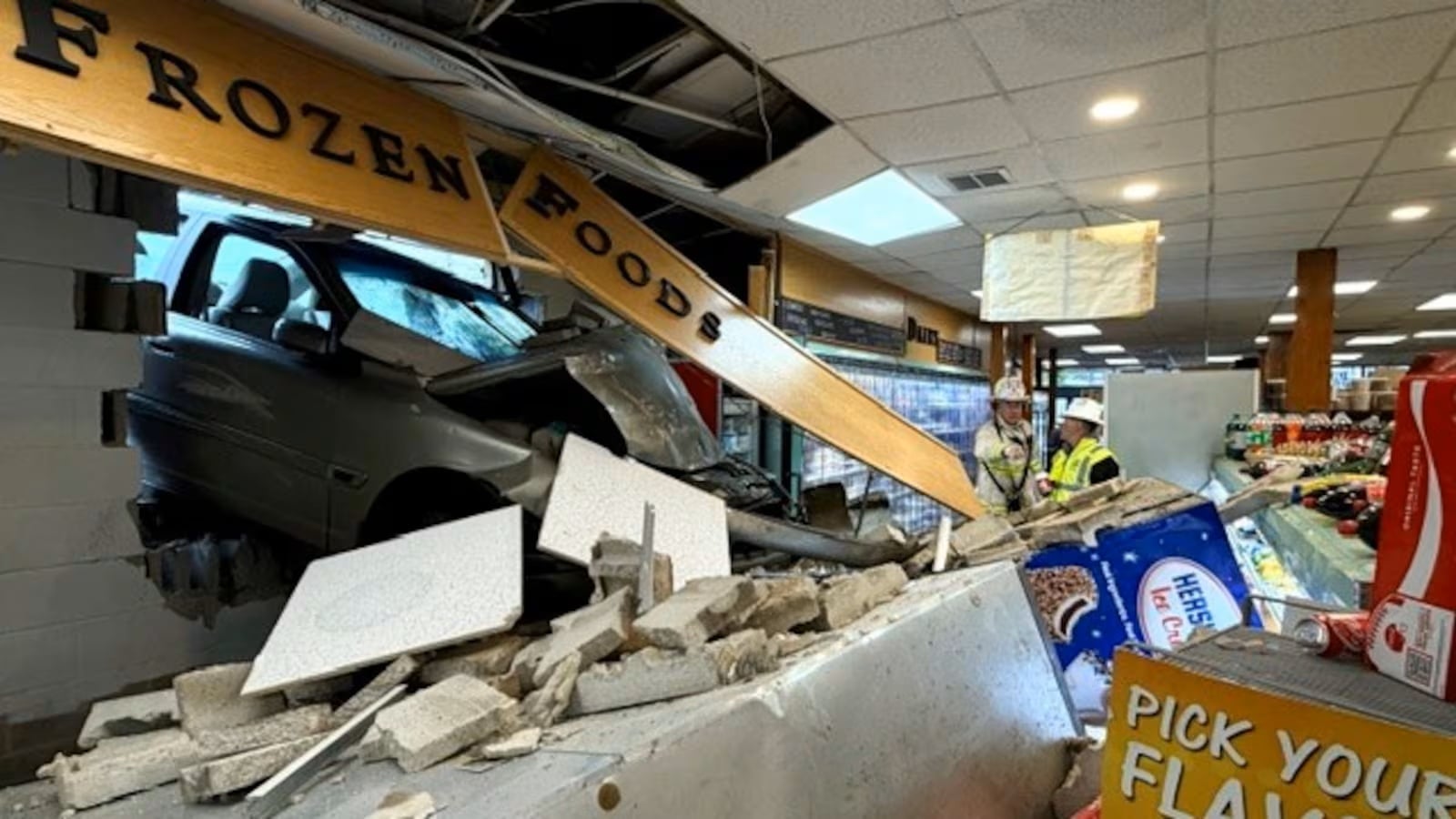
A Saturday morning shopping trip took a frightening turn at the New England Meat Market in Peabody, Massachusetts, when a car drove straight through the front of the store. The owner was in the back cutting meat when a thunderous bang sent him running to the front of the building, only to find a vehicle sitting halfway inside his shop. It is the kind of scene that stops you cold, and unfortunately, it is far more common across the country than most people realize.
According to the store owner, responding officials removed the elderly female driver from the vehicle and transported her to the hospital. Before ending up inside the market, the car reportedly struck another vehicle in the area. The owner noted that the driver appeared to be doing okay, which, all things considered, qualifies as the best possible outcome from a situation that could have gone much worse.
No injuries among store employees or bystanders were reported, but the damage to the market was plainly visible in photos from the scene. The car sat fully inside the store, surrounded by the kind of chaos that takes days to sort out and weeks to repair. For a small, independent butcher shop, that is no small thing.
The investigation into what exactly caused the crash is ongoing, and the full details have not yet been released by Peabody authorities. What is clear is that a Saturday morning at a neighborhood market turned into something nobody on the premises had planned for. The store’s future operations in the short term remain to be seen.
This Is Not a Freak Accident. It Happens Constantly.
Car-into-building crashes are treated by the news cycle as oddities, the kind of local story that gets a chuckle and a shake of the head. The reality is considerably less amusing. Across the United States, a vehicle crashes into a storefront, commercial building, or non-residential structure roughly 100 times per day, totaling more than 36,000 incidents every year. That number deserves more attention than it typically gets.
These crashes injure more than 16,000 people annually, and up to 2,600 people are killed each year in what are often dismissed as unfortunate but isolated incidents. The Storefront Safety Council, which tracks this data, has been pushing for better infrastructure design and driver screening for years, with modest success at best.
Pedal Error: The Suspect Nobody Wants to Blame
In the Peabody crash, the specific cause has not been confirmed, but the circumstances fit a pattern that researchers have studied extensively. As many as 54% of all storefront crashes are a result of pedal error or other operator error.
The scenario plays out one of two ways with remarkable consistency: a driver pulling into a parking space in front of a business hits the gas instead of the brake, or a driver leaving a space puts the car in drive instead of reverse and accelerates forward when expecting to go back.
The NHTSA estimates that pedal error accidents occur up to 16,000 times every year in the United States, averaging roughly 44 per day. These are not high-speed incidents. They are low-speed mistakes with high-consequence outcomes, and the physics of a two-ton vehicle moving even slowly into a glass storefront are unforgiving.
Age Is a Factor, But Not the Only One
It would be easy, and unfair, to pin this entirely on older drivers. The data does show an elevated risk at both ends of the age spectrum. About 40 percent of vehicle-into-building crashes involve drivers older than 60, and researchers note that many elderly drivers mistake the gas pedal for the brake, a pattern that points to the need for more thorough testing for older drivers or anyone with visual, mental, or physical impairments affecting their driving.
That said, the other 60 percent of these crashes involve younger drivers, with causes often traceable to distraction and impairment. Alcohol is involved in a significant share of incidents as well. The point is not that any one group of drivers is uniquely dangerous.
The point is that the design of most commercial parking lots, with nose-in spaces pointed directly at glass storefronts and only a small rubber wheel stop between a moving car and the people inside, does essentially nothing to prevent the worst outcomes when a driver makes a mistake.
What This Means for Small Business Owners
For the owner of the New England Meat Market, who heard the crash from inside his cutting room and walked out to find a car occupying his sales floor, the immediate concerns are practical ones. Structural inspections, insurance claims, inventory losses, and the question of when the shop can reopen are all on the table. Independent butcher shops operate on tight margins under the best of circumstances.
The broader issue, which the Storefront Safety Council and safety engineers have raised for years, is that commercial buildings in most municipalities are not required to install bollards or other barriers that would stop a vehicle from penetrating the building.
Wheel stops are largely considered useless as safety devices, and the failure to provide substantive barriers may increase liability for property owners and business operators in the event of a crash. That is a conversation the business community and local governments around the country have been slow to have in any serious way.
The New England Meat Market story is still developing. Whether charges will be filed, what the full damage assessment looks like, and when the shop expects to resume operations have not yet been reported. What is certain is that the owner showed up to work on a Saturday expecting a normal day behind the counter, and got something else entirely.