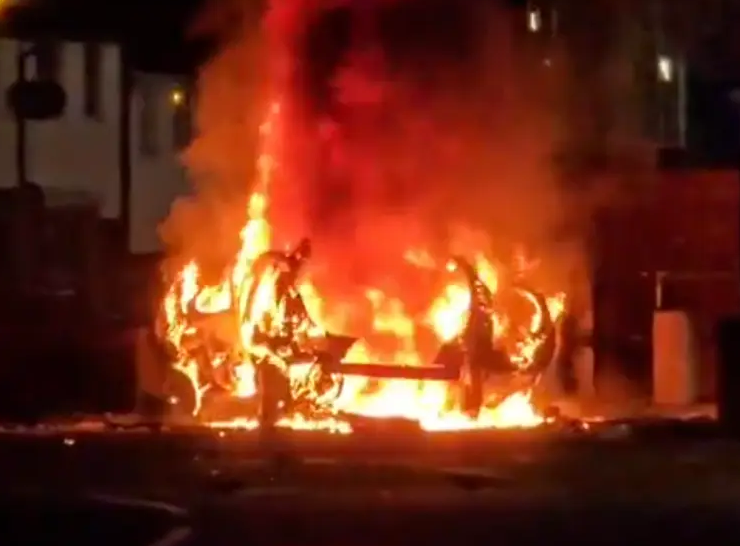
Early Sunday morning, residents across west Belfast were jolted awake by a massive explosion that rattled windows, sent neighbors flooding into the streets, and triggered a flood of alarmed social media posts. A car bomb had detonated outside the Police Service of Northern Ireland station in Dunmurry, and the images that followed were the kind most people in Northern Ireland hoped they would never see again.
Videos circulating on social media showed the vehicle completely engulfed in a roaring inferno at the gates of the station. Thick black smoke billowed skyward as police rushed to cordon off the area and begin an evacuation operation. While authorities had not immediately confirmed the nature of the device, the scene spoke for itself, and Irish journalist Kevin Scott was among the first to report plainly on X: a car bomb had gone off at the Dunmurry station.
The car involved had reportedly been hijacked before it was used in the attack, a detail that adds another grim layer to an already disturbing incident. Fortunately, no police officers were reported injured. The PSNI quickly issued a statement asking members of the public to stay away from the area, noting that cordons were in place and an evacuation was underway. About an hour after the explosion, a bomb disposal robot was spotted at the scene, and debris from the blast remained scattered across the road.
For many in Northern Ireland, the attack was not just a security incident but a deeply personal gut punch. It dragged forward memories of a conflict most people believed had been buried, if not forgotten. One Reddit user who heard the blast put it plainly and without much diplomatic polish: “F–ks sake. Can they just not? Nobody wants that shite anymore.”
What Is The Troubles, and Why Does This Incident Bring It Back Up?
— Kevin Scott (@Kscott_94) April 25, 2026
To understand why this explosion carries such heavy weight, it helps to know the history behind it. From 1968 to 1998, Northern Ireland was the site of a brutal and prolonged sectarian conflict known as The Troubles. On one side were the predominantly Roman Catholic Republican groups, most notably the Irish Republican Army, who wanted Northern Ireland to unify with the Republic of Ireland. On the other side were Protestant Unionist groups who wanted to remain part of the United Kingdom.
The violence was widespread and devastating. Car bombings became one of the most feared and frequently used tactics during those three decades of conflict. By the time it was over, more than 3,600 people had lost their lives and over 30,000 had been injured. Entire communities were scarred in ways that still have not fully healed.
The conflict officially ended with the signing of the Good Friday Agreement in 1998, a landmark peace deal that established a power-sharing assembly in Northern Ireland and created cross-border cooperation between the Irish and Northern Irish governments. It was a historic achievement, and it held. But held does not mean ironclad.
Splinter Groups Have Never Fully Disappeared
While the vast majority of people in Northern Ireland embraced the peace brought by the Good Friday Agreement, not everyone did. A small number of dissident republican splinter groups have continued to reject the accord and its political framework, viewing any arrangement that keeps Northern Ireland within the United Kingdom as unacceptable. These groups have periodically targeted symbols of British authority, including police stations, in the years since the agreement was signed.
The Dunmurry attack fits that pattern. It was not random. Police stations represent the authority of the state in Northern Ireland, and attacking one is a deliberate, symbolic act designed to send a message, even if that message is rejected by the overwhelming majority of people on the island of Ireland.
The timing of the attack also raised eyebrows. It occurred while Sinn Fein, the political party that advocates for a united Ireland and carries historic ties to the IRA, was holding its annual conference in Belfast. Known as the Ard Fheis, the gathering was taking place in Belfast for the first time since 2018. Sinn Fein has long since committed to a peaceful, democratic path toward Irish unity, and there is no suggestion the party had any connection to the bombing whatsoever. But the timing was not lost on observers.
What We Can Learn From the Dunmurry Bombing
An army bomb disposal robot is now approaching the shell of the vehicle.
Debris from the explosion has been scattered across the road.
A large cordon remains in place around Dunmurry https://t.co/4EwRzpPHgl pic.twitter.com/vqJjTprr2N
— Kevin Scott (@Kscott_94) April 26, 2026
Incidents like this serve as a sobering reminder that peace agreements, however historic and hard-won, do not come with lifetime guarantees. The Good Friday Agreement transformed Northern Ireland, and the progress made since 1998 is real and significant. But where there are unresolved political grievances and small, determined groups willing to use violence to express them, the threat never fully vanishes.
It also illustrates the difficult position law enforcement occupies in post-conflict societies. The Police Service of Northern Ireland, which replaced the old Royal Ulster Constabulary as part of the peace process reforms, has worked hard to build legitimacy across communities that historically distrusted it. Attacks like this one are designed to undermine exactly that trust and to provoke a reaction that deepens division.
For ordinary people in west Belfast and beyond, the message from the community has been pretty clear. Nobody asked for this. Nobody wants to go back. The anger expressed online was not directed at police or politicians; it was directed at whoever thought lighting a car on fire outside a police station in 2025 was going to accomplish anything. As one local made clear with memorable bluntness on Reddit, the appetite for renewed conflict among the broader population appears to be essentially zero.
What Happens Next
A major security alert was declared in the area following the explosion, and the road outside the Dunmurry station remained closed as authorities worked the scene. A bomb disposal team was deployed, and an investigation is expected to follow to determine who was responsible and whether they are connected to any known dissident republican organizations.
The attack will likely renew conversations about the ongoing security situation in Northern Ireland and the resources needed to monitor and counter the small but persistent threat posed by groups that reject the peace process. It may also prompt renewed political discussion about the stability of the institutions established by the Good Friday Agreement and what more can be done to address the underlying grievances that keep fringe groups from accepting its legitimacy.
What it will not do, if the reaction of ordinary people in Northern Ireland is any indication, is find a receptive audience for whatever point the bombers were trying to make.