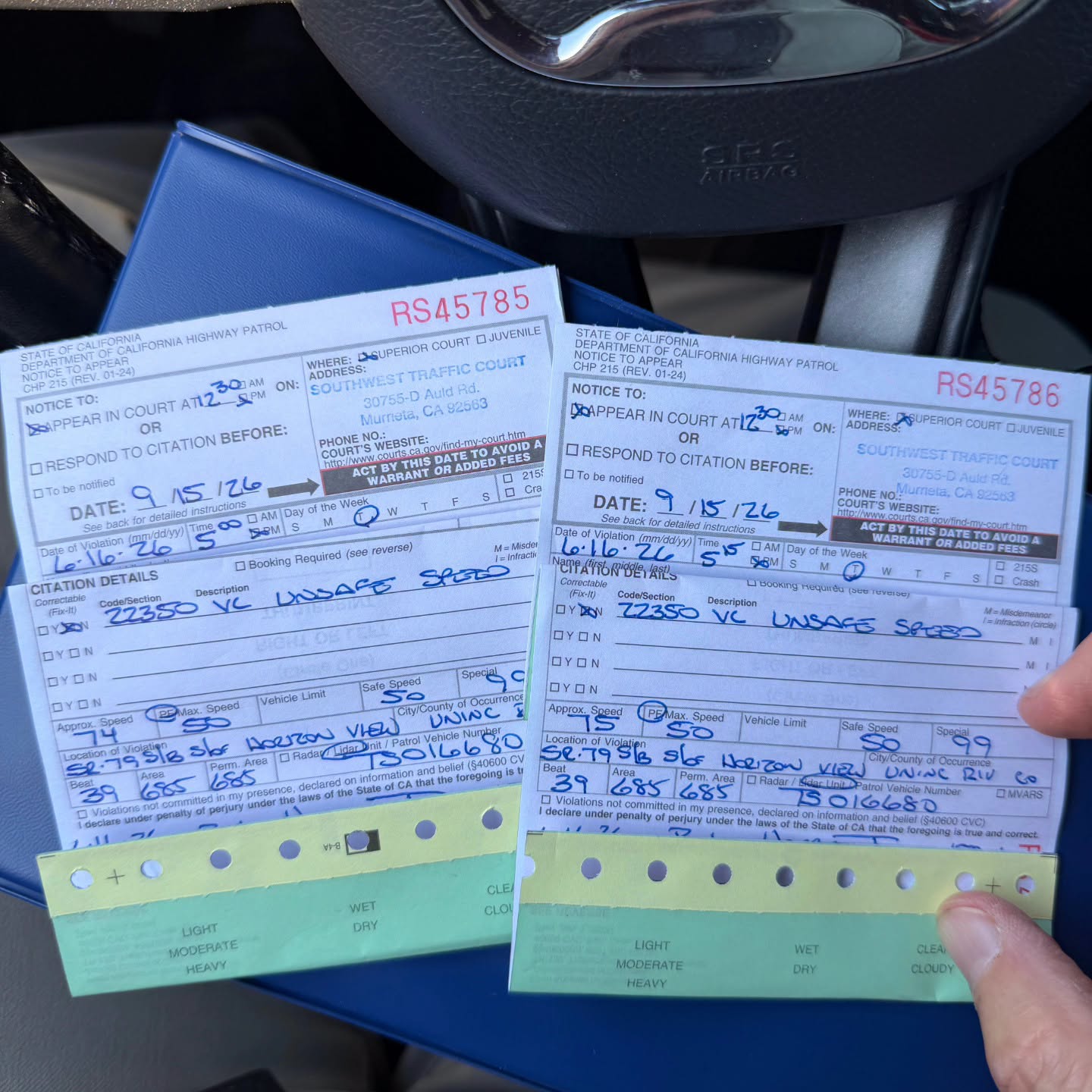
A Temecula traffic stop turned into an awkward family reunion when a father pulled up on the same stretch of road where his son had just been cited for speeding, and managed to do nearly the exact same thing.
On a Tuesday afternoon in Temecula, California, the CHP issued a speeding citation to a driver clocked at 74 mph in a posted 50 mph zone. Fifteen minutes later, a second driver came through the same corridor doing 75 mph. Officers soon discovered the second driver was the father of the first. When confronted with the news, dad reportedly admitted he couldn’t even be upset with his son, because he had just done the exact same thing. The apple, it turns out, did not fall far from the tree, or the accelerator.
The CHP Temecula division shared the story on social media under the heading “Like Father, Like Son,” and it quickly caught attention for reasons that go well beyond the comedy. Both drivers were traveling 24 to 25 mph over the limit, which in California is the threshold at which a speeding ticket can become significantly more serious. Exceeding a posted limit by 25 mph or more brings steeper fines, potential court appearances, and a harder hit on the driving record.
What makes this more than just a quirky local story is what it illustrates about driving habits as a learned behavior. Whether it’s how someone handles a merge, how they treat a yellow light, or apparently how they interpret a 50 mph sign, patterns tend to pass between generations behind the wheel. That’s not an editorial judgment, that’s just what happened on this particular road in Temecula.
The Numbers Behind California’s Speeding Problem
The CHP reported issuing more than 491,000 speeding citations across California in the most recent year on record. In that same period, unsafe speeds contributed to over 110,000 crashes, more than 400 fatalities, and roughly 68,000 injuries statewide.
Those figures put a sharper edge on what might otherwise read as a lighthearted anecdote.
What Speeds Like That Actually Mean
Both drivers were cited under California Vehicle Code 22350, the state’s basic speed law, which holds drivers accountable for traveling at speeds unsafe for conditions regardless of the posted limit.
At 74 or 75 mph in a 50 mph zone, the margin for error in the event of a sudden hazard drops considerably. Stopping distance increases with the square of speed, not linearly, which is the kind of physics that doesn’t negotiate.
Why the 50 mph Zone Matters
Temecula sits in Riverside County, where a mix of surface roads, commercial corridors, and residential development means 50 mph limits often reflect genuine infrastructure constraints rather than conservative signage.
Roads posted at 50 are typically not highway-grade, and traffic density during late afternoon hours, when this incident occurred, adds another variable.
Inherited Driving Habits Are More Common Than People Admit
Research on driving behavior has long suggested that young drivers mirror the habits of the adults who taught them or who they regularly rode with. Speeding tendencies, following distances, and risk tolerance behind the wheel tend to track across households. The Temecula case made that dynamic visible in real time, with timestamps to prove it.
Neither driver was arrested. Both received citations. The son presumably had to find another ride home.
I live in Temecula and would like to know which road the citations were issued on.