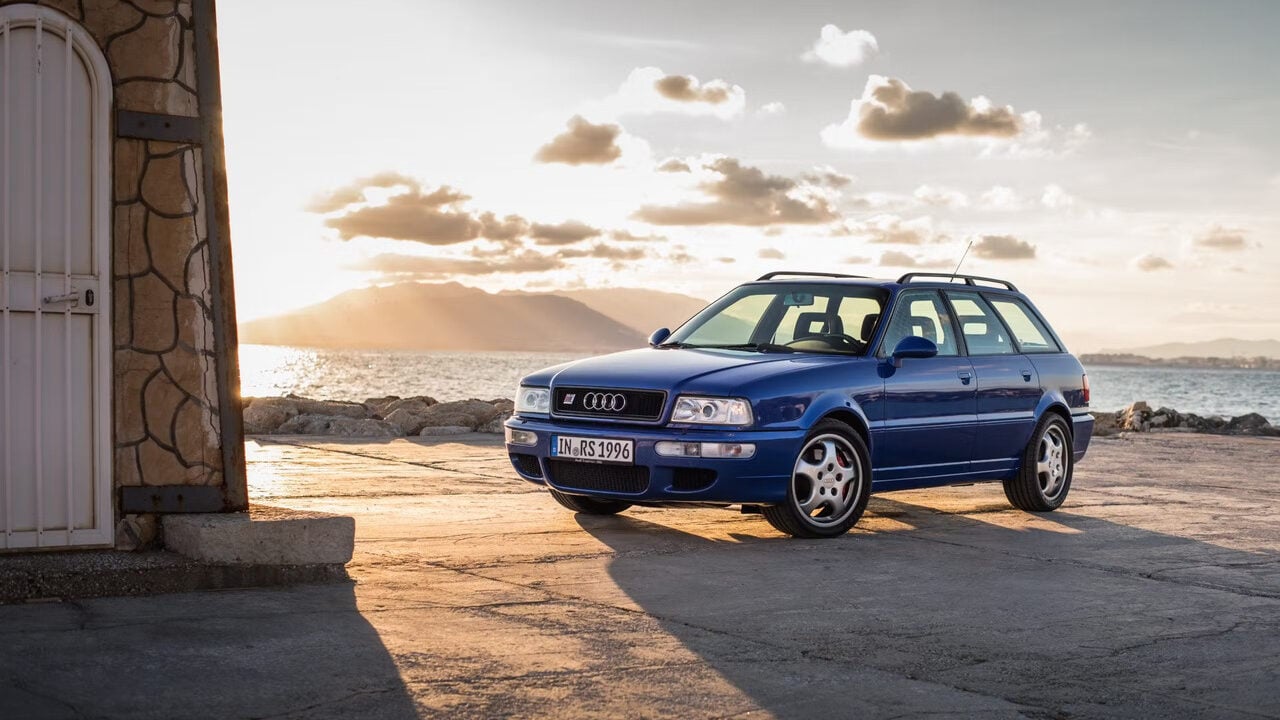
In the 1990s, two German giants collaborated to build a car that I still can’t believe exists. The Audi RS2 Avant – a station wagon built as a collaboration between Audi and Porsche – was designed with one goal in mind: to be the ultimate sleeper car.
In one famous period-style comparison, the RS2 is often quoted at about 1.5 seconds to 30 mph, fractionally quicker than the McLaren F1’s commonly cited 1.7-second 0–30. Truth be told, it only outperformed the F1 from 0 to 30 mph, but beating the fastest car in the world at anything is worthy of celebration. On top of this, the Audi RS2 was Audi’s very first RS car, paving the way for a performance brand that’s still around to this day.
During the 1980s, Audi dominated the rally scene with the insane Audi Quattro. Due to homologation rules, a set of rules to allow us peasants to enjoy race car technology, their road cars received the same all-wheel-drive system and five-cylinder engine. I like to think of it as the Quattro’s performance DNA swimming through the gene pool of the rest of Audi’s lineup, and the perfect example thereof is the Audi RS2 Avant.
Plenty Of Power For Its Time
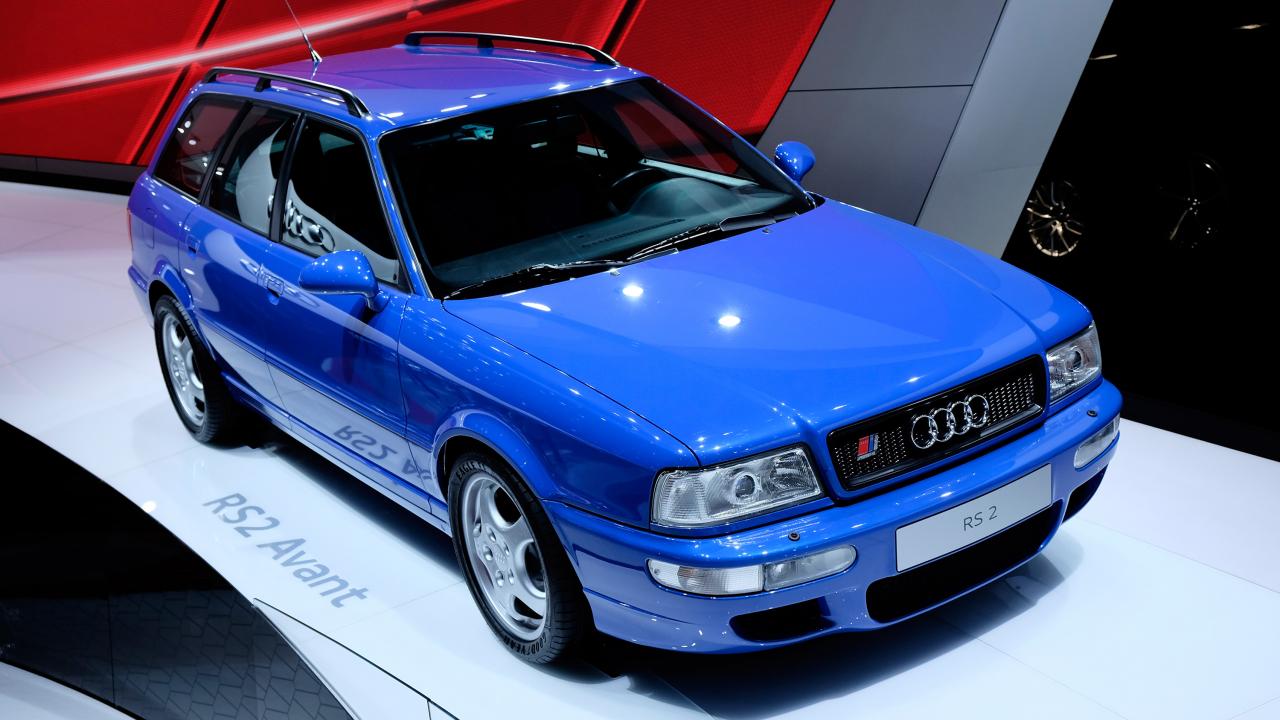
Back in the day, the RS2 would outrun almost everything on the road, leaving other drivers with dropped jaws, wondering how they failed to keep up with a car that could be described using words such as “neat” and “practical.”
Under its hood, there was a 2.2-liter turbocharged inline-five mill that Porsche had tinkered with. Porsche put in a hilariously large turbocharger, a brand-spanking-new camshaft, more efficient fuel injectors, a more robust intercooler, a more efficient induction system, and a new ECU, among other things.
This resulted in 311 bhp and 410 Nm (302 lb-ft) of torque. Keep in mind, this was during a time when the V8-powered Ferrari F355 had only 70 hp more at its disposal. Let me repeat that: an exotic supercar had just 70 more ponies than this five-door station wagon.
Porsche didn’t just modify the engine. Porsche developed the braking system; contemporary write-ups note Porsche-branded calipers and major brake upgrades as part of the package. It used 17-inch Porsche Cup-style wheels and Porsche-sourced door mirrors (often described as 911/964-era items), along with other Porsche components. Porsche played a major part in the RS2 Avant’s existence, which is why there are Porsche badges scattered across the wagon, such as on the front grille, rear hatch, and the brakes, as if they left their stamp of approval.
Thanks to Audi’s impeccable Quattro all-wheel-drive system, the RS2 Avant accelerated like it had a rocket strapped to its behind. The headline performance figure was its 0 to 30 mph, which was recorded at merely 1.5 seconds, marginally quicker than the McLaren F1, which did it in 1.7 seconds. After that, the McLaren wiped the floor with the RS2.
Still, the mere fact that the humble Audi managed to compete with the F1 was almost unbelievable. In the past, cars from such different segments would never be mentioned in the same breath.
The Porsche-tuned Audi wagon period figures commonly quote 0–60 mph at about 4.8 seconds, while Porsche’s own retrospective cites 0–100 km/h in 5.4 seconds, fast enough to embarrass plenty of sports cars of its era, and even some that came later, especially in real-world launches thanks to quattro traction in the process. Top speed was 262 km/h (163 mph), and Porsche notes it was the first Audi to break the 250 km/h (155 mph) barrier.
The Audi RS2 Avant was the perfect example of a four-wheeled Jekyll and Hyde. It packed a punch and had more than enough room to accommodate the whole family and their baggage for a trip across the country or an entire month’s worth of groceries (or a couple of bodies).
How Much To Buy One?
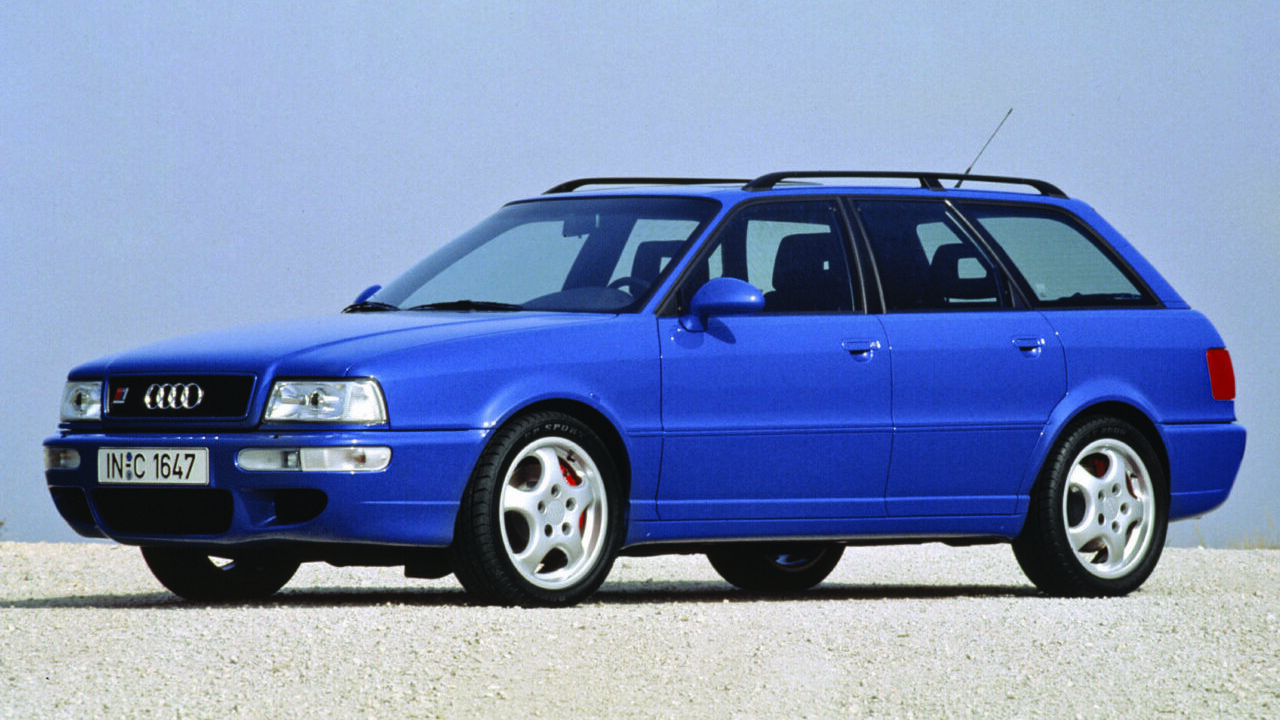
Total production was about 2,900 cars (commonly cited as 2,891, though Audi Tradition has also published 2,908), with roughly 180 right-hand-drive examples. It pioneered the fast wagon, was the very first RS car, and is one of the coolest testimonials to showcase how carmakers can work together to create a bespoke work of art.
Because of that, it’s no wonder that the Audi RS2 has become highly sought-after by collectors globally. Classic.com’s Market Benchmark (CMB) for RS2 sales data sits around the low-$60k range (about $63k), with individual cars swinging widely by condition and mileage. By no means is it an attainable classic car, but it’s pretty tempting, considering you can buy two of them for the same price as a brand-new Audi RS6 Avant. I know which option I would choose.