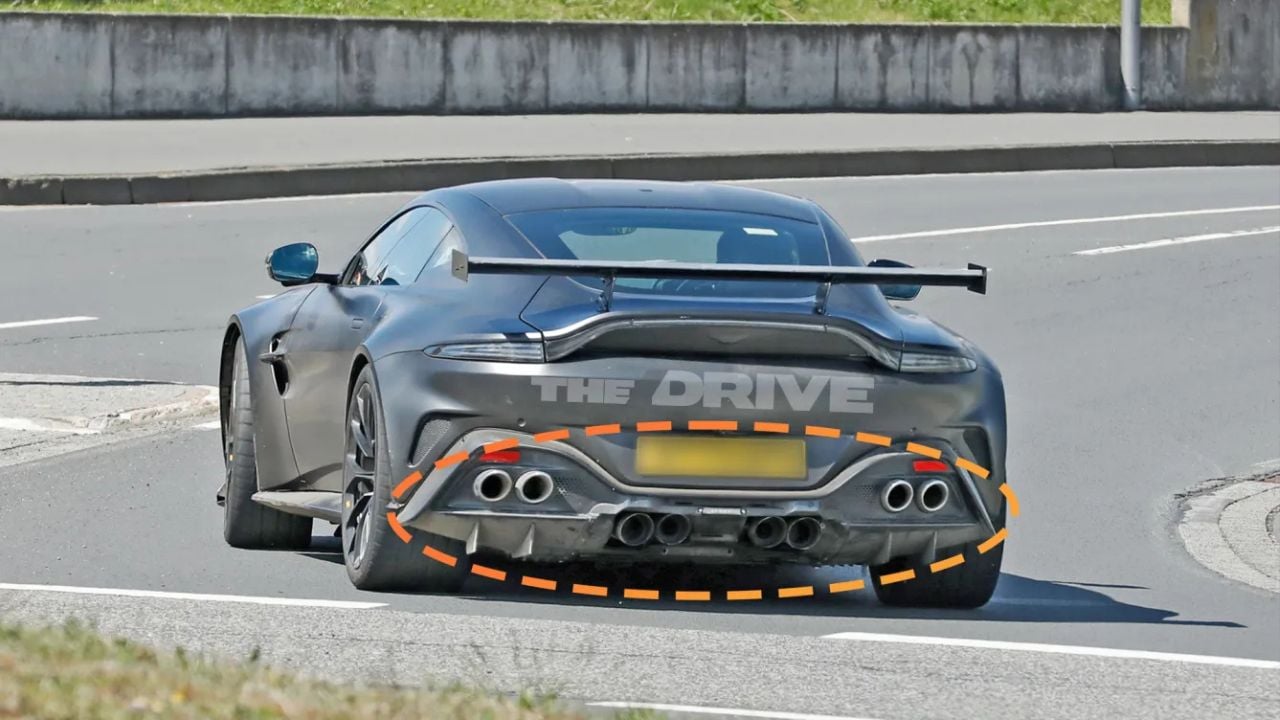

The Aston Martin prototype recently spied wearing eight exhaust tips looks absurd only to casual eyes, like someone doubled the rear fascia in a design studio dare. It is not absurd at all. It is a rolling lab.
Start with the baseline.
The current Aston Martin Vantage runs a quad-exhaust layout fed by a 4.0-liter twin-turbo V8 mounted in a front-mid configuration. Exhaust gas leaves each cylinder bank, passes through turbochargers, catalysts, and a valved system that can alter flow and sound, then exits through two pipes per side.
That conventional setup already hides complexity. A cross-plane V8 does not breathe evenly. Its firing order creates irregular exhaust pulses, which engineers manipulate through pipe length, merging strategies, and valve timing to balance backpressure and extract power.
Now imagine doubling the exits.
Lucky Number 8
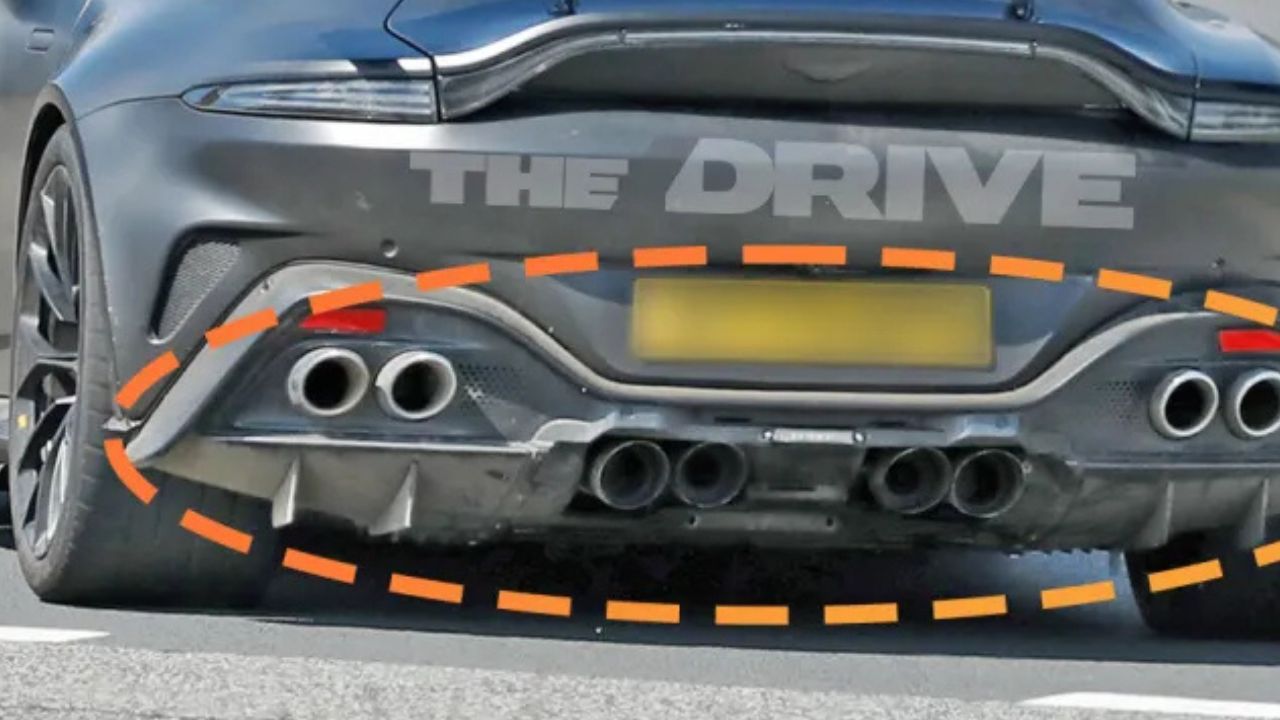
The eight-tip configuration seen on the Nürburgring test car introduces a second layer of possibilities. Spy analysis suggests four outer pipes remain consistent with the production car, while four central outlets appear newly added, likely experimental rather than permanent.
We couldn’t look away because exhaust design is not just about letting gases escape. It is about controlling pressure waves.
When exhaust pulses collide or harmonize, they influence turbo spool, cylinder scavenging, and thermal load. With eight outlets, engineers can split the flow into parallel paths, each tuned for a different objective.
One path could prioritize low backpressure for peak power. Another could route through additional catalysts or mufflers to satisfy emissions and noise regulations.
A third could exist purely to study heat rejection, dumping excess thermal energy away from sensitive rear components during track abuse. This kind of modular routing lets engineers swap internal configurations without redesigning the entire rear end.
A Peace Offering to the Road and Track
Look closer at the car as a whole and the intent sharpens.
The prototype wears a fixed rear wing, wider track, and aggressive cooling apertures. Those are tell-tales of a shift from grand tourer to track weapon. When sustained lap performance demands thermal stability more than headline horsepower, exhaust routing becomes a cooling tool as much as a performance enhancer.
Heat is the invisible enemy here.
Turbocharged V8s generate extreme exhaust temperatures, often exceeding 900°C under load. In a tight front-mid layout, that heat must travel rearward without cooking the gearbox, suspension bushings, or rear diffuser airflow. Splitting the exhaust into multiple outlets spreads that thermal burden spatially, reducing hotspots.
There is also acoustic engineering at play.

Modern performance cars must satisfy strict drive-by noise limits while still delivering emotional sound. Multi-channel exhaust systems allow variable acoustics.
Inner pipes could be valved for track mode, bypassing mufflers for a sharper note, while outer pipes maintain compliance on the road. The result is a car that can whisper past regulations and then howl on command.
Then comes the aerodynamic interaction.
Exhaust flow contributes to underbody airflow, especially around the diffuser. Multiple outlets can energize airflow in different regions, subtly influencing downforce. In a track-focused Vantage variant, even marginal gains in rear stability count for much.
Aston Might Be Trippin’
Not all eight pipes are likely functional in the traditional sense.
Development mules often use “decoy hardware” to mask final solutions or to test multiple configurations simultaneously. But even non-functional outlets can house sensors, pressure probes, or thermal instrumentation. What looks like excess might be data collection in disguise.
Zoom out and the picture becomes clearer; this is not styling excess.
It is a transitional machine exploring the limits of an internal combustion platform in an era edging toward electrification. The eight exhaust tips question how far airflow, heat, and sound can be manipulated before the architecture itself runs out of headroom.
The Vantage’s rear is about eight different engineering conversations happening at once, all routed through a single, very loud experiment.