
There is a very specific kind of dread that settles in the moment you pull into a car wash and hand over control of your vehicle to a conveyor belt and a curtain of spinning brushes. The worries are ordinary enough — did you close that back window all the way? Is your antenna still attached? — but they tend to pile up fast once the soapy foam starts flying.
Now imagine all of that standard-issue car wash anxiety, and then your car suddenly erupts into a full symphony of warning tones, beeps, and alerts — none of which you triggered, none of which you understand, and all of which you are completely powerless to stop.
That is exactly what happened to TikTok creator Cheyenne Wilson (@cheyennewil), who posted a video that spread rapidly across social media showing her wide-eyed and frozen in the driver’s seat of her mother’s car while the vehicle’s entire alarm and alert system appeared to activate at once. The car was mid-rinse cycle. She was mid-panic.
The video racked up views fast — not because it was particularly dramatic or dangerous, but because nearly every driver who watched it had the same immediate thought: that could absolutely be me.
Why Modern Cars Go Haywire Inside Car Washes
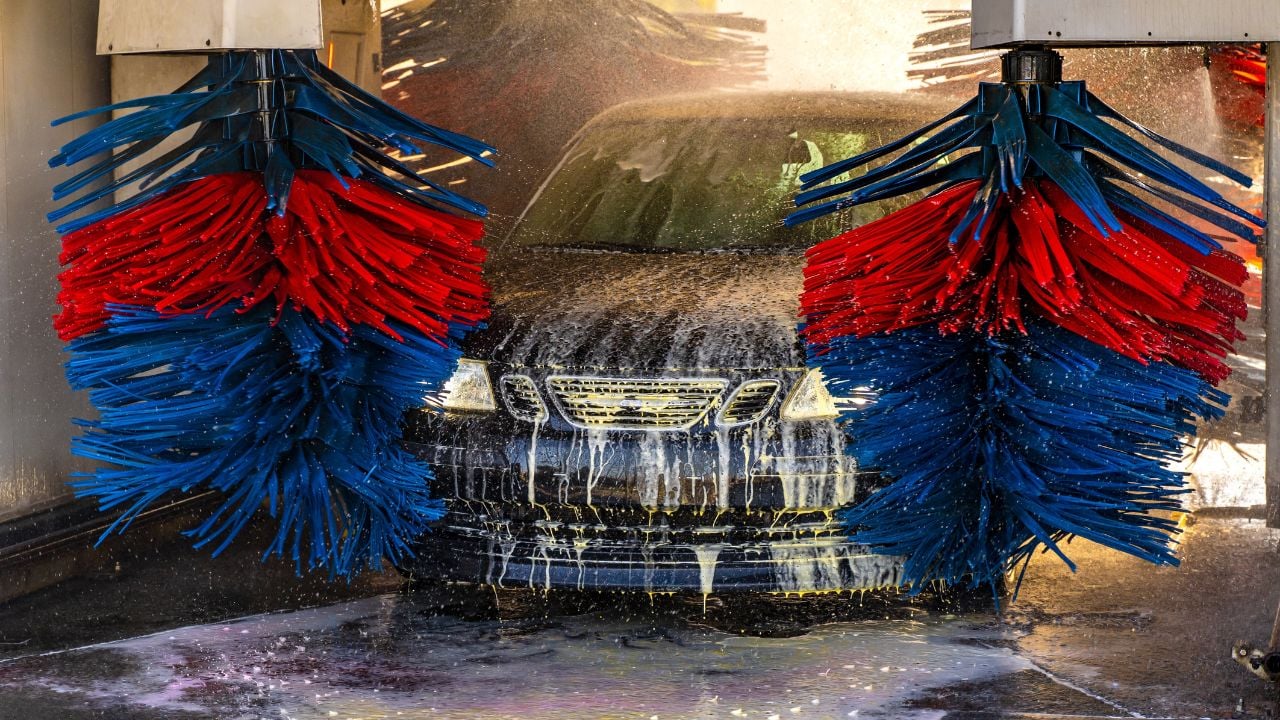
The culprit behind most car wash chaos is the same technology that makes modern vehicles so much safer on the road: advanced driver assistance systems. These systems rely on a network of cameras, radar sensors, and short-range ultrasonic sensors that continuously scan the space around the car for obstacles, lane markings, pedestrians, and other hazards.
Ultrasonic parking sensors, for example, work by sending out sound waves and measuring the speed at which those waves bounce back. The closer an object is, the faster the return — and the more urgent the warning tone the driver hears. In a normal parking situation, that system is incredibly useful. Inside a car wash, where spinning brushes, water jets, and foam applicators are passing within inches of the vehicle on all sides, those same sensors essentially interpret the entire machine as a rapidly approaching wall of obstacles.
The result is a car that genuinely believes it is about to be demolished — and reacts accordingly. That is not a malfunction. It is the sensors doing exactly what they were built to do, just in a context their designers probably never fully anticipated.
Can You Actually Turn Off Your Car’s Sensors?
Wilson’s video caption acknowledged the obvious fix — turning off the sensors before entering the car wash — but the problem is that doing so is rarely straightforward. Modern vehicles do not come with a single master mute button for all driver assistance alerts. Instead, individual systems can sometimes be toggled off, but the method varies significantly depending on the make, model, and year of the vehicle.
Some cars have a dedicated physical button, often marked with a “P” and a series of sound-wave lines, that temporarily disables parking sensors. Others require digging through the vehicle’s infotainment system menus, which is not exactly the kind of task you want to attempt while inching toward the entrance of a car wash tunnel.
A growing number of newer vehicles have addressed this problem with a purpose-built solution: a dedicated “car wash mode.” This setting, typically buried somewhere in the vehicle settings menu, is designed to temporarily disable automatic systems like parking sensors, rain-sensing wipers, and in some cases automatic emergency braking — all the things that get confused when you are surrounded by water and machinery.
The catch is that the name and location of this mode varies from brand to brand. One automaker might call it “car wash mode” and place it prominently in the main settings menu. Another might label it differently and tuck it several sub-menus deep. If you have never looked for it before, finding it under pressure while sitting in the car wash line is not a realistic expectation.
What We Can All Learn from One Viral Panic Attack
@cheyennewilShould have looked at how to turn off the sensors before going in here
Beyond the entertainment value, Wilson’s video quietly exposes a real gap in how people interact with increasingly complex vehicles. Cars today are packed with sophisticated technology designed to keep drivers safe — but that technology is only useful when drivers understand how and when it activates.
Most people spend very little time reading their owner’s manual, and dealership walkthroughs rarely cover every feature in depth. The result is that millions of drivers are operating vehicles with capabilities they have never fully explored. That is fine the vast majority of the time — until you are in a car wash, borrowing your mom’s car, and suddenly every alert the vehicle has ever learned is going off at once.
A few things every driver should probably know before their next car wash: check whether your vehicle has a car wash mode and locate it before you need it. If no such mode exists, find out whether your parking sensors have a physical disable button and where it is. If you drive a car that is not your own, take a few minutes to get familiar with the alert systems before you pull into any kind of automated situation.
None of this is complicated in hindsight. It is just the kind of thing nobody thinks to check until they are trapped in a tunnel with soap on their windows and a car that sounds like a submarine collision alarm.
The Bigger Picture: As Cars Get Smarter, Drivers Need to Keep Up
Wilson’s video arrived at an interesting moment for the auto industry. Vehicles have been steadily absorbing more and more sensor-driven technology over the past decade, and that trend shows no signs of slowing. Features that were once reserved for luxury models — adaptive cruise control, lane-keep assist, automated emergency braking, surround-view cameras — are now standard or optional equipment on a wide range of everyday vehicles.
That is largely a good thing. These systems genuinely save lives and prevent accidents. But they also introduce new moments of confusion — especially when they activate in contexts that are unfamiliar, unusual, or simply beyond what the driver anticipated. A car wash is a low-stakes example. There are higher-stakes versions of the same knowledge gap out on the road every day.
The takeaway is not that modern driver assistance systems are bad or unreliable. It is that understanding your vehicle well enough to know when to let it do its job — and when to tell it to stand down — is becoming a meaningful part of being a competent driver.
In the meantime, if you happen to find yourself in a noisy car wash with no idea why your car is screaming at you, know that you are in very good company. Cheyenne Wilson has the video to prove it.