

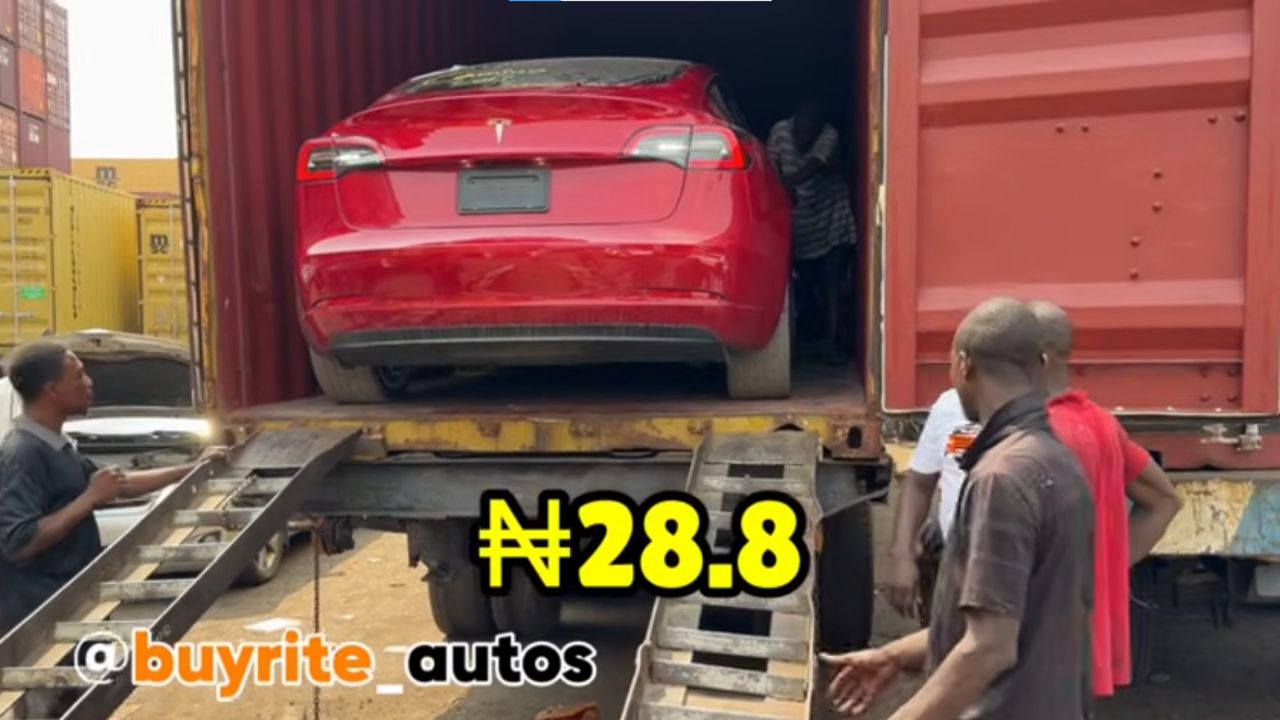
Importing cars is rarely glamorous, but one Nigerian auto dealer’s YouTube video has struck a nerve far beyond West Africa. In the footage, an exhausted importer documents what he calls one of the most punishing containers of his career, headlined by a jaw-dropping claim. He says he paid ₦28.8 million naira to clear a single 2023 Tesla Model 3 through customs.
At today’s exchange rates, that figure hovers around $20,000 to $21,000. And that money did not buy the car or ship it. It only allowed it to leave the port.
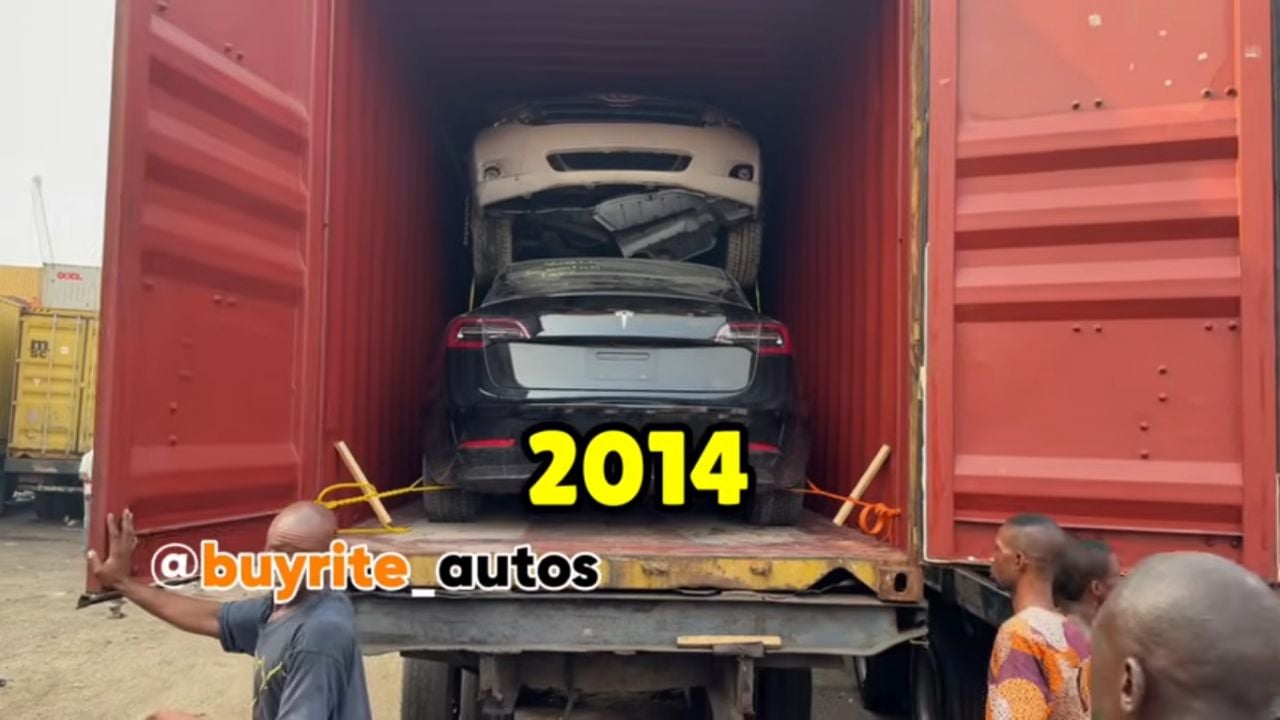
The container in question held four vehicles. Two Tesla Model 3 sedans, one from 2018 and another from 2023. A 2013 Toyota Venza with a minor accident history. And a 2014 Toyota Camry XLE. On paper, it looked like a standard mixed shipment. In reality, it turned into a month-long ordeal that nearly broke the importer.
“This container nearly finished me,” he says at the start of the video, sounding drained rather than dramatic.
A Month in Port and a $20,000 Fee
The biggest problem was not shipping or unloading. It was clearing the Teslas. According to the importer, EVs (electric vehicles) in Nigeria must be shipped in sealed containers rather than roll-on roll-off vessels. That alone raises costs. But customs charges are where things spiraled.

The 2023 Tesla Model 3, simply because of its model year, was assessed at ₦28.8 million. The container arrived in late December, around Christmas Eve. The importer expected to clear it by early January. Instead, the car sat at the port for nearly a month while fees piled up and paperwork dragged on.
The older 2018 Tesla was not spared either. That car reportedly cost ₦11.2 million (roughly $8,000) to clear. Even so, it added another layer of chaos. Its battery was completely drained, the key was locked inside, and the usual 12-volt jump procedure failed to open the hood.
With no way to power the car, it had to be dragged out of the container using a flatbed to avoid damage.
“You cannot afford to offload a Tesla the conventional way,” the importer explains, pointing out how easily EVs can be damaged during rough unloading.
The Invisible EV Policy and a $13,000 Venza

As the video unfolds, the frustration shifts from logistics to policy. The importer claims there is an existing government policy meant to make electric vehicles cheaper to import. According to him, that policy is not being real or applied by customs officials.
He says he was told the only way to access the policy was through a letter from the presidency itself. Go figure.
“Electric vehicles are supposed to be the cheapest,” he insists. “As good as free.”
In America, a statement like that can easily sound exaggerated. If found to be true, someone is looking to go to jail. But this isn’t America. Without transparent rules and respect for the rule of law, everything goes, including importers negotiating blindly while fees fluctuate wildly.
Meanwhile, the rest of the container had to keep moving. The Toyota Venza, despite a minor accident, drew immediate buyer interest at the port. The importer rejected offers around ₦18 million (that’s roughly $13,000), insisting the 2013 model was worth closer to ₦23 million ($16,600).

The Camry and the functioning 2023 Tesla followed, with the newer Model 3 managing to drive off under its own power thanks to a remaining 16 percent battery charge.
The Price Tag Shock
We can’t help but notice the prices implied in the video are so far above market values for the same vehicles here.
Take the 2013 Toyota Venza he mentions. In the U.S., even well-equipped Venza Limited models from that year typically trade between roughly $8,000 and $16,000 on the used market, with many listings clustered around the low end of that range.
So, rejecting ~₦18 million (~$13,000) offers and pushing toward ~₦23 million (~$16,600) for a fixer-upper isn’t far off what a pristine U.S. example might fetch, though most are closer to the $10,000 neighborhood.
For the 2014 Toyota Camry, listings and dealer data show this generation generally ranges between about $7,000 and $14,000, with average pricing near $8,000-$10,000 for clean examples. That makes an ₦18 million price tag (even after currency conversion) on a basic Camry notably high compared with what the same vehicle would sell for stateside.
F*****g Rich People
The contrast is stark with the 2023 Tesla Model 3. In the U.S., recent used listings for that exact year run broadly from about $15,000 to as much as the high $40,000s, but most fall in the $20,000-$30,000 bracket depending on trim and mileage.
Even at the upper end, that’s well below the roughly ₦28.8 million (~$18,000-$20,000) clearing cost alone in Nigeria, meaning the importer may be paying more just to release the vehicle from customs than a typical U.S. buyer would pay to actually own and drive the same car. You’d have to wonder how much a customer would eventually pay for the car at their dealership.

In essence, our Nigerian brothers are richer than we are. In fact, they might as well be one of the richest in the world, considering they pay significantly more than our brothers in the UAE.
The import fees in this Nigerian context could eclipse the retail value of these cars in the U.S., and here lies a crystal-clear snapshot of how tariff—sorry—duties, taxes, and policy-driven charges can dramatically distort the economics of the global used car market.
An Exhausted Importer and a Stark Global Contrast
In the end, the 2023 Tesla exited the port without scratches. Its owner, visibly nervous during the offloading, was relieved. The importer, however, was left reflecting on a month of stress and a customs bill that rivals the purchase price of some used cars in the United States.
The video, though shot overseas, offers a stark contrast to the EV conversation at home. While Tesla buyers in the U.S. debate tax credits and charging networks, importers elsewhere are battling opaque policies, aging infrastructure, and clearance fees that can eclipse the value of the vehicle itself.
Apparently, the global EV transition does not look the same everywhere. In some markets, the biggest obstacle is not range anxiety or charging infrastructure. Or thieves stealing charging cables for copper. It is simply getting the car out of the port.