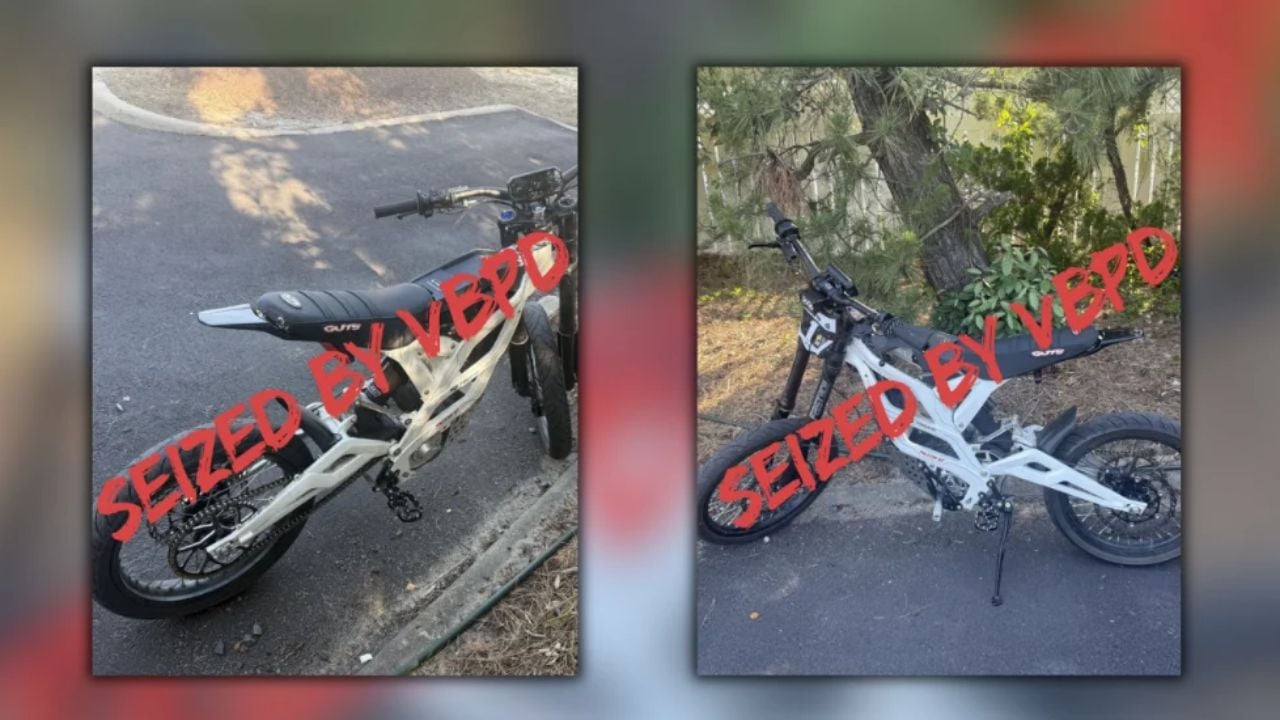
It takes a certain kind of audacity to flee from police on an electric dirt bike while already on probation for the exact same behavior. That’s precisely what a 15-year-old in Virginia Beach managed to pull off on June 6, triggering a chase that eventually required air support before officers could bring things to a stop. The whole thing wrapped up when the teen ditched the bike and was taken into custody on foot, but not before police had burned a significant amount of time and resources tracking down a vehicle that, by the way, has no business doing the speeds it was doing.
What made this particular electric bike more than just a nuisance is what was under the hood, so to speak. Authorities say the machine was packing a 16,800-watt battery pack and was capable of exceeding 59 miles per hour. That is not a bicycle in any meaningful sense of the word. That is a motorcycle with pedals attached for legal camouflage, and it was being ridden by a minor with a documented history of ignoring police.
This was not the teen’s first rodeo. Virginia Beach police noted that officers had issued three prior warnings for the same reckless riding behavior before this incident escalated to the point of requiring a helicopter. The teen was already on probation when this chase happened, which raises obvious questions about what the earlier warnings actually accomplished.
When the teen sped away from an officer on Flanagan’s Lane near Sand Bridge Road around 4:18 p.m., it set off a pursuit that involved multiple police vehicles and eventually an aerial unit that tracked the rider until the bike was abandoned. The e-bike was seized, and the teen now faces 13 charges including reckless driving and misdemeanor eluding. At some point, the warnings stop working and consequences have to fill the gap.
Why E-Bikes Keep Finding Themselves in Police Reports
Electric bikes occupy a genuinely confusing legal space in the United States, and that ambiguity has not gone unnoticed by people looking to exploit it. Depending on the state, e-bikes are classified by their top speed and motor wattage into tiers that determine where they can be ridden and whether a license is required. A standard Class 2 e-bike tops out at 20 mph and stays under 750 watts. The bike in this case had a 16,800-watt motor and a top speed over 59 mph, which puts it firmly in motorcycle territory regardless of what it looks like parked on a curb.
The problem is that enforcement is inconsistent. Many of these high-powered machines are marketed and sold through channels that blur the line between bicycle and motor vehicle, and they often look similar enough to legal e-bikes that police do not immediately flag them. By the time the speed becomes obvious, the rider is already gone.
What 16,800 Watts Actually Means
For perspective, a standard household clothes dryer runs on roughly 5,000 watts. The motor in this bike was well over three times that output, packaged into something that can weave through traffic, jump curbs, and disappear down paths where a patrol car cannot follow. High-powered e-bikes and electric dirt bikes in this wattage range are technically capable of matching the acceleration of entry-level gasoline motorcycles, and without the registration, insurance, or licensing requirements that come with those vehicles.
That gap in regulation is exactly what makes these bikes attractive to riders who want the performance without the accountability. For law enforcement, they represent a real operational headache. Ground units lose them in residential neighborhoods. They cut through parks and trails. The only reliable way to track them, as Virginia Beach learned firsthand, is from above.
Why It Took a Helicopter to Stop a Bicycle
The use of aerial support in this case is worth pausing on. Police helicopters are not cheap to operate. Depending on the department and aircraft, flight costs can run anywhere from $500 to over $1,000 per hour once fuel, maintenance, and crew costs are factored in. Deploying one to track a teenager on a dirt bike might sound like an overreaction on paper, but from a safety standpoint, it makes sense.
Ground pursuits of high-speed riders through residential and coastal areas carry serious risks for bystanders, and calling off a chase is often the safer choice until air assets can take over. A helicopter can track a fleeing suspect without triggering a dangerous ground pursuit, waiting for the rider to stop on their own terms. In this case, it worked.
The Repeat Offender Problem
Three warnings followed by a chase that required air support and resulted in 13 charges is a pattern that deserves some scrutiny. The teen was already on probation for reckless riding when this happened, which means prior consequences had not been sufficient to change the behavior. That is not unique to this case or this rider. Across the country, law enforcement agencies are dealing with a persistent problem of high-powered, unregistered electric bikes being ridden aggressively by minors in residential areas, and the legal tools available to address it vary significantly by jurisdiction.
Virginia law does allow for the seizure of vehicles used in certain violations, which is exactly what happened here. Whether that, combined with 13 charges, is enough to break the cycle remains to be seen.