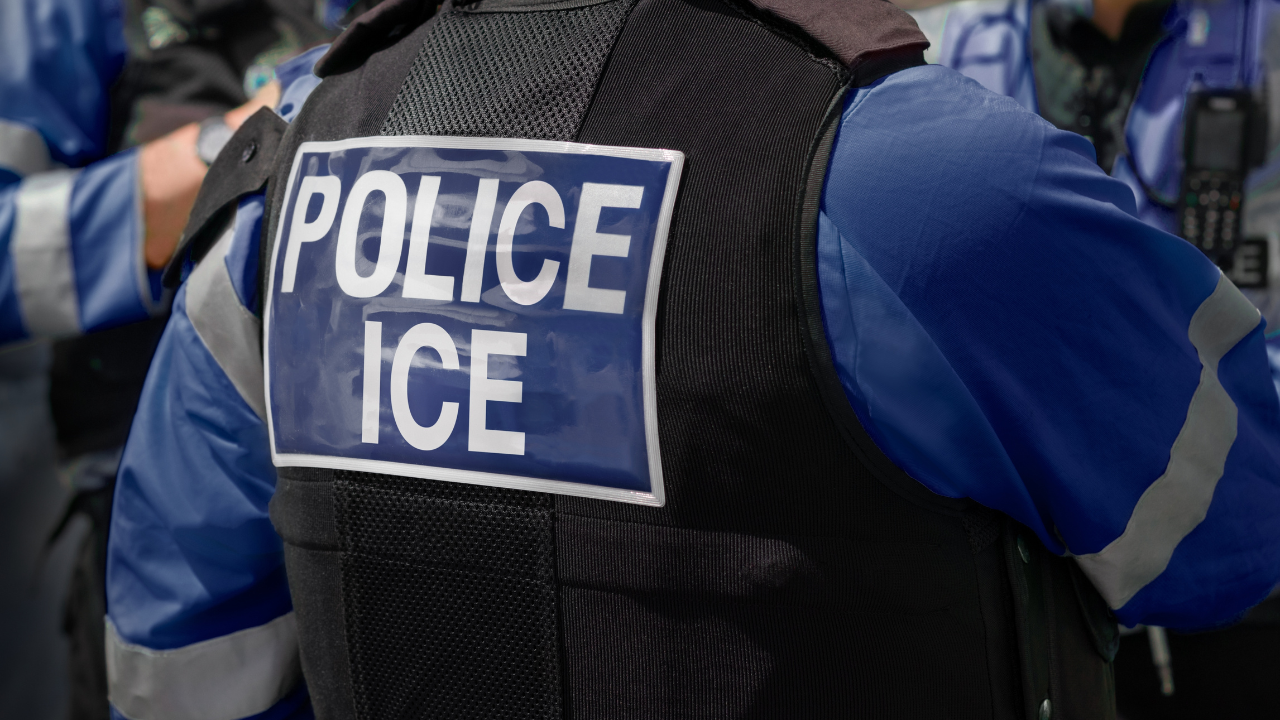
If you drive a white work van with a ladder rack in Georgia, you may want to make absolutely sure your left turn signal works. Because according to body camera footage obtained by the Atlanta Journal-Constitution, that vehicle profile was, at one point, considered a roughly 90 percent indicator that you were worth pulling over for reasons that had nothing to do with traffic law.
That’s not speculation. It came directly from a text message sent by a Jefferson, Georgia police officer named Jordan Redman to a colleague. The exchange, captured on Redman’s own body camera during a traffic stop, spelled out the approach plainly: work vans and trucks with multiple occupants were the general target, and if you spotted one, you were to radio in and ICE would head your way. Redman mentioned he typically parked in front of a Waffle House near the interstate to catch them coming off the ramp. Whatever you think about immigration enforcement, there’s something almost poetic about the Waffle House being the operational headquarters.
The footage was obtained through the Georgia Open Records Act and reviewed by the AJC. It shows three traffic stops in northeast Georgia where minor infractions, including one involving the state’s “Slow Poke” law, which requires slower drivers to clear the left lane, quickly escalated into immigration arrests once ICE was summoned to the scene. In one case, a federal agent arrived in an unmarked vehicle less than three minutes after being texted a location pin and a photo of a driver’s passport.
The stops raise a practical and legal question that doesn’t require you to have strong opinions about immigration to find interesting: at what point does a traffic stop stop being a traffic stop?
The Mechanics of How It Worked
ICE does not have the authority to pull vehicles over for traffic violations in Georgia. That’s a key detail. What federal immigration agents can do is check the immigration status of individuals once local police have already made a stop. So the arrangement described in the footage works like a relay: local officers make the stop, and ICE shows up to handle whatever follows.
Jefferson Police’s involvement was informal. The city attorney explained that an ICE agent simply walked into the department’s lobby one day and asked to speak with a shift sergeant. The agent extended an open invitation: if officers encountered someone they thought might be in the country illegally, give us a call. No official policy was written. No formal agreement was signed. Some officers chose to participate; others didn’t.
Georgia State Patrol operates under a different setup. It signed a formal 287(g) agreement with ICE in March 2025, which requires officers to complete training before performing immigration-related duties. That training includes coursework on avoiding racial profiling. The agency maintains that its day-to-day traffic enforcement practices have not changed as a result.
The Work Van Problem
Two separate Georgia State Patrol stops in Gainesville in June 2025 followed a similar pattern. Troopers pulled over vehicles for minor infractions, including a cracked windshield and window tint that was too dark, both in the parking lot of a grocery store in a ZIP code where over 40 percent of residents are Hispanic. In both cases, ICE arrived within minutes. Both drivers were taken into federal custody.
A Gainesville immigration attorney quoted in the AJC’s reporting put it directly: the stops weren’t happening in country club parking lots. They were happening where workers live and shop.
A Georgia State University criminology professor and former Memphis police captain drew a distinction that’s worth understanding. There’s a difference, he said, between notifying ICE after a routine stop has already occurred for legitimate reasons, and using traffic enforcement as the front end of an immigration operation. The first is standard interagency cooperation. The second is something else, and it raises questions about equal protection and profiling, regardless of whether the traffic violations cited were technically real.
What the Law Actually Says

Pretextual traffic stops, meaning stops where a minor violation is the stated reason but something else is the actual motivation, are generally legal in the United States under existing Supreme Court precedent, as long as a real violation was committed. That bar isn’t especially high. But legal and sound policy aren’t always the same thing, and the pattern documented here, specifically targeting vehicle types associated with immigrant labor, tests where that line sits.
Redman, the officer who described work vans as “the target” and invited a colleague to help him “snatch up some folks,” left the Jefferson Police Department last fall. The city attorney has said the July 2025 stop appears to have been the last direct ICE involvement for Jefferson police. Whether that’s the end of the story or just the end of the paper trail remains to be seen.