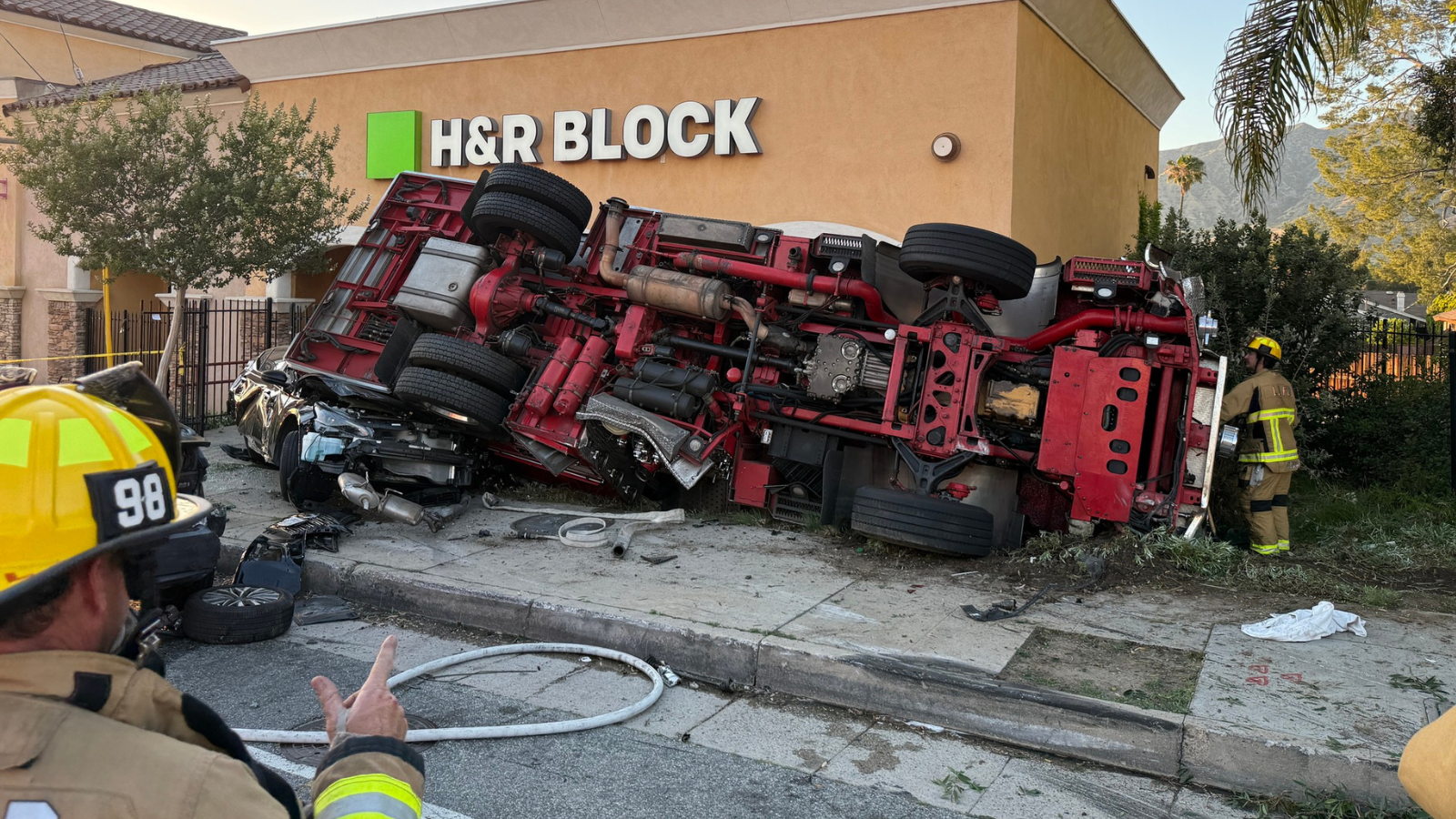
A fire engine going the wrong way down the emergency call hierarchy, a white SUV that moved at exactly the wrong moment, and a 60,000-pound truck ending up on its side against a tax office. Tuesday night in Sunland had no shortage of drama.
Around 6:45 p.m. on May 19, a Los Angeles Fire Department engine lost control on Foothill Boulevard, struck parked cars, and rolled onto its side against an H&R Block building near the corner of McVine Avenue. The crash was captured on video and quickly made the rounds, showing the kind of scene that stops people mid-scroll. Eyewitnesses at nearby businesses described feeling the shockwave before they ever saw the truck. “I heard like a loud explosion,” said one employee from the Panda Express next door. “And then it just shook.”
The good news – and in an incident like this, it is genuinely remarkable news – is that only two firefighters were aboard the engine, both sustained minor injuries, and both have since been released from the hospital. No civilians were hurt. The parked car crushed under the engine was empty. The H&R Block had already closed for the evening. If there was ever an incident designed to look catastrophic while somehow sparing everyone serious harm, this was it.
What remains under investigation is exactly how a fire engine responding to an emergency call ended up sideways against a commercial building. New footage captured by a Tesla dashcam at a nearby intersection is beginning to answer that question, and the answer involves something every Los Angeles driver has probably done at some point: merging right back into traffic the moment a fire truck passes.
What the New Video Actually Shows
The crash happened in the context of two fire engines traveling together to a structure fire in Sun Valley. According to reporting by ABC7, a ladder truck from Fire Station 74 had navigated through traffic first; the typical tighter squeeze when you are talking about a vehicle that long. As it cleared, a white SUV on the right side of the road began to move forward, cutting into the space that the second engine, following close behind, needed to pass through safely.
The second engine attempted to thread the shrinking gap, lost control, clipped a parked vehicle, and then rolled into the building. The H&R Block has since been yellow-tagged, meaning it has been deemed structurally unsafe until further evaluation. Three parked cars were involved in the crash: two were damaged, and a third ended up pinned underneath the engine itself.
The LAFD has not released the speed the engine was traveling at the time, though Foothill Boulevard carries a posted speed limit of 35 mph. Fire engines can legally exceed posted limits during emergency responses, and they are also hauling up to 60,000 pounds when fully loaded; meaning the physics of stopping or steering quickly are considerably less forgiving than a sedan.
Why Station 74 Was Even There
One detail that adds context to the full picture: under normal circumstances, this call would have been handled by Fire Station 77, which sits about a mile and a half from the Sun Valley structure fire and would have been the logical first responder. But Station 77’s ladder truck was already committed to another call that evening.
That sent the job to Station 74, more than six miles away. By the time the crash occurred, the engine had traveled well over half a mile from its own station — which means the crew had been in active emergency response mode for several minutes before the collision happened. None of that caused the crash, but it illustrates the logistical reality that fire departments in large cities operate in constantly: resources stretched thin, units routed from farther out, and every additional mile driven at speed is another opportunity for something to go wrong.
What This Incident Tells Us About Drivers and Emergency Vehicles
Law enforcement expert Bruce Thomas put it plainly after reviewing the footage. Legally, California drivers are required to maintain a distance of 300 feet behind an emergency vehicle after it passes. In practice, Thomas told ABC7, “people merge right away to get back into the flow of traffic.” He went further: “Unfortunately, drivers are in their own little world. They don’t really see or hear the lights and or siren until it’s possibly right upon them.”
That is not a new problem. Distracted driving continues to be a leading factor in emergency vehicle collisions nationwide. But incidents like Tuesday night’s crash put a very clear face on the cost. A split-second decision by one driver – moving forward after a ladder truck passed – set off a chain of events that put two firefighters in the hospital, wrecked multiple cars, rendered a building uninhabitable, shut down a stretch of businesses for the evening, and required investigators to spend hours on scene gathering evidence.
What drivers can do is simple, even if it does not always feel intuitive in traffic: after an emergency vehicle passes, wait. Give it room. The 300-foot rule exists precisely because the convoy does not always end with the first truck.
The Aftermath on Foothill Boulevard
The scene stayed active for hours. Investigators and LAFD personnel photographed the wreckage while the engine remained on its side against the building, visible to drivers and residents passing by. Businesses along the stretch of Foothill between McVine and Oro Vista avenues were asked to close for the evening — which, for a Tuesday night dinner crowd, was not a small ask.
Employees from the Panda Express next door described the moments after impact in vivid terms. Within minutes, firefighters were moving through the area and telling staff to leave everything and evacuate immediately. The yellow tape was up within ten minutes. The street itself was closed between Scoville and McVine avenues as cleanup stretched deep into the night.
Workers in the area also noted, with a particular kind of weariness, that this stretch of Foothill is not a stranger to crashes. One employee recalled a separate collision near the same location the previous November that turned fatal. “We were just thinking, hopefully this isn’t something that happened again,” she said.
This time, thankfully, it was not. But the engine is still there in the photographs, resting on its side, and the building behind it is wearing a yellow tag. The investigation continues.