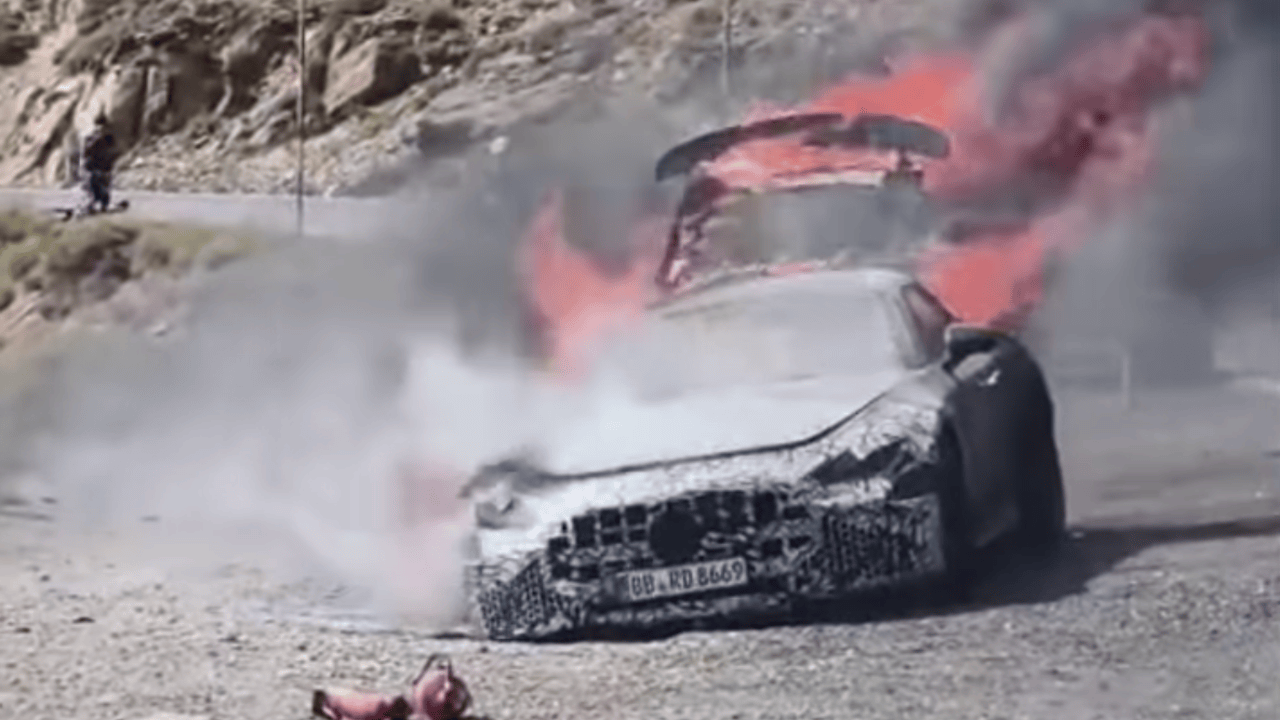
A camouflaged Mercedes-AMG GT prototype has been destroyed by fire during development testing in southern Spain. Video shared on Instagram by kikisnevada_pgarage shows the coupe completely engulfed in flames, with thick smoke rising above the road as the blaze consumes the rear and passenger compartment.
The incident reportedly occurred in the Sierra Nevada mountains, an area frequently used by manufacturers for demanding hot-weather evaluations.
No injuries were reported, and the surrounding landscape appears to have escaped significant damage. Emergency crews eventually attended the scene, although the AMG had already been reduced to a heavily burned shell by the time the fire was brought under control.
The cause remains unknown, and Mercedes-Benz has not publicly explained what triggered the blaze. Claims that the prototype’s hybrid battery was responsible have circulated online, but that theory has not been independently confirmed.
Prototype Was Testing In Southern Spain
View this post on Instagram
Automakers regularly send development vehicles to regions with extreme temperatures to evaluate cooling systems, powertrain durability, cabin climate control, and other components under sustained stress. Mountain roads also allow engineers to combine high ambient temperatures with steep gradients, repeated acceleration, heavy braking, and low-speed operation.
Those conditions can reveal weaknesses that may not appear during laboratory testing or ordinary road use. Although losing a prototype is an expensive setback, identifying serious faults before production is one of the main reasons manufacturers conduct such demanding development programs.
The burned vehicle appears to have been a facelifted version of the current Mercedes-AMG GT Coupe, judging by its familiar proportions and camouflage. Reports suggest the updated model is being prepared for the 2027 model year, although Mercedes-AMG has not publicly detailed the specific prototype involved in the fire.
Fire Reportedly Began Near The Rear
The person who filmed the incident claimed the flames initially appeared toward the rear of the car. That area contains several potential heat sources and mechanical components, depending on the prototype’s exact specification, making it impossible to identify the origin from the video alone.
The original social media account also alleged that onboard fire extinguishers failed to contain the blaze. There has been no official confirmation regarding what suppression equipment was carried or whether engineers attempted to use it before leaving the vehicle.
Modern development cars are often fitted with additional monitoring equipment, temporary wiring, sensors, and prototype hardware that differ considerably from production vehicles. A fire affecting a test mule therefore does not automatically indicate that customer cars have the same defect.
Hybrid Battery Claims Are Unverified
Online discussion quickly focused on the possibility that the destroyed AMG was fitted with an electrified powertrain. Mercedes-AMG already offers E Performance plug-in hybrid technology in parts of its lineup, making speculation about a hybrid test vehicle understandable.
Nothing visible in the footage conclusively identifies the car’s powertrain, however. Mercedes has not confirmed whether the prototype used a conventional V8, a hybrid system, or another experimental configuration.
A battery-related cause should not be treated as established without an investigation or statement from the manufacturer. Fuel, oil, electrical wiring, hot exhaust components, and test instrumentation can all contribute to vehicle fires, especially when a prototype is being pushed through an intensive development cycle.
An Expensive Yet Valuable Development Failure
The prototype appears to be a total loss, taking months of engineering work and specialized equipment with it. Even so, the data gathered before and during the incident could help Mercedes-AMG determine what failed and whether changes are required before the refreshed GT enters production.
The current AMG GT range continues to use Mercedes-AMG’s twin-turbocharged 4.0-liter V8 in several versions, including the GT 63 and track-focused GT 63 Pro. The latter produces 612 horsepower and 627 lb-ft of torque, illustrating the substantial thermal and mechanical demands placed on the platform during performance testing.
For now, the only confirmed outcome is that one development car was destroyed and nobody was hurt. Until Mercedes or investigators release additional information, conclusions about a battery failure, engineering defect, or specific powertrain problem remain speculation.