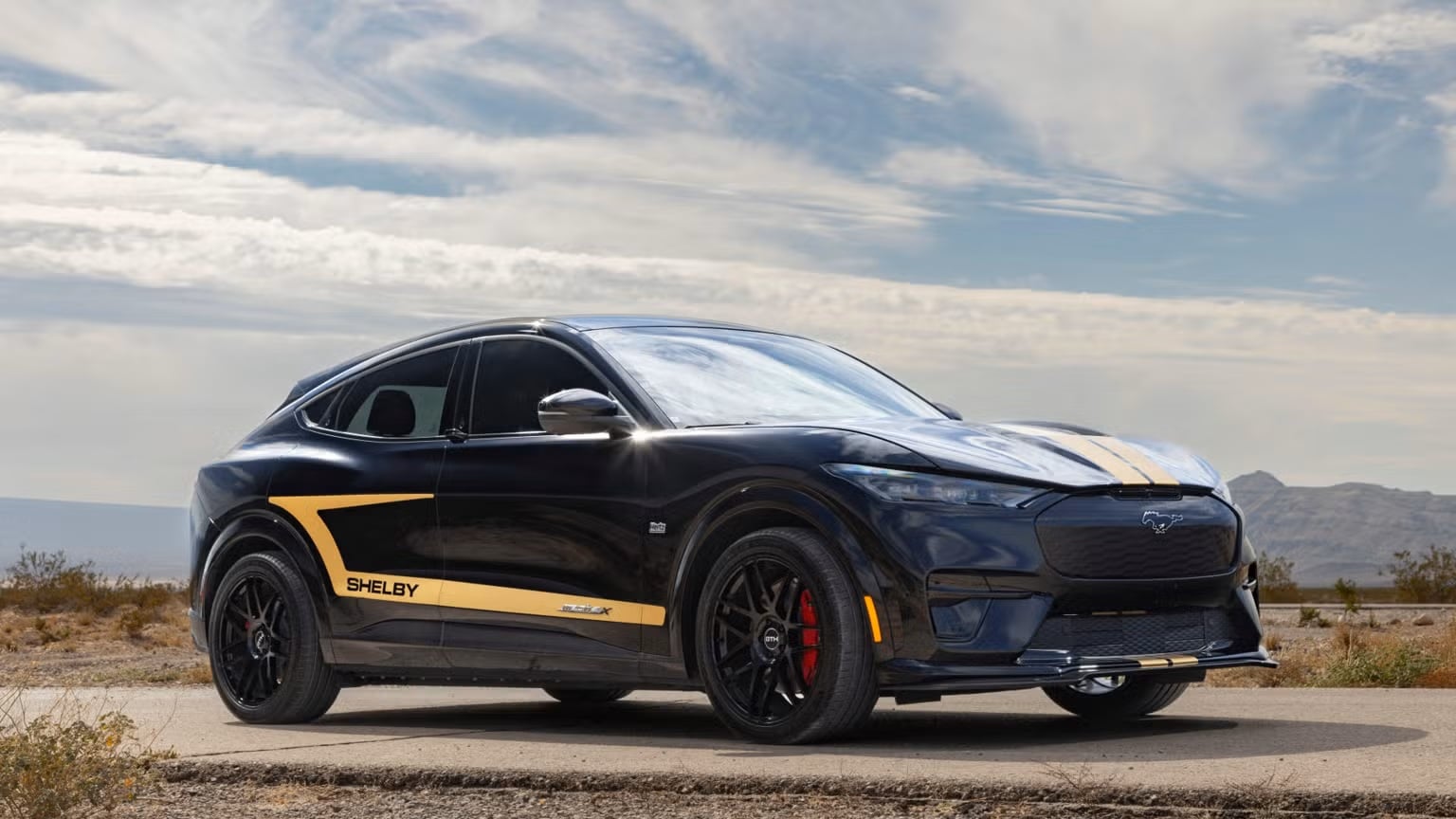
The used car market has seen some wild swings over the past few years, but few stories capture the current state of electric vehicles quite like what’s happening with the Hertz Shelby Mustang Mach-E. These are not your standard rental-fleet castoffs. They came with gold racing stripes, a Borla Active Performance Exhaust Sound System, special black wheels, and all the drama of a Shelby badge on the hood. And yet, according to a report from Carscoops, they are now sitting on Hertz’s used car lot for around $40,000.
That figure might not sound alarming on its own, until you consider that these same vehicles debuted in 2024 at roughly $65,000. By January 2025, they had already slid to around $60,000. Now, just a year and a half after launch, they have shed approximately $25,000 in value. For a special-edition vehicle with fewer than 15,000 miles on most examples, that is a steep fall from grace.
To be fair, these cars were always an interesting gamble. Hertz has historically offered special-edition Mustangs through its “Rent-A-Racer” program, which gives buyers the chance to own a piece of rental history with some extra flair. The idea is fun in theory. In practice, however, launching 100 units of a premium-priced special-edition EV at the exact moment the broader market started pumping the brakes on electric vehicles was not the most fortunate timing.
The broader context matters here. The U.S. EV market hit significant headwinds throughout 2025, and that turbulence has shown no signs of fully clearing. What’s happening with the Hertz Shelby Mach-E is not an isolated quirk. It is one of the clearest, most quantifiable examples of how that market slowdown is playing out in real dollar terms on real vehicles sitting on real lots.
What You Actually Get for $40,000
Before writing these off as overpriced leftovers, it’s worth being clear about what the Shelby Mustang Mach-E actually brings to the table. The cosmetic package is genuinely distinctive: gold stripes, a Borla exhaust sound system (which, for an EV, is quite a flex), and exclusive black wheel styling that sets it apart from a standard Mach-E GT.
Under the skin, the performance specs are solid but not superhero-level. These are based on the Ford Mustang Mach-E GT, which means all-wheel drive, 480 horsepower, 600 lb-ft of torque, and an EPA-estimated range of 280 miles. One important note: the Shelby branding does not come with an actual performance upgrade. The power figures are the same as any standard Mach-E GT. The Shelby treatment is largely aesthetic, which is either a dealbreaker or totally fine depending on what you’re after.
For context, a brand-new Ford Mustang Mach-E GT from a dealership starts at just over $50,000. That means the Hertz examples, with their exclusive styling touches and up to 15,000 miles of rental use, are now priced roughly $10,000 below new. Ford also offers a rally-inspired Mach-E variant for around $4,000 more than the standard GT, giving buyers a lot of options in the same general price neighborhood.
The EV Market Slowdown Is Real, and This Is What It Looks Like
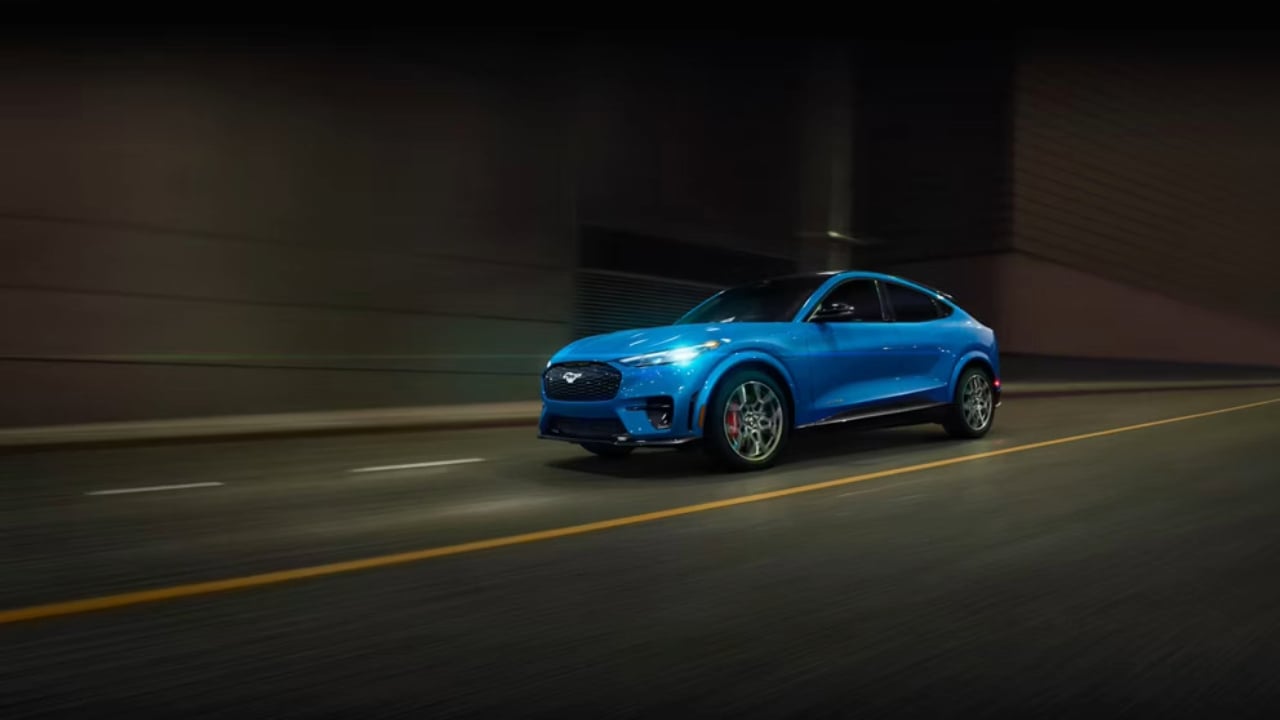
For anyone who has been following the EV space, the numbers surrounding these Mach-Es are not entirely surprising. The broader U.S. electric vehicle market ran into serious resistance throughout 2025, and the ripple effects have touched nearly every corner of the industry.
Even Ford itself has had to recalibrate. The F-150 Lightning, once positioned as the flagship of Ford’s EV push, has been repositioned toward a range-extended electric version. And in an interesting twist, the gas-powered Mustang has started clawing back momentum against the Mach-E this year, reversing a two-year trend where the electric version was actually outselling the traditional pony car in the U.S.
Policy has not helped either. The current administration has shown little enthusiasm for supporting EV adoption through incentives or federal backing, including rolling back emissions standards that had previously pushed automakers toward electrification. Without that tailwind, the math on premium EV pricing gets harder to justify for a lot of buyers.
The Hertz Mach-Es are sitting at the intersection of all of these forces: a softening market, reduced consumer urgency around EVs, and the added complication of rental-car provenance, which always gives some buyers pause regardless of how low the mileage is.
What This Situation Teaches Us About Specialty EVs and Market Timing
There is a broader lesson buried in these depreciation numbers, and it applies beyond just Hertz and Ford. Specialty and limited-edition vehicles, especially in emerging categories like EVs, are extraordinarily sensitive to market timing. When the Hertz Shelby Mach-Es launched in 2024, EVs still carried a certain novelty premium. Buyers were willing to pay up for the technology and the cachet. That sentiment has cooled considerably.
The rental-car-to-resale pipeline also carries unique risks with EVs that do not apply quite the same way to gas vehicles. Battery health, charging habits, and the general wear patterns of a fleet vehicle add layers of uncertainty that private buyers have to weigh carefully. That uncertainty gets priced in, and it shows.
For manufacturers and auction houses considering similar plays in the future, the Hertz Shelby experiment is a useful data point. Specialty editions need a market willing to pay for them, and right now, EV buyers are being selective. The days of slapping a premium badge on an electric vehicle and expecting the price to hold are, at least for the moment, behind us.
What Comes Next for These Cars
If the current market trajectory holds, it would not be surprising to see these vehicles drop further before they find their floor. The forces working against them, from softening EV demand to federal policy shifts, are not short-term disruptions. They reflect a genuine recalibration of where the market thinks EVs should be priced right now.
That said, for the right buyer, a sub-$40,000 Shelby-badged Mustang Mach-E with under 15,000 miles and a genuinely unique cosmetic package is not obviously a bad deal. It is a very specific kind of car for a very specific kind of buyer, and one who probably already knows exactly what they want. The question is whether enough of those buyers exist at scale or whether these vehicles continue their slow drift downward. Given everything happening in the EV market right now, the smart money is probably not betting on a price recovery anytime soon.