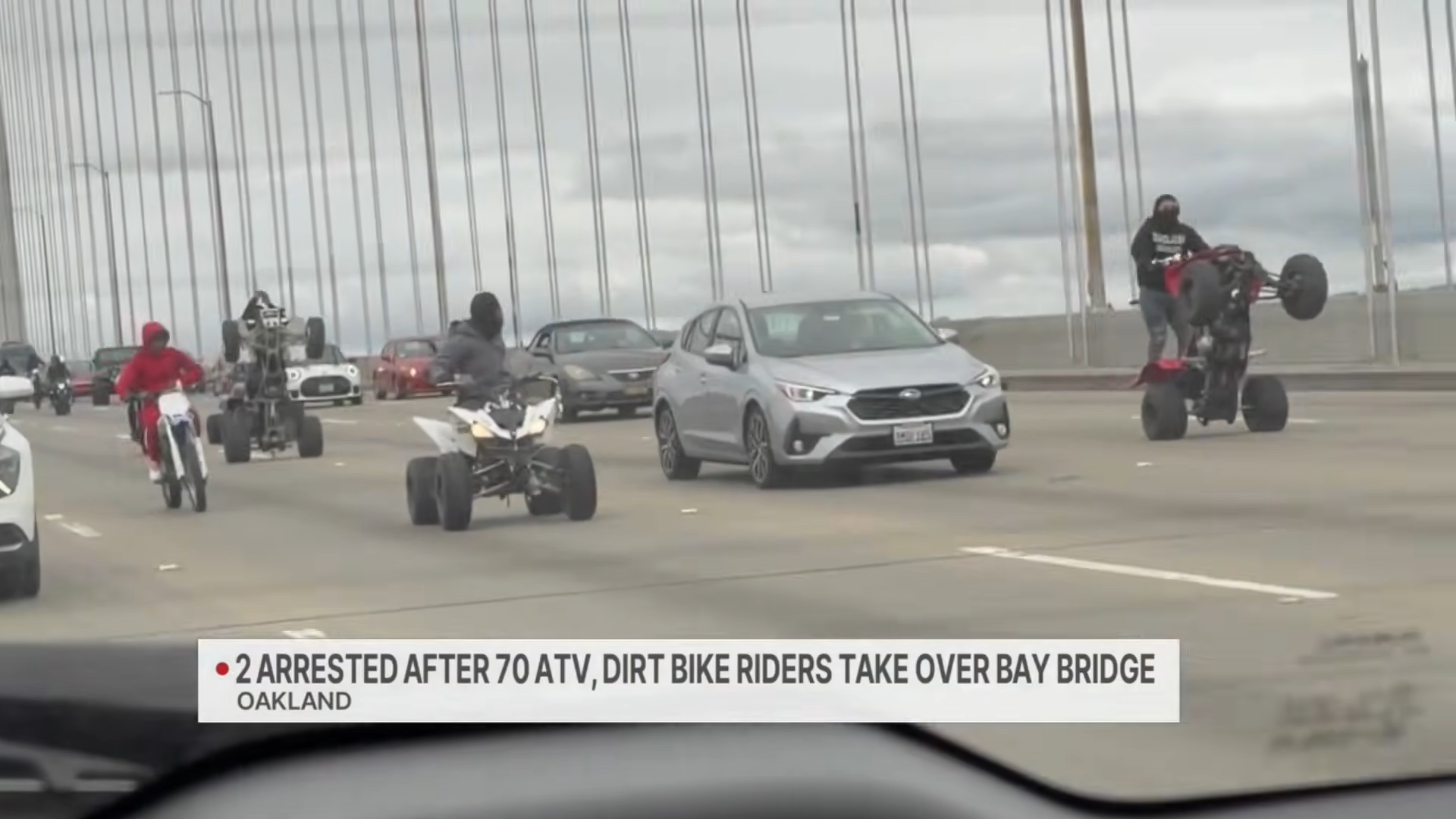
The Bay Bridge is many things to many people: a commuter lifeline, an engineering landmark, a backdrop for Instagram shots at golden hour. What it is not, or at least what it is not supposed to be, is a makeshift off-road course for a fleet of ATVs and dirt bikes. Somebody forgot to send that memo on Sunday evening.
California Highway Patrol Public Information Officer Mark Andrews confirmed that a large group of riders stormed the bridge in the early evening hours, creating chaos across multiple lanes and backing up traffic in both directions. What started as a moving party of roughly 50 to 60 riders was later revised upward by the Oakland Police Department to approximately 70 suspects. When that many people show up uninvited to a bridge, you tend to take a second count.
The riders came in from Oakland, crossed into San Francisco, and then hung around the city for somewhere between 45 minutes and an hour before deciding the fun wasn’t over and heading back across the bridge toward Oakland. At that point, CHP shut down eastbound lanes 3, 4, and 5 to stop the group in their tracks. It worked, more or less. The riders abandoned their vehicles and scattered on foot.
Nine people have since been arrested by the Oakland Police Department as of Monday afternoon, and the confiscated ATVs and dirt bikes were loaded onto a Caltrans tow truck. Somewhere out there, 60-plus people are having a very uncomfortable Monday knowing their rides are gone and investigators are still working the case.
How the Takeover Unfolded
The incident followed a pattern that Bay Area residents will find grimly familiar. A large group assembled, moved as a pack, and used sheer numbers to overwhelm normal traffic flow. The bridge, which typically handles tens of thousands of vehicles per day, became a temporary playground for riders who had no business being there in the first place.
CHP, San Francisco Police Department, and the Oakland Police Department all responded. The coordinated multi-agency effort managed to stop traffic on the bridge, force the group to ditch their vehicles, and make two immediate arrests on the scene. The additional seven arrests came later, bringing the total to nine as of the following afternoon. Lanes reopened around 7:15 p.m., giving commuters their bridge back.
What a Multi-Agency Response Actually Looks Like
Incidents like this don’t get handled by one department clicking their heels together. The Sunday response involved CHP managing bridge traffic and coordinating closures, SFPD handling the San Francisco portion of the route, and OPD making the actual arrests once riders abandoned their bikes near the Oakland side.
That kind of coordination sounds smooth on paper and is significantly messier in real time, especially when you are dealing with 70 moving targets who have already proven they are not interested in following traffic laws. The fact that any arrests happened the same night speaks to how quickly the agencies were able to communicate and deploy.
What This Incident Tells Us About Urban Sideshows
Sideshow culture has deep roots in the Bay Area, and that context matters if you want to understand why incidents like this keep happening. What started as an Oakland phenomenon decades ago has expanded far beyond its origins, now surfacing on highways, bridges, and public streets across the region. The Bay Bridge takeover is not an anomaly. It is a symptom.
The challenge for law enforcement is that large groups are inherently harder to stop than individual riders. You cannot pull over 70 vehicles all at once, and attempting to do so in a high-speed environment creates its own safety risks. The strategy of shutting down lanes and forcing a confrontation is really the most practical option available, and even then, most of the group got away on foot.
The vehicles being confiscated is a meaningful consequence, though. Losing an ATV or a dirt bike is a real financial hit, and it removes the tool being used to cause the disruption. Whether that proves to be enough of a deterrent remains to be seen. Sunday evening’s chaos was a reminder that the problem is not going away quietly, and the Bay Bridge is apparently no longer off the table as a venue.