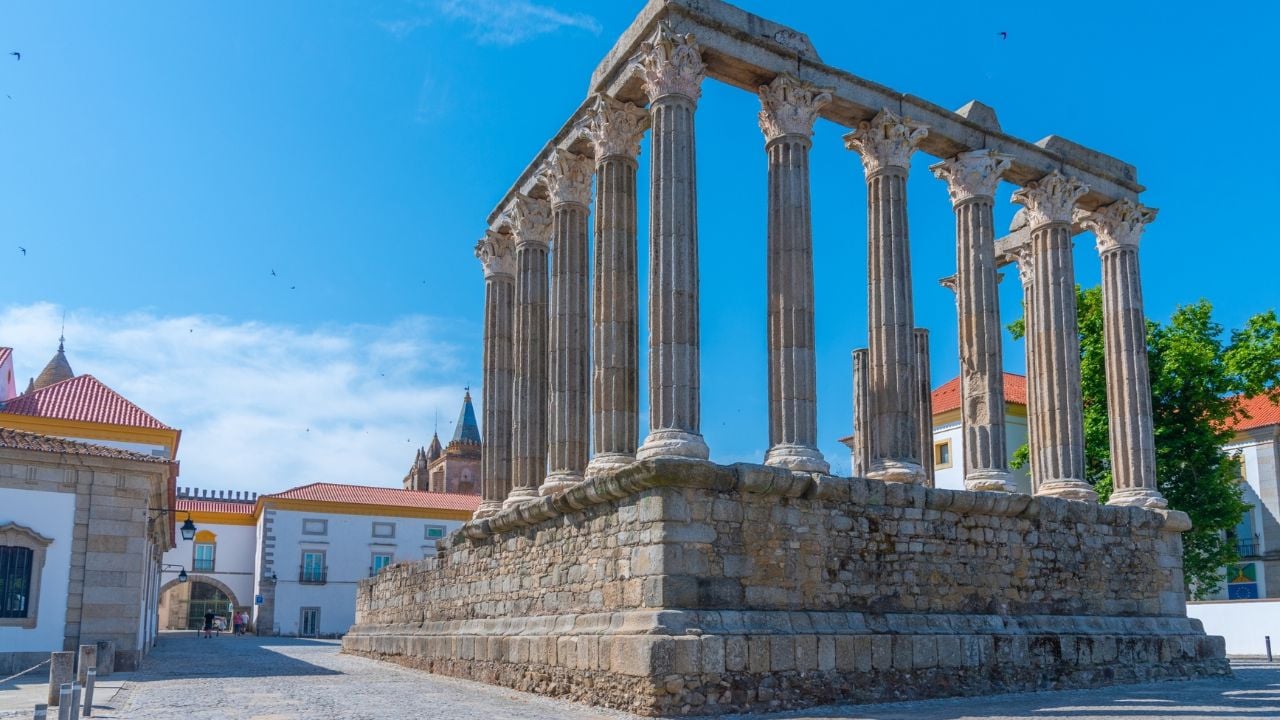
Many Portugal itineraries stop at Lisbon, Porto, Sintra, and the Algarve. That route is easy to understand, but it leaves out smaller cities where history is still part of the street: Roman columns beside whitewashed houses, granite squares filled with café tables, university stairways above a river, and fortress walls facing the Spanish border.
This is the Portugal travelers miss when they stay only on the obvious route. In Évora, the Alentejo sun hits white walls and Roman stone. In Guimarães, the old center tightens around granite squares tied to the country’s beginnings. Coimbra climbs from the Mondego River toward university courtyards and baroque library rooms. Braga keeps cathedral doors, tiled streets, pastry shops, and hilltop devotion in the same trip. Tomar has a Templar complex above a river town, while Elvas turns border pressure into walls, gates, forts, and a long aqueduct.
Some of these cities can be visited in a day, but most feel better with a night. After tour buses leave, shutters close, restaurant lights come on, and the sound in the squares changes from sightseeing traffic to dinner plates, local voices, and footsteps crossing stone.
Travelers who want history without spending every hour inside museums will find it in the open here. A worn stair edge, a shaded arcade, a chapel doorway, a tiled wall, a riverbank, a fortress gate, or a cathedral tower over pale roofs can say more than another crowded landmark stop.
1. Évora
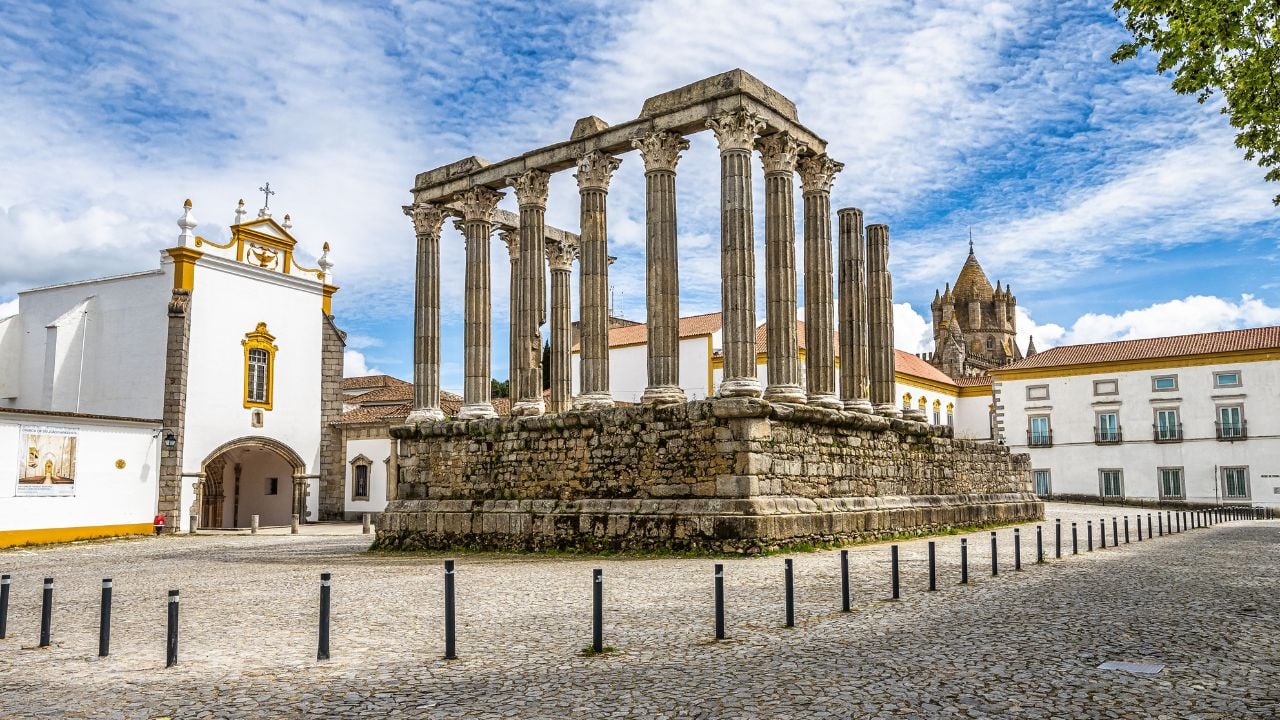
Évora starts with a strong physical contrast: bright white streets, pale stone, hard Alentejo light, and Roman columns standing above the old center. The temple is not hidden away behind a museum entrance. It sits near churches, university buildings, old walls, and lanes where the sun bounces off limewashed façades.
UNESCO describes Évora’s historic center as a “museum-city” with roots going back to Roman times and says it reached a golden age in the 15th century when it became a residence of Portuguese kings. Visit Portugal points visitors toward the Roman temple and the cathedral, noting that Évora’s cathedral is the largest medieval cathedral in Portugal.
Praça do Giraldo gives the city an open starting point. Arcades run along the square, café tables sit on stone paving, and the façades can look almost bleached in strong afternoon light. Step away from the square and the streets narrow quickly. A balcony casts a thin shadow on a white wall, blue-and-white azulejo details appear beside ochre trim, and doorways offer brief relief from the heat.
Inside the Chapel of Bones, walls and columns are lined with human bones and skulls. The room is dim and enclosed after the glare outside, with the remains arranged into the architecture rather than placed behind a display case. The shift from white streets and café noise to bones, skulls, and low interior light is blunt and uncomfortable.
After São Francisco, the cathedral area brings the walk back into open air. Heavy stone, towers, rooflines, and views across the old center make Évora feel larger than its compact street plan. A day trip from Lisbon can cover the highlights, but staying overnight gives the Roman temple and surrounding lanes a quieter evening, when dinner tables open and the old center no longer feels like a timed circuit.
2. Guimarães
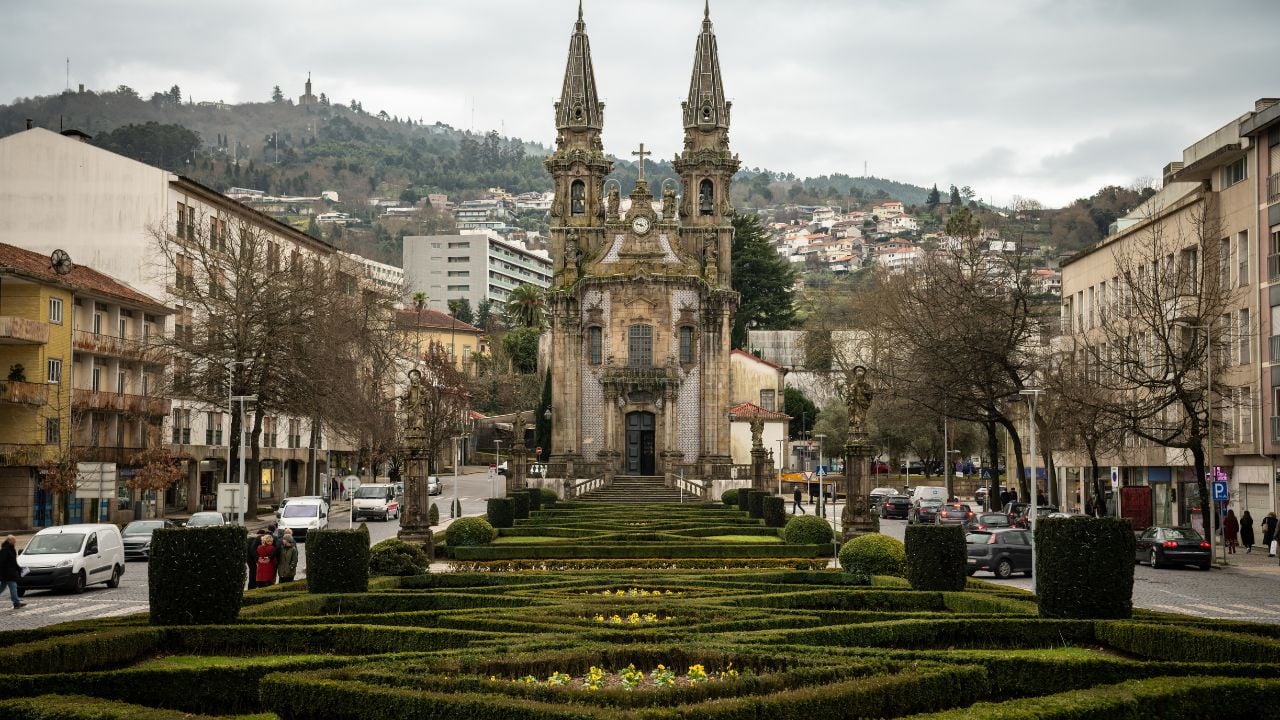
Guimarães places Portugal’s national story inside a compact old center of granite, arcades, timbered balconies, and uneven stone paving. The streets feel enclosed because buildings hold the squares tightly, and that closeness gives the center a strong medieval texture before the castle even enters the day.
UNESCO links the historic town to the emergence of Portuguese national identity in the 12th century and describes it as an exceptionally well-preserved example of a medieval settlement evolving into a modern town. Visit Portugal points visitors from the historic center toward the Palace of the Dukes of Bragança and the castle above town.
In Largo da Oliveira, stone arcades hold pockets of shade and café tables spread across the paving. Praça de São Tiago feels looser and more social, with people crossing between terraces, doorways, and narrow streets. Plates arrive at tables, footsteps echo under arches, and the old façades stay close enough to make the squares feel sheltered without turning them into a set piece.
The route toward the Palace and castle leaves those intimate spaces for grass, heavier walls, and more formal stone. The Palace of the Dukes brings broad medieval mass and ceremonial rooms; the castle adds rougher defensive lines above the town. Guimarães pairs easily with Porto, but a rushed stop misses the way the center and castle hill work together: café squares below, national-origin stone above.
3. Coimbra
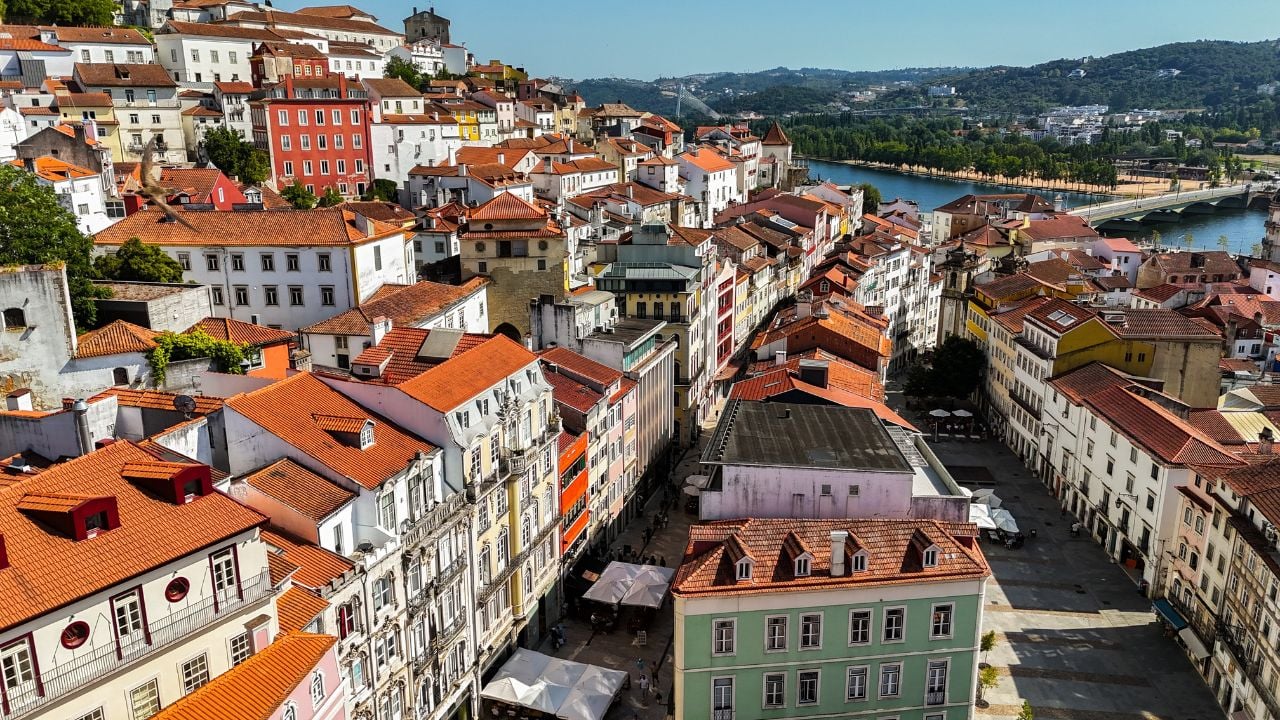
Coimbra begins low by the Mondego River and climbs into its history. The lower streets have cafés, shopfronts, traffic, and river light; above them, stairways and narrow lanes pull the walk toward the university. The city is physical before it is academic: legs feel the slope before the visitor reaches the courtyards.
UNESCO says the University of Coimbra, Alta and Sofia has grown over more than seven centuries into a defined urban area within the old town. Visit Portugal notes that the university was founded in 1290 and is one of the oldest in Europe.
The climb from the lower town to the university gives the visit its sequence. At the bottom, people move between shops, cafés, and crossings near the river. Higher up, the streets tighten, stone steps interrupt the route, and views back toward the Mondego open between walls and rooftops. By the time the university buildings appear, the city below has dropped into layers of red roofs and pale façades.
The Library adds a very different interior. Visit Portugal describes the Biblioteca Joanina as one of Europe’s richest Baroque libraries, built between 1717 and 1728, with gold decoration on green, red, and black backgrounds. Inside, dark shelving, gilded carving, painted surfaces, and controlled light replace the glare and movement of the climb outside.
Coimbra fits naturally between Lisbon and Porto, but the city deserves more than a train-platform pause. A night below the hill gives time for dinner, a walk near the Mondego, and the sound of students moving through the streets after the official visiting hours have ended.
4. Braga
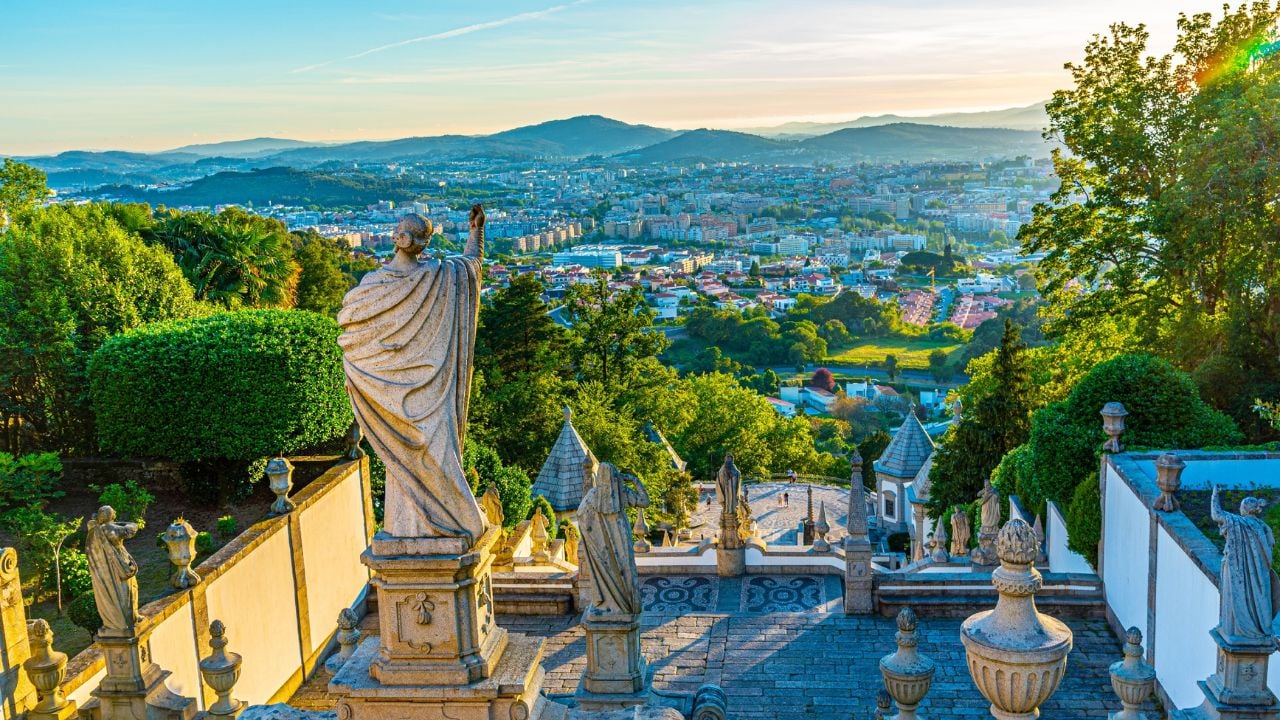
Braga’s center mixes religious weight with ordinary northern city life. Church doors open near shopfronts, blue-and-white tiles brighten corners, café terraces sit close to carved portals, and bells share the street with traffic, pastry counters, and people moving between errands.
Sé de Braga is the older anchor in the center. Visit Portugal describes it as the first Portuguese cathedral, built before the founding of the country, with construction beginning at the end of the 11th century. Its stone portals, chapels, tombs, and heavy doors give the old core a deeper register than the shopping streets alone suggest.
A walk around the cathedral keeps folding sacred detail into everyday movement. One street may carry a row of shops, then a church façade appears between them. A tiled building catches light across from a café. A carved doorway sits close enough to a pastry counter that the city feels lived in rather than staged around monuments.
At Bom Jesus do Monte, the setting shifts to Mount Espinho. UNESCO describes the sanctuary as a cultural landscape developed over more than 600 years, mainly in Baroque style. The approach is built from stone stairways, chapels, fountains, landings, and a pale church at the top. Water runs through the stairway design, the steps rise in measured sections, and Braga opens below through trees and terraces.
Braga is stronger when the center and Bom Jesus are seen together. In town, cathedral stone sits among shops, traffic, tiled corners, and café noise. On the hill, the same city appears below a religious landscape built around ascent, symmetry, fountains, and ritual.
5. Tomar
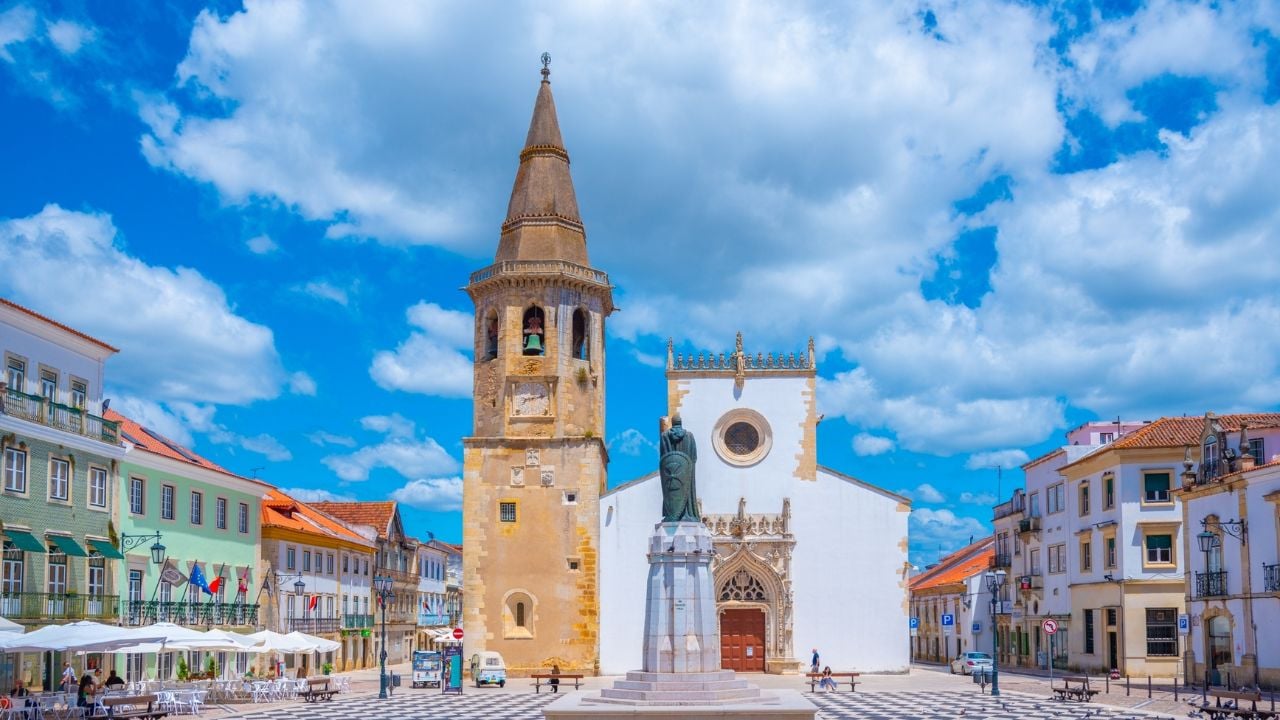
Tomar starts as a small river town before the Templar story takes over. Praça da República sits at the center with the Church of São João Baptista, pale stone, tiled paving, café tables, and narrow streets leading toward bakeries, shaded corners, and the Nabão River.
UNESCO says the Convent of Christ dominates Tomar’s cityscape from a hill, belonged to the Order of the Templars, and was founded in 1160 by Gualdim Pais. Visit Portugal describes Praça da República as the center of the old medieval urban area and notes the castle hill and Convent of Christ to the west.
At street level, Tomar has river light, bakery windows, café tables, and the Nabão moving below the old center. Above the roofs, the convent and castle walls pull the eye uphill. Inside the complex, the visit turns into cloisters, heavy portals, the round Charola, and Manueline stone tied to the Templars and the Order of Christ.
Visit Portugal points to the Charola, the Renaissance portal, the Manueline Window in the Chapter Hall, and the Main Cloister. The Charola gives the Templar story its round, church-like core. The Manueline window turns stone into ropes, vegetal forms, and royal symbolism. The cloisters move more quietly, with columns, shadows, and enclosed architectural space after the heavier fortress approach.
Tomar fits well into a central Portugal route with Coimbra, Batalha, Alcobaça, or Lisbon. The visit works best when the town and the monument stay connected: cross toward the Nabão, return through Praça da República, then climb or descend with the convent still visible above the roofs.
6. Elvas
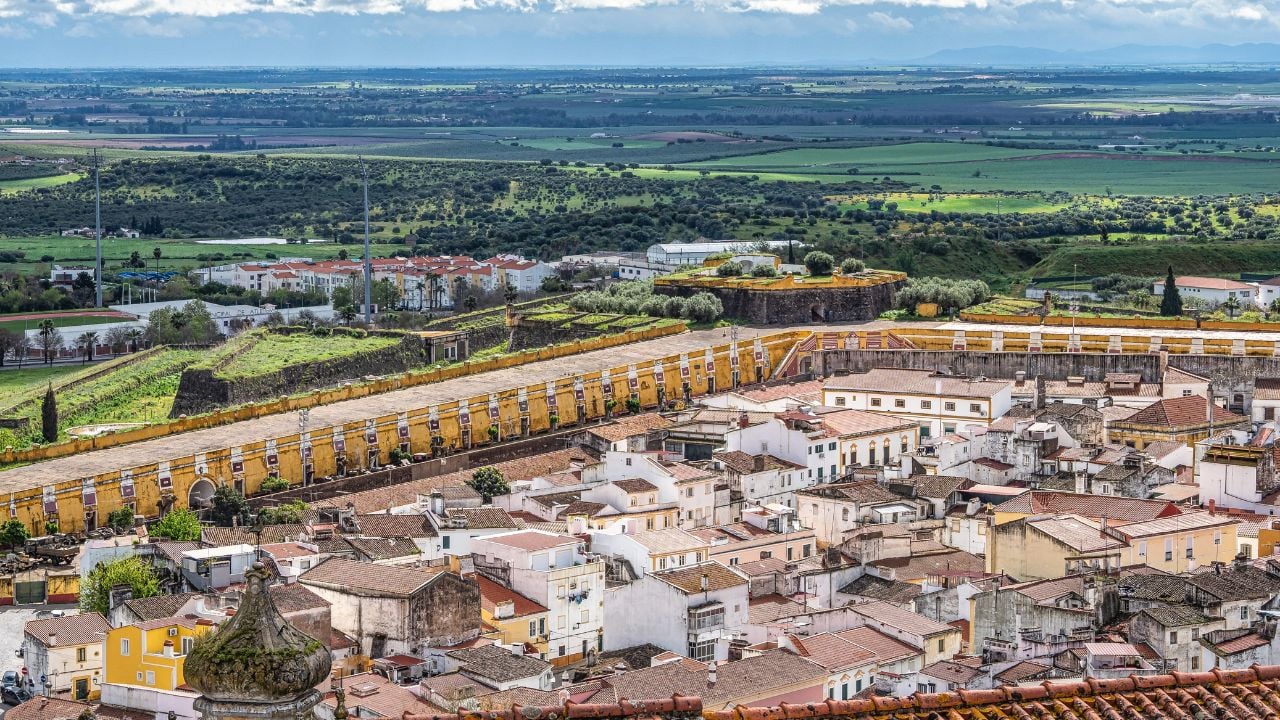
Elvas sits close to the Spanish border, and the city still reads like a fortified frontier town. Walls wrap the old center, gates control the approaches, and the open land around the town makes the defensive purpose visible before any museum explanation is needed.
UNESCO describes the Garrison Border Town of Elvas as guarding the key crossing between Lisbon and Madrid and says it was fortified from the 17th to the 19th centuries into the largest bulwarked dry-ditch system in the world. Visit Portugal says the Amoreira Aqueduct stretches for 7 kilometers and has 843 arches.
The Amoreira Aqueduct rises outside the center in long rows of pale arches. Under strong Alentejo light, it looks dry, severe, and practical rather than decorative. It carried water into a fortified city, and that function is still easy to read from the road before the visitor reaches the streets inside the walls.
Inside the fortifications, Elvas tightens into whitewashed houses, cobblestone lanes, old gates, small plazas, and military buildings. The entrances feel controlled rather than ornamental. The streets do not have the softness of a riverside town or the polish of a royal square; they feel built for heat, distance, and defense.
From the walls or nearby forts, the view stretches across dry land, low hills, roads, and border country. Elvas is easier with a car and fits best into an Alentejo route, but the detour gives travelers a side of Portugal that Lisbon-Porto itineraries usually miss: a city shaped by water supply, artillery lines, border pressure, and the need to watch the horizon.