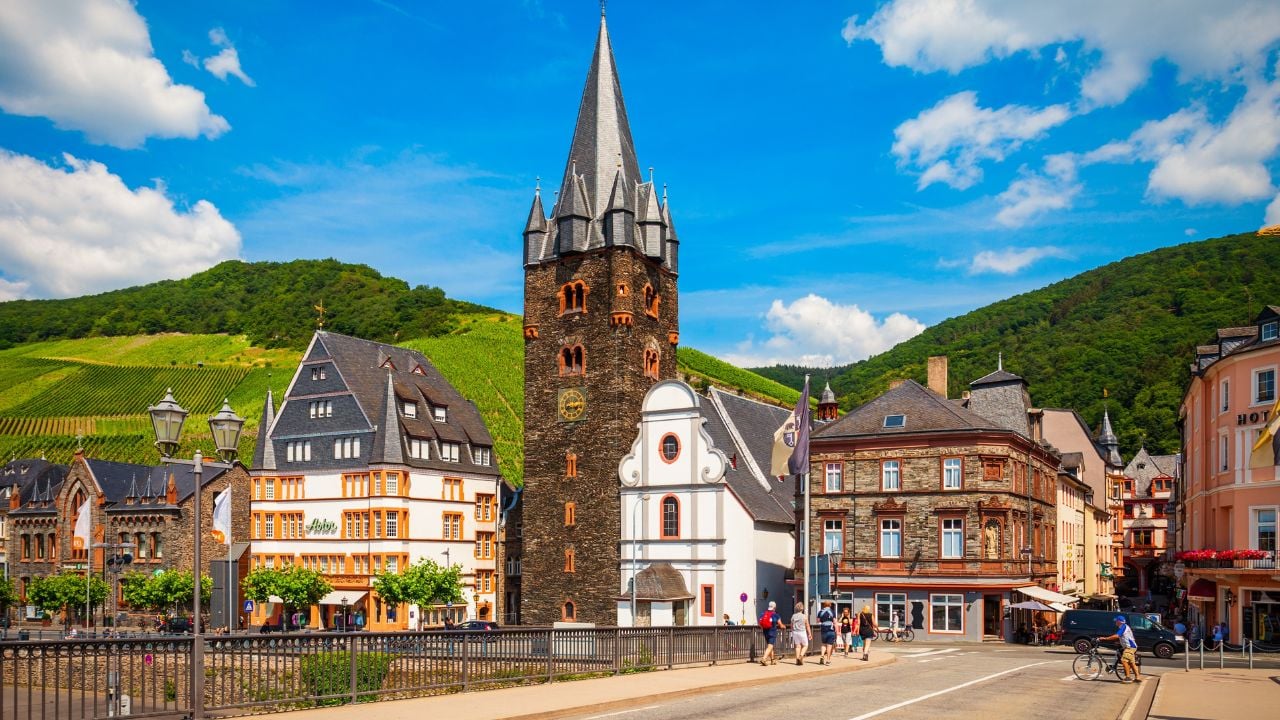
Germany’s smaller river towns can look unreal before the first coffee order. A castle rises above the Moselle, vineyard rows cut across steep hillsides, half-timbered houses lean over market squares, and boats pass below terraces where lunch can stretch into the afternoon.
In Cochem, pastel houses sit below Reichsburg Cochem and the Moselle runs along the promenade. In Bacharach, slate roofs, old walls, church towers, and Stahleck Castle rise between the Rhine and the vineyard slopes. Miltenberg keeps its timber-framed old town close to the Main. Bernkastel-Kues gathers crooked façades, wine taverns, and narrow lanes near the Moselle. Tübingen lines the Neckar with colorful houses, punts, students, trees, and the yellow Hölderlin Tower.
A fast photo stop catches the obvious view. A slower walk catches the details that make the place look real again: damp cobblestones after rain, shutters open above bakeries, wine glasses on outdoor tables, boats passing under a bridge, and river light shifting across old walls near evening.
These towns are useful for travelers who want Germany beyond Berlin, Munich, and big museum days. They are small enough to explore on foot, scenic enough for a full afternoon, and compact enough that the riverbank, bridge, castle path, market square, and vineyard slope can fit into the same unhurried visit.
1. Cochem, Moselle River
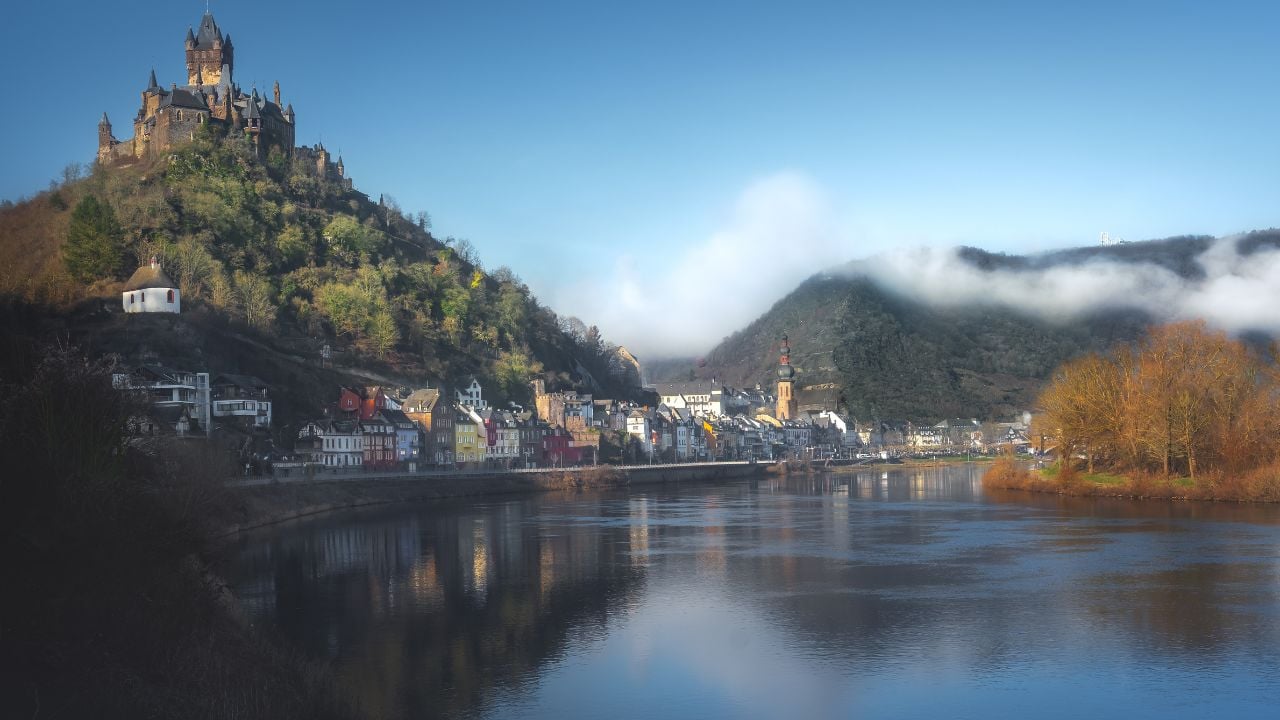
Reichsburg Cochem rises above the Moselle on a steep crag, with pointed roofs, towers, battlements, and vineyard slopes below it. From the riverfront, the view breaks into clear layers: excursion boats along the water, pastel buildings behind the promenade, vine rows climbing the hillside, and the castle above the roofs.
Germany’s national tourism site describes Cochem as a small but much-visited Moselle destination with a castle above the old town. The official Reichsburg site says the castle soars over Cochem on a mighty crag and notes its delicate bays and imposing battlements.
Along the Moselle, terraces face the water and boats line the embankment. The castle remains visible above the roofs even when the streets narrow behind the promenade. In bright weather, light reflects from the river toward the façades; under cloud, the vineyards and castle walls look darker and more severe.
From the castle approach, the Moselle curves below, vineyard rows cut across the hillsides, and Cochem’s roofs gather tightly beside the water. Back in the old center, narrow lanes lead past wine taverns, shopfronts, and tables set close enough to the river for boats to remain visible during lunch.
2. Bacharach, Rhine River

Bacharach sits between the Rhine and the vineyard slopes behind town. Slate roofs stack below church towers, old walls climb the hillside, and Stahleck Castle stands above the lanes. At street level, side alleys open toward the wide Rhine, where boats pass below the hills.
The regional tourism page for Bacharach points to its medieval architecture, half-timbered houses, narrow streets, fortifications, St. Peter’s Church, and Stahleck Castle. It also notes that Stahleck Castle is a 12th-century castle perched high above town, now used as a youth hostel with views of the Rhine.
The lower lanes are close and shaded. Timber-framed buildings crowd the streets, signs hang over doorways, and old stone underfoot keeps the town from looking too polished. The Rhine appears at the end of side streets as a broad gray-blue strip, with barges, tour boats, and vineyard hills beyond it.
Above town, rooftops, church towers, old wall lines, vines, and the river sit in one frame. Walk through the lanes, climb toward the fortifications, then return to the river near evening, when the hills darken first and the water keeps the last light longer than the streets.
3. Miltenberg, Main River
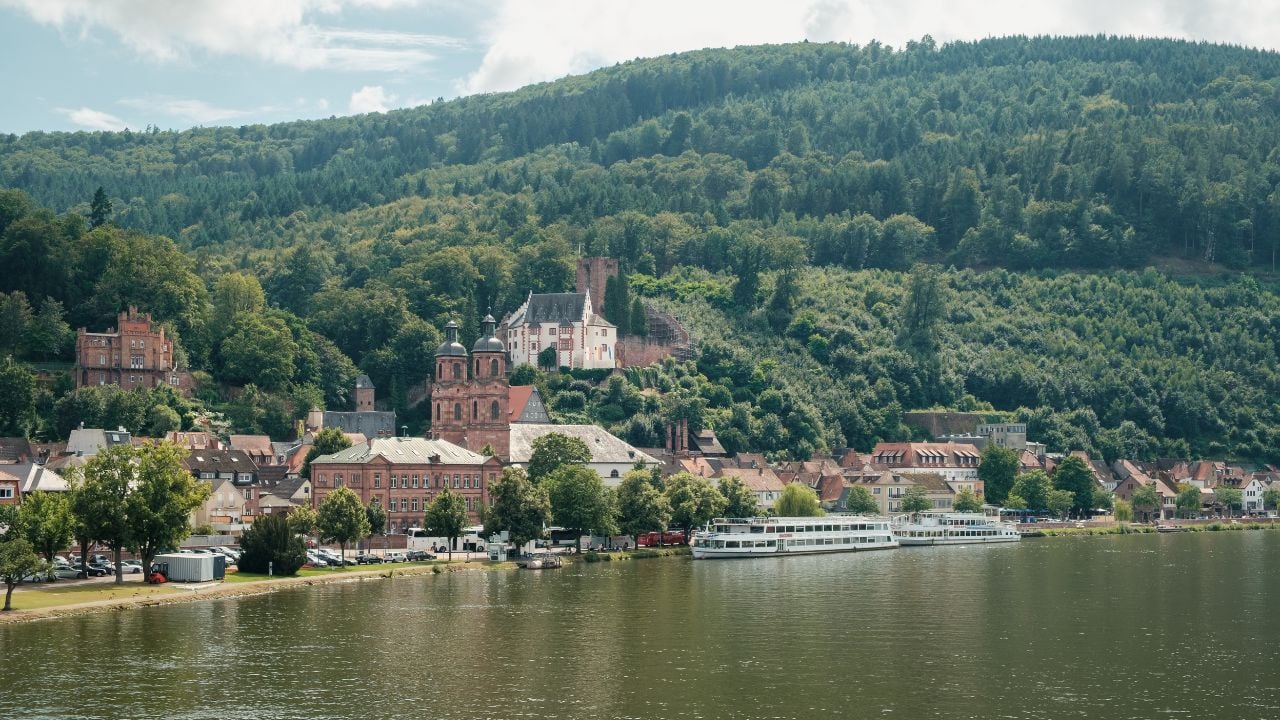
Miltenberg sits on the Main with wooded hills behind it and half-timbered streets close to the water. The old town is narrow, warm-toned, and built for walking, with upper floors leaning slightly over lanes that still feel scaled to footsteps rather than cars.
The official Miltenberg tourism site describes a medieval old city center with half-timbered houses, alleyways, hidden corners, and the famous Schnatterloch market square. It also points to the Gasthaus zum Riesen, described as Germany’s oldest inn for nobility, and names the market square ensemble as one of the most photographed places in Germany.
At Schnatterloch, timber-framed houses crowd around the fountain. Dark beams crisscross above plaster walls, window boxes sit under small panes of glass, painted signs hang from façades, and narrow passages slip away from the square. The upper floors lean at slightly different angles, so the buildings look handmade rather than decorative.
A short walk back toward the Main opens the view to water, bridge lines, low hills, and the wooded edges of the Odenwald and Spessart landscapes. Miltenberg fits travelers who want a quieter river stop with wine, food, market-square architecture, and enough water nearby to keep the old center tied to the valley around it.
4. Bernkastel-Kues, Moselle River

Bernkastel-Kues has the classic Moselle wine-town look in a compact old center. The market square gathers timber-framed buildings with crooked lines, carved details, upper floors that push outward, and lanes that narrow quickly away from the main space. The Moselle runs nearby, with vineyard slopes rising behind the town.
Visit Mosel describes Bernkastel as having a medieval old town, narrow romantic streets, and impressive timber-framed buildings, calling it a natural choice for a romantic holiday on the Moselle. The town’s official tour page also highlights the market square, half-timbered houses, and Graacher Tor.
In the old square, beams bend slightly out of line, windows sit at uneven heights, and carved timber details give each building its own face. Wine taverns and cafés keep the square in daily use, with glasses, menus, and outdoor tables set directly beneath façades that could easily look unreal without people moving through them.
Along the Moselle embankment, lanes open toward boats, water, vineyard slopes, and tables near the river. A relaxed overnight suits the town well: dinner near the Moselle, a walk back through the market square, and the crooked façades looking sharper once the daytime crowd thins.
5. Tübingen, Neckar River

Tübingen’s Neckarfront places color directly above the water. Old houses rise along the riverbank, trees lean over the channel, and punts slide beneath the façades in good weather. People stand near the bank, boats move under the branches, and painted walls reflect unevenly in the current.
Germany’s tourism site describes Tübingen through its famous Neckar waterfront, Hölderlin Tower, steep steps, narrow lanes, pointed gabled houses, pubs, boutiques, and student life. Baden-Württemberg tourism describes the old town as an authentic ensemble where people live, work, research, and celebrate rather than a museum-like setting.
On the Neckarfront, punts pass slowly under trees and colorful houses sit close enough to the water for their reflections to break across the surface. The Tower itself is yellow with a pointed roof, set beside the houses and riverbank in one of the town’s most recognizable views.
Steps climb away from the Neckar into streets with bookshops, cafés, pubs, boutiques, and university life. Students pass shop windows, bikes lean near doorways, and steep lanes funnel people between the market square and the river. Once a year, the race turns the normal slow movement of punts into a crowded Neckar event, with more than forty boats carrying eight people each. On quieter days, the boats move below the houses while people cross the bridge, sit near the bank, and climb back into the old town streets.