
You know that feeling when you spot a classic car at a stoplight and suddenly everyone else disappears? That’s the magic of truly timeless automotive design. These are machines that rewrote the rulebook and continue to influence everything rolling out of design studios today.
I’ve spent countless hours at car shows, poring over auction catalogs, and talking with fellow enthusiasts over the years about what makes certain designs endure while others fade into footnotes. The cars on this list didn’t just look good for their era, they created new languages of style that designers still reference decades later.
Tracing Lines Through Time

Picking these cars wasn’t about personal favorites (though trust me, that was tempting). Each one earned its spot by fundamentally changing how we think about automotive design, inspiring countless derivatives, and maintaining relevance across generations. It’s also, by no means, a complete list, as it would be borderline impossible to include every design, feature, and technological advancement that has influenced cars as we know them.
Whether it’s a silhouette that’s been continuously refined for 60 years or proportions that still make modern supercars look right, these designs have proven their staying power. Even as times and trends change, these car designs endure. And they’ll always evoke emotions within us.
Ford GT40
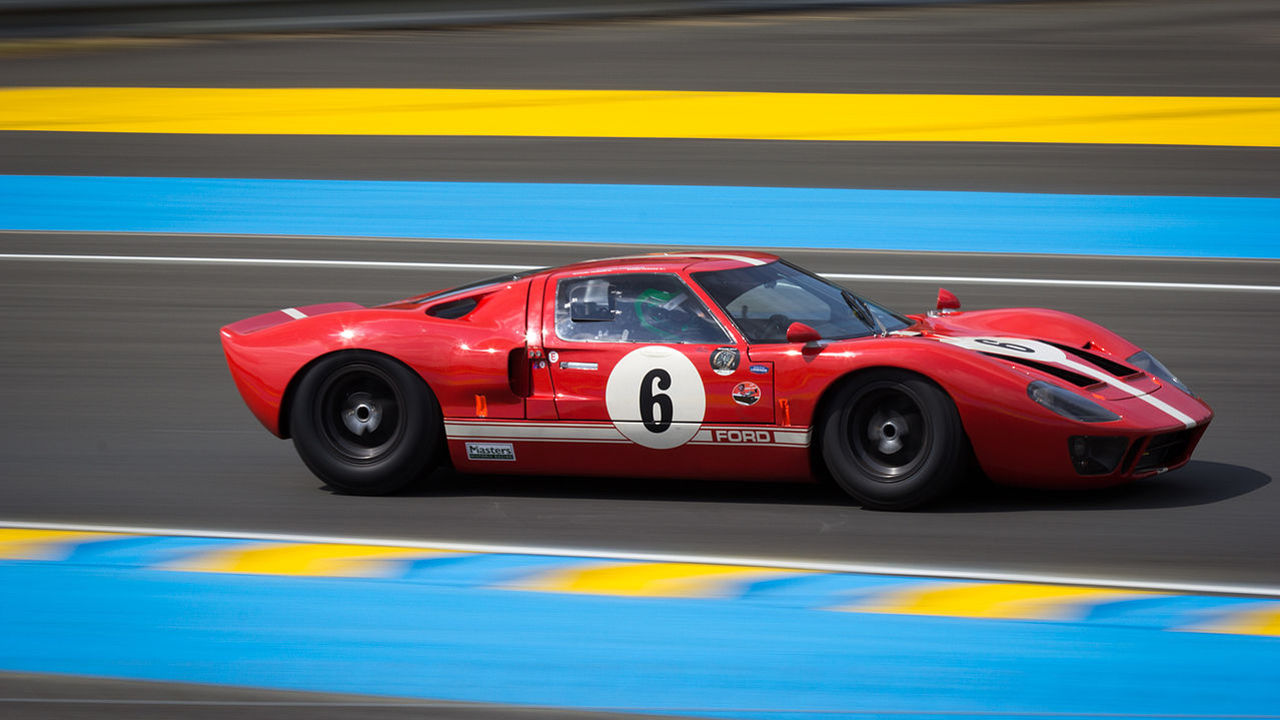
Talk about David versus Goliath. When Henry Ford II got snubbed by Enzo Ferrari in a potential acquisition deal, he didn’t just get mad, he got even. The GT40 program wasn’t just about beating Ferrari at Le Mans; it was about proving American engineering could create something both beautiful and brutally effective.
That impossibly low 40-inch height (hence the name) wasn’t just for show. Every curve was wind-tunnel tested, every vent served a purpose. The long-tail version that dominated Le Mans in 1968-69 pushed aerodynamic thinking forward by decades. When you see modern hypercars like the Ford GT or McLaren F1, you’re looking at the GT40’s design DNA.
The original Gulf-liveried GT40s are among the most valuable American race cars ever sold, with a 1968 GT40 selling for about $11 million at auction. But beyond the money, the GT40 proved that purposeful design creates its own beauty.
Lamborghini Miura

Here’s a fun fact most people don’t know: the Miura almost never happened! Lamborghini’s young engineers, Gian Paolo Dallara, Paolo Stanzani, and Bob Wallace, developed it largely outside official approval, working on it in their spare time. When they revealed their mid-engine prototype at the 1965 Turin Motor Show, Ferruccio Lamborghini was reportedly furious. Good thing he came around.
The Miura’s transverse-mounted V12 behind the driver created proportions nobody had seen before. That distinctive “eyelash” around the pop-up headlights became a Lamborghini signature, and you can still see its influence in today’s Huracán and Aventador. Marcello Gandini’s design at Bertone created the template for every supercar that followed.
Frank Sinatra owned one. The Shah of Iran had several. But the real testament to its design? Lamborghini brought back the Miura name for their stunning 2006 concept car, proving some silhouettes never go out of style.
Aston Martin DB4

If you want to understand British automotive elegance, study the DB4. Designed by Touring of Italy using their lightweight Superleggera construction method, it combined Italian flair with British reserve in ways that still influence luxury car design today.
The DB4 introduced the proportions that define Aston Martin to this day: that long, flowing hood, the distinctive grille, and cabin placement that suggests both power and refinement. When you look at the current DB12 or Vantage, you’re seeing 65 years of evolution from this original masterpiece.
The rare DB4 GT Zagato models, with 19 original examples produced in period, have become some of the most valuable British cars ever made. But even the “regular” DB4 represents something special, a time when manufacturers took genuine pride in creating beautiful objects that happened to be fast cars.
Chevrolet Corvette Stingray

Bill Mitchell knew he was onto something special when he first sketched the second-generation Corvette. Based on his experimental Stingray racer and the Mako Shark concept, the C2 ‘Vette brought European sophistication to American muscle.
That split rear window on the 1963 coupe? Zora Arkus-Duntov hated it, calling it a visibility hazard. Mitchell fought to keep it, and thank goodness he did: it became the most recognizable design element in Corvette history. Chevrolet removed it after just one year, making ’63 split-windows incredibly valuable today.
The Stingray’s influence extends far beyond Corvettes. Those dramatic fender flares, the hidden headlights, and the overall wedge profile became the blueprint for American performance design. Even today’s C8 mid-engine Corvette carries design cues that trace back to Bill Mitchell’s masterpiece.
Ferrari Testarossa

Let’s be honest, you probably had a Testarossa poster on your wall at some point (or, maybe that was just me…). Designed by Pininfarina under design chief Leonardo Fioravanti, the Testarossa became the visual definition of 1980s excess and glamour.
Those side strakes weren’t just for show, they channeled air to the side-mounted radiators, a necessary cooling solution for the flat-12 engine. The wide rear track and dramatic overhang created a stance that screamed performance even at idle. Miami Vice became a cultural icon, thanks to its timeless design.
Here’s something interesting: the Testarossa was actually wider than many modern supercars. At 77.8 inches wide, it was broader than today’s 488 or F8 Tributo. Yet somehow, Pininfarina made those extreme proportions work perfectly. Modern Ferrari design still references its clean surfaces and dramatic air management solutions.
Mercedes-Benz 300SL

The 300SL’s gullwing doors weren’t a styling gimmick, they were brilliant engineering. The space-frame chassis sat so high that conventional doors were impossible. Rudolf Uhlenhaut’s solution became one of the most iconic design elements in automotive history.
This was also the first production car with direct fuel injection, a technology that wouldn’t become common for another 30 years. With the right gearing, the 300SL could reach up to about 160 mph (around 263 km/h), and it was widely regarded as the fastest production car of its time. That combination of beauty, innovation, and performance set the template for every Mercedes flagship since.
Celebrity owners included Gina Lollobrigida, Pablo Picasso, and Formula 1 champion Juan Manuel Fangio. Today, pristine examples sell for well over $1 million, but their real value lies in how they changed perceptions of what a luxury performance car could be.
Ferrari 250 GTO

If you ask any serious car collector what they’d choose if money were no object, most will say Ferrari 250 GTO. It’s not just the $70+ million auction prices: it’s the perfect marriage of racing success and aesthetic brilliance.
Designed by Giotto Bizzarrini and refined by Mauro Forghieri, the GTO combined the best of Ferrari’s racing knowledge with street car elegance. Those purposeful air vents, the distinctive rear spoiler, and the perfectly balanced proportions created something that looked fast even when parked.
The racing record speaks for itself: Ferrari won the over-2000cc class of the FIA International Championship for GT Manufacturers in 1962, 1963, and 1964, with 250 GTOs racing in each season. But beyond the trophies, the 250 GTO established the visual language for every Ferrari grand tourer that followed. You can trace design elements from the GTO through the 275 GTB, Daytona, and even modern cars like the 812 Superfast.
Porsche 911

Ferdinand “Butzi” Porsche created something magical when he penned the 901 (later renamed 911) in the early 1960s. That distinctive silhouette – round headlights, sloping roofline, rear-engine proportions – has remained fundamentally unchanged for over 60 years.
Here’s what’s remarkable: every attempt to replace 911 has failed. The 928 was supposed to be its successor. The Panamera was meant to broaden appeal. Yet the 911 endures because Butzi got the proportions so perfectly right that they’ve transcended trends and generations.
The current 992-generation 911 is faster, safer, and more refined than any 911 before it, yet you can park it next to a 1965 original and immediately see the family resemblance. That’s the power of truly timeless design, it doesn’t need to be reinvented, just continuously perfected.
Jaguar E-Type

When Enzo Ferrari calls your car “the most beautiful car ever made,” you know you’ve created something special. The E-Type’s design came from aerodynamicist Malcolm Sayer, who approached car design like aircraft design, form following function in the most elegant way possible.
That impossibly long hood, the perfect proportions, the way light plays across its curves – the E-Type looked like a sculpture in motion. The lightweight monocoque construction and independent rear suspension made it a genuine sports car, not just a pretty face. At its 1961 launch, it could outrun most Ferraris while costing a fraction of the price.
Modern Jaguars still chase the E-Type’s magic. The F-Type deliberately evoked its proportions, and even the upcoming all-electric replacements reference its design language. Some shapes are so perfect they become eternal.
BMW 507

The 507 nearly bankrupted BMW, but what a way to almost go out. Designed by Count Albrecht Goertz (who later did design work for Nissan, though the 240Z’s design is credited to Nissan’s in-house team), the 507 was BMW’s answer to the Mercedes 300SL. Though it failed commercially, it succeeded artistically in spectacular fashion.
Those flowing lines, the distinctive twin-kidney grille, and perfect roadster proportions created a template BMW still follows today. Every Z4, Z8, and i8 carries some DNA from the 507. Elvis Presley owned one during his Army service in Germany, and his 507 was later famously restored by BMW Classic. Clean 507s today can sell well into seven figures.
The 507’s failure taught BMW valuable lessons about positioning and pricing, lessons that helped them become the luxury performance brand we know today. Sometimes, the most important cars are the ones that don’t succeed commercially but succeed in advancing the art of automotive design.
Memories Written in Steel

Walking through any major auto show today, you’ll spot influences from these cars everywhere. Modern designers don’t copy them directly – they understand the principles that made them special and reinterpret those principles for contemporary needs.
What unites all these cars is honesty. Their beauty comes from purpose, not decoration. Whether it’s the GT40’s aerodynamic efficiency or the E-Type’s perfect proportions, each design solved real problems while creating something emotionally stirring.
These cars remind us that great design isn’t about following trends, it’s about understanding fundamental principles of beauty, proportion, and function. They’ve influenced everything from how we shape headlights to how we position cabins, and their influence will continue as long as people care about how cars look.
The best part? Unlike fashion or architecture, many of these masterpieces are still out there, still running, still turning heads at every stoplight. That’s the ultimate testament to timeless design, it doesn’t just age well, it gets better with time.