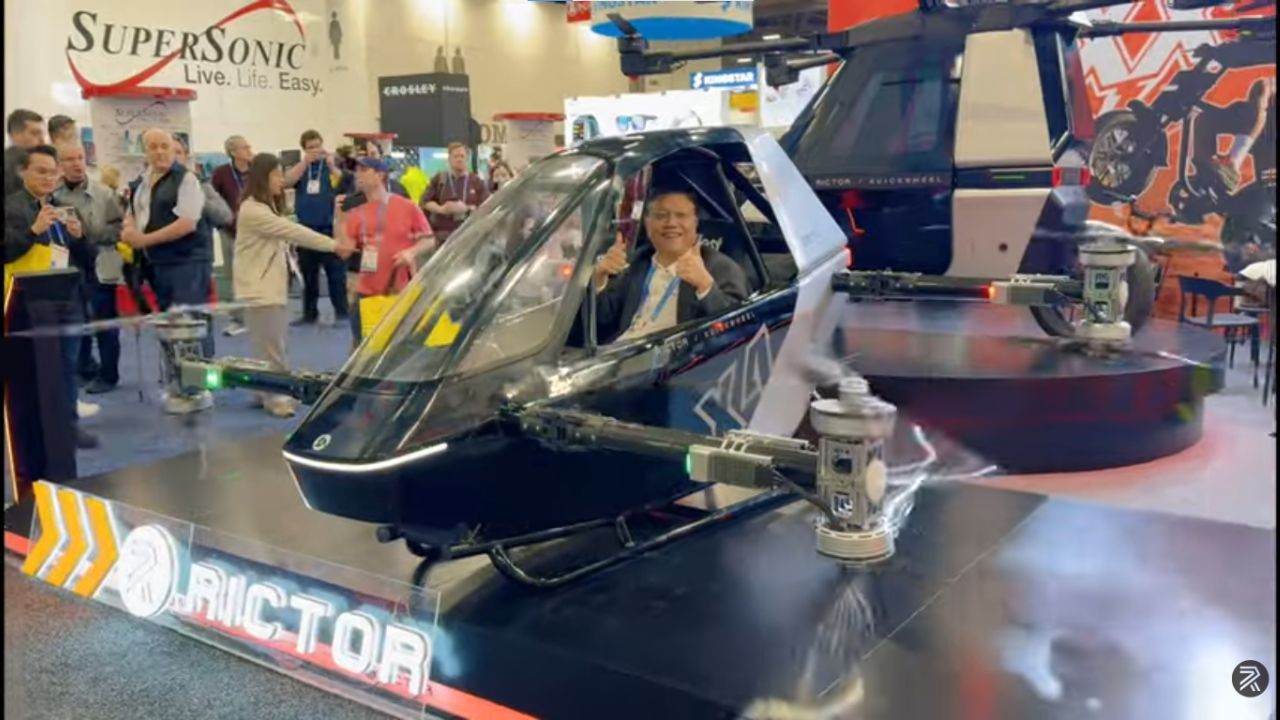

What if your weekend getaway started in a pickup truck bed instead of a congested airport terminal? That’s the pitch behind the Rictor X4, unveiled at CES 2026 in Las Vegas and billed as the world’s most affordable personal electric vertical take-off and landing aircraft (eVTOL).
The company behind it claims a price tag under US$40,000 and no requirement for a pilot’s license. If true, this could be as disruptive to air mobility as the Ford Model T was to road transport.
The X4 Air Mobility Pod has the looks of a chopper-meets-hovercraft: a single-seat ultralight with four arms, each holding two folding carbon-fiber propellers, giving it eight independent lift units.
It runs on a dual battery system with semi-solid-state cells and a proprietary “Dynamic Balance Algorithm” that continuously adjusts motor output to keep it stable even in side winds of up to Level 6. Noise is impressively low, at under 65 decibels: that’s quieter than a typical conversation.
Flying Under FAA Part 103
All of this engineering might make for impressive trade show photos, but the X4’s true ambition is regulatory and cultural disruption. In the U.S., it falls under FAA Part 103 rules for ultralight craft, meaning no pilot’s license, no airworthiness certificate, no medical exam.
These rules are aimed at small aviation devices like hang gliders and motorized ultralights. Rictor says its autonomous flight features, including pre-programmed route capability and very low altitude operation down to three meters, ensure compliance. This is a bold claim that will almost certainly draw scrutiny from regulators and aviation safety experts.
It gets even more interesting. The X4 is not built to compete with commercial air taxis or certified eVTOL aircraft being developed by the likes of Joby, Archer, or Vertical Aerospace. Those companies are navigating years-long certification processes in multiple jurisdictions to carry passengers safely over cities at speeds north of 100 miles per hour.
In contrast, the X4 tops out at about 50 mph and offers roughly 20 minutes of flight per battery charge. In other words, it’s a commuter for short hops, a sort of aerial moped for the skies.
That doesn’t make it frivolous, but it does raise questions about real-world use cases. Where do you safely and legally fly an ultralight eVTOL without designated vertiports or clear airspace rules? FAA Part 103 prohibits flight over congested areas or open assemblies of people.
As one aviation commentator pointed out, “There will be no legal flight right over people’s heads.” They highlighted how current rules aim to keep ultralights well clear of crowds and urban density.
The Untested Sky
Safety is another rub. Rictor’s dual battery redundancy and automatic stability control sound reassuring on paper. If one battery fails, the system is designed to still make a safe landing. There’s also an emergency parachute. But an ultralight in a park or near a suburb still brings the risk of spinning rotors and potential ground impacts.
The trade-off between accessibility and safety will be central to how regulators and the public respond to this impressive novelty. Real-world testing and independent validation will matter more than marketing claims.
The X4 also speaks to a broader market vision. Or perhaps a market experiment. Rictor’s parent company, Kuickwheel Technology, comes from smart ground mobility, exporting e-bikes and scooters into 80 countries.
Its leadership sees “light aerial mobility” as the next frontier: inexpensive, broadly accessible flight for individuals. But there’s a gulf between aesthetic empowerment and operational integration. Urban air mobility startups have been wrestling with infrastructure, public acceptance, air traffic management, and certification for years.
The X4’s approach sidesteps certification by design, which makes it fascinating and potentially controversial.
The Price of Disruption
Economics matter too. At $39,900 with a $5,000 deposit, the X4 undercuts established personal eVTOL concepts like the Jetson One, which was priced around $128,000.
Rictor aims to open up price-conscious market segments that have never dreamed of owning a personal aircraft. That could democratize flight if the vehicle actually delivers on its specifications and if regulatory frameworks evolve to safely accommodate millions of short-range, low-altitude flights.
Ultimately, the X4 is as much a vision piece as it is a product debut. If Rictor delivers even a fraction of what it promises, it could be the first of a new class of personal aerial vehicles. But widespread adoption will hinge on safety data, regulatory evolution, and societal appetite for seeing more than scooters and drones in the low sky.
Sources: New Atlas