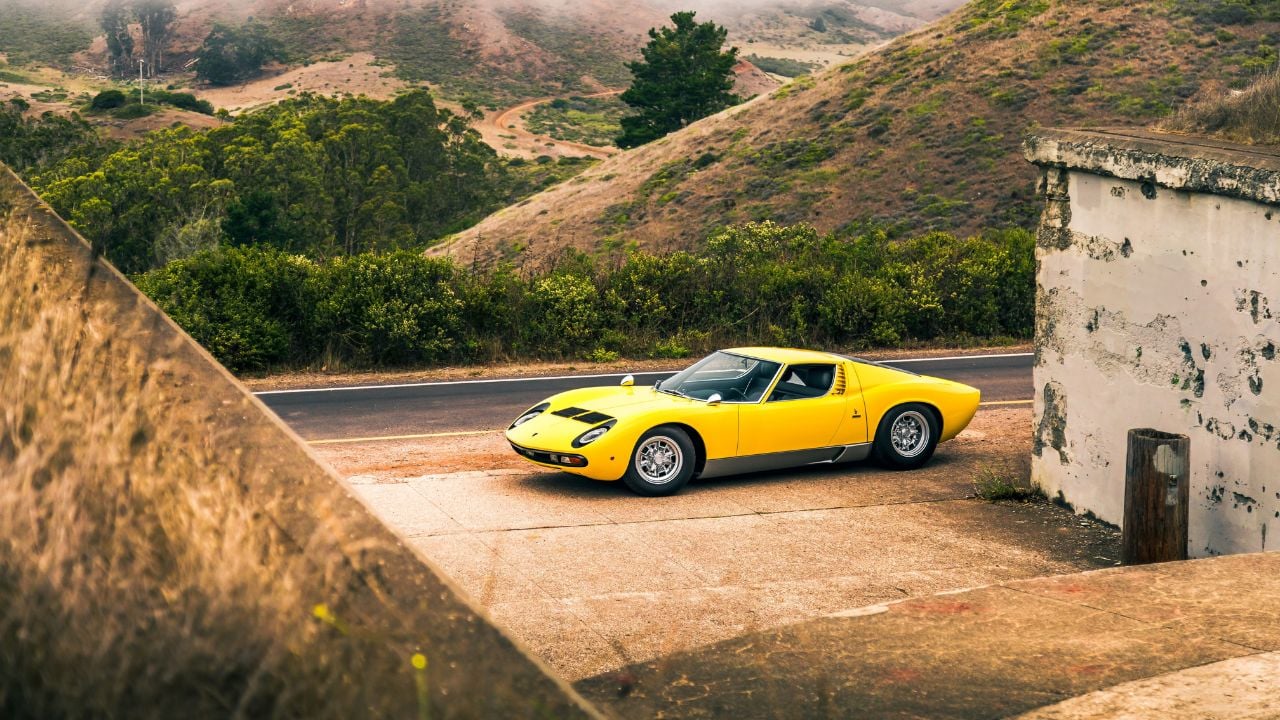
The Lamborghini story begins with the kind of petty revenge that would make reality TV producers weep with joy. In the early 1960s, Ferruccio Lamborghini, a guy who made serious money selling tractors, had the audacity to complain to Enzo Ferrari about his car’s clutch. Ferrari’s response is often retold as dismissive, but the exact wording varies by account. What is well documented is that Ferruccio was fed up with repeated clutch issues and believed Ferrari was using a common clutch similar to what he used in his tractors, which helped push him toward building his own GT cars. Big mistake. Ferruccio decided to show Ferrari what a real grand touring car looked like, and the rest is automotive history written in burnt rubber and wounded Italian pride.
Early models like the 350 GT and 400 GT were solid efforts, the automotive version of clearing your throat before delivering a devastating comeback. But it was the Miura that dropped the mic so hard it created seismic activity across Europe.
Arriving in the late 1960s when tie-dye was considered high fashion and Moon landings were the hottest new trend, the Miura didn’t just match the era’s ambition, it lapped it twice and asked for more. This was a complete rethinking of what a road car could be. While other manufacturers were still figuring out how to make their cars go straight without catching fire, Lamborghini created something that looked like it had been beamed down from 1985.
What Made the Lamborghini Miura the First Supercar

Let’s be clear about something: calling the Miura the first supercar isn’t just Italian marketing hyperbole (though they’re certainly good at that). It’s backed by cold, hard engineering facts and the kind of innovation that makes modern car designers question their life choices.
The process of understanding why the Miura deserves this title involves examining its engineering breakthroughs, styling achievements, and cultural influence, plus the fact that it made every other sports car look like it was designed by a committee of accountants with a grudge against fun.
The Miura’s creators were young, ambitious engineers who were basically given the keys to the kingdom and told to “make something fast.” Their average age was probably younger than most people’s car loans, but they had ideas that would reshape the industry. These weren’t seasoned veterans playing it safe; these were automotive rebels with a cause and unlimited access to Italian coffee.
Each feature of the Miura’s design served a purpose beyond just looking spectacular (though it certainly did that). This examination focuses on the technical and emotional elements that made it revolutionary, because frankly, there’s enough marketing fluff in the world already.
Groundbreaking Mid-Engine Layout

Lamborghini’s decision to mount the Miura’s 4.0-liter V12 engine transversely behind the driver was the automotive version of putting the punchline in the middle of the joke. Like yeah, it’s an unexpected way to do things… But it works in the right hands.
Before the Miura, mid-engine layouts were reserved for actual race cars, where comfort meant “the seat doesn’t eject you into the crowd.” Road cars kept their engines up front like civilized machinery. Lamborghini looked at this convention and said, “Hold my espresso.”
The transverse mounting, engine sideways, not lengthwise, was particularly audacious. This configuration delivered about a 44/56 front-to-rear weight distribution that made the car rotate around corners with the precision of a ballet dancer and the enthusiasm of a caffeinated Italian. The low center of gravity (about 41.3 inches high for the early P400, and about 43.2 inches for the later P400 S) meant the Miura could change direction faster than a politician during election season.
This layout also freed up space for proper aerodynamics up front, contributing to a drag coefficient that made other sports cars look like they were towing parachutes. The result was a driving experience that felt more connected than a teenager to their smartphone: every input translated directly into action, creating what Lamborghini called “the purest form of automotive communication” and everyone else called “absolutely terrifying in the best way possible.”
Design by Bertone and Gandini

The Miura’s styling came from Marcello Gandini at Bertone, a man who apparently woke up one day and decided to redesign the concept of beautiful. At just 27 years old, Gandini created a shape that made other car designers consider career changes to accountancy.
Those signature “eyelash” headlights weren’t just styling flourishes, they were functional covers that kept the lights clean while adding character that could melt steel. The overall proportions followed what’s now called the “supercar wedge,” but Gandini invented it here: long hood, low roofline, dramatic rear deck. The wheelbase measured about 98.4 inches with track width around 55.5 inches on early cars, creating a stance so perfect it should have been illegal in several countries.
Every body panel flowed into the next with the kind of seamless integration that makes modern CAD programs have nervous breakdowns. The door handles were flush-mounted, the side air intakes were perfectly positioned, and the rear window louvers helped with engine cooling while looking like they belonged on a spaceship.
Its low nose and smooth canopy helped it cut through the air cleanly for its era, and the design clearly paid attention to airflow even without modern CFD tools. The visual impact was so strong that the Miura became instant automotive jewelry, photographed more often than a Kardashian and with considerably more substance.
Lightweight Chassis Construction

The Miura’s steel platform chassis was engineered with the kind of obsessive weight-consciousness usually reserved for Olympic athletes and anorexic supermodels. Depending on version and how it is measured, published weights land around 2,750 to 2,850 pounds, which is still light by modern standards.
The Miura used a pressed-steel semi-monocoque chassis with integrated front and rear subframes, engineered for low weight and good rigidity. Torsional stiffness was impressive enough that the car could handle the V12’s 350 horsepower and 271 lb-ft of torque without turning into a wet noodle during spirited driving.
The result was a chassis that could handle modern tire technology better than many cars built decades later. It was the engineering equivalent of building a foundation so good that you could put any house on top of it and it would still be spectacular.
High-Revving V12 Engine

The Miura’s 3,929cc V12 was built by people who actually understood what “reliability” meant. Producing 350 horsepower at 7,000 rpm and about 262 lb-ft of torque at 5,000 rpm in P400 form, it was the kind of engine that made other powerplants file restraining orders.
Unlike Ferrari’s tendency to build engines that sounded glorious right up until they grenaded, Lamborghini’s V12 was designed for people who actually wanted to drive their cars instead of just polish them in garages. Four triple-choke Weber 40 IDL carburetors fed the beast, creating a throttle response so immediate it could cause whiplash.
The engine’s transverse mounting required some creative engineering: early Miuras used a common engine and transmission lubrication system, a layout Lamborghini changed on the SV with separate lubrication for the engine and gearbox. Peak power arrives at 7,000 rpm in P400 form, with later versions rated higher.
Acceleration figures were staggering for 1966. Period tests and factory claims vary by version, but figures commonly land in the mid 6 second range to 60 mph with top speed around 170 plus mph. These were physics-bending achievements that made other manufacturers question whether Lamborghini had access to alien technology.
Innovative Suspension Geometry

The Miura’s suspension was designed by people who clearly understood that handling wasn’t optional. Independent wishbones all around with coil springs and anti-roll bars created a setup that could handle both Sunday grocery runs and track day heroics without breaking a sweat.
The front suspension featured unequal-length A-arms with coil-over dampers, while the rear used a similar setup adapted for the unique packaging constraints of the transverse engine. The Miura’s double wishbone suspension used coil springs and anti-roll bars to balance control and compliance, giving the chassis real capability for its era.
Geometric precision was remarkable: the suspension maintained proper camber curves throughout its travel, keeping the contact patch optimized even during aggressive cornering. The front and rear track widths were carefully calculated to work with the wheelbase, creating natural stability that didn’t require electronic nannies.
The system absorbed road imperfections while maintaining tire contact, turning potentially dangerous situations into merely exciting ones. It was the kind of suspension setup that made professional drivers nod appreciatively and weekend warriors drive home very, very carefully.
Aerodynamic Advantage

While most 1960s sports cars approached aerodynamics with all the scientific rigor of throwing spaghetti at the wall, the Miura was actually wind-tunnel tested. That 0.33 drag coefficient wasn’t achieved by accident, it was the result of careful attention to airflow management.
The low nose and curved windscreen created a smooth flow transition, while the rear deck’s gentle slope prevented the kind of turbulence that could make high-speed driving feel like wrestling with an angry octopus. Strategic air intakes fed the engine and brakes without disrupting the overall aerodynamic package.
Downforce wasn’t a primary concern in 1966, but the Miura’s shape naturally generated some rear downforce at speed, helping keep the tail planted when things got interesting.
The integration of functional aerodynamics into stunning design was revolutionary. This wasn’t about slapping wings and splitters onto a car: this was about creating a shape that worked as well as it looked.
Advanced Cooling System

The Miura’s cooling system had to manage the thermal output of a high-performance V12 engine mounted backwards in the middle of a car. This was like trying to air-condition a house with the furnace in the living room, possible, but requiring serious engineering creativity.
Twin radiators mounted in the nose provided primary cooling, while carefully designed ducting channeled airflow through the engine bay and out through rear vents. The system included an electric cooling fan, which was considered pretty high-tech in 1966 when most cars relied on belt-driven fans and prayer.
Oil cooling was achieved through a dedicated oil cooler mounted in the front of the car, with lines running back to the engine. The whole system was designed to handle extended high-speed operation without the kind of dramatic cooling failures that made other exotic cars more suitable for short sprints than long journeys.
In testing, the Miura maintained stable operating temperatures even during extended high-speed runs, proving that exotic doesn’t have to mean unreliable. It was the kind of thermal management that let owners actually use their cars instead of just admire them.
Luxurious Yet Functional Interior

The Miura’s cabin was crafted with the understanding that fast cars should be beautiful inside and out. Hand-stitched leather covered nearly every surface, while the dashboard layout prioritized both form and function in a way that would make modern UX designers weep with envy.
The driving position was optimized for control, with low-slung seats that positioned the driver at the perfect angle to operate the controls while maintaining good visibility. The steering wheel was thin-rimmed and perfectly sized, providing the kind of tactile feedback that made every input feel meaningful.
Instrumentation included a full set of gauges that actually provided useful information instead of just looking pretty. The tachometer redline at 7,700 rpm was a constant reminder of the engine’s potential, while the speedometer went to 200 mph because optimism is an Italian virtue.
Climate control was basic but effective, and the overall ergonomics were surprisingly good for a car designed when “user experience” meant making sure the door handles worked. It was a place where drivers could spend hours without discomfort, assuming they could resist the temptation to constantly explore the car’s performance envelope.
Cultural Icon of the Jet Set Era

The Miura made an entrance like a movie star walking down a red carpet. Within months of its debut, it was being photographed with celebrities, featured in fashion magazines, and generally treated like automotive royalty.
The car became shorthand for sophisticated speed, appearing in films and becoming the preferred transportation for people who had already achieved everything else and needed something to match their lifestyle. It showed that the owner had money, taste, vision, and the confidence to drive something that drew attention from three counties away.
Frank Sinatra owned one. So did Miles Davis and Rod Stewart. The Miura attracted people who understood that life’s too short for boring cars and too long for unreliable ones. It represented a perfect moment in time when technology, design, and culture aligned to create something genuinely special.
The car’s influence extended beyond automotive circles into fashion, architecture, and industrial design. It proved that functional objects could be beautiful, and beautiful objects could be functional: a lesson that many industries are still trying to learn.
Engineering Freedom for Young Designers

Lamborghini’s decision to let Gian Paolo Dallara, Paolo Stanzani, and Bob Wallace create the Miura was either brilliant management or a lucky accident, possibly both. These engineers were young enough to question everything and talented enough to find better answers.
Dallara and Stanzani were both born in 1936, and chief test driver Bob Wallace was born in 1938, so the core team was in its late 20s during the Miura’s mid 1960s development. They weren’t burdened by decades of “that’s not how we do things” and “it’ll never work” that typically plague automotive development. Instead, they approached every challenge with fresh eyes and the kind of enthusiasm that makes older engineers simultaneously jealous and concerned.
The collaborative atmosphere at Lamborghini meant ideas could flow freely between departments. If the styling team wanted something aerodynamic, the engineers found a way to make it work. If the engineers needed better packaging, the designers adapted. This kind of cooperation was revolutionary in an industry known for departmental warfare.
The result was a car that felt cohesive in a way that committee-designed vehicles never could. Every element supported every other element, creating a whole that was genuinely greater than the sum of its parts.
Influence on Future Supercars

The Miura basically wrote the rulebook for future supercars. Mid-engine layout? Check. Dramatic wedge shape? Check. Exotic materials and construction? Check. The ability to make grown adults act like children? Double check.
Every major supercar since 1966 has borrowed elements from the Miura’s formula. The Porsche 911 switched to mid-engine for its race cars. Ferrari finally admitted that maybe putting engines in the middle wasn’t such a crazy idea after all. Even manufacturers who had never made sports cars started sketching mid-engine layouts.
The visual influence was equally profound. That long, low wedge shape became the universal language of speed, while the Miura’s proportions established the golden ratios that designers still reference today. The integration of functional elements into beautiful forms became the standard for exotic car design.
Modern supercars like the McLaren P1, Ferrari LaFerrari, and Porsche 918 Spyder all trace their DNA directly back to the Miura’s revolutionary approach to packaging, performance, and presentation. It’s the automotive version of genetic inheritance: the Miura’s genes are everywhere.
A Legacy Preserved in Rarity

Only 764 Miuras were built between 1966 and 1973, making each one more precious than unicorn tears and twice as valuable. But the rarity isn’t what makes them special, it’s the other way around. They’re rare because they were so advanced that Lamborghini could only build them in small numbers.
Each surviving Miura represents a perfect storm of engineering, design, and cultural timing that will never be repeated. Well-maintained examples now command seven-figure prices at auction, not because they’re old, but because they’re irreplaceable.
The cars that remain are rolling museums, each one a testament to what happens when vision meets capability. They appear at concours events like automotive celebrities, drawing crowds who understand they’re seeing something genuinely historic.
For collectors, owning a Miura isn’t just about having a fast car: it’s about preserving a moment in automotive history when everything went right. It’s the difference between owning a watch and owning the watch that defined what all future watches would aspire to be.
The Lasting Echo of the Miura

The Lamborghini Miura proved that revolutionary ideas don’t come from playing it safe. It showed that a small team with big ideas could reshape an entire industry, and that sometimes the best way to honor tradition is to completely ignore it.
Today, nearly 60 years later, the Miura still looks modern. Still sounds incredible. Still drives like a car designed by people who understood that transportation could be transcendent. It remains the benchmark against which all other supercars are measured, not because of nostalgia, but because it got so many things fundamentally right.
The Miura created the supercar category and defined what that category could become. It proved that cars could be art, that engineering could be poetry, and that sometimes the most practical solution is also the most beautiful one.
For anyone who has ever felt their pulse quicken at the sight of a perfectly designed machine, the Miura represents everything right about human creativity applied to mechanical motion.
In a world increasingly dominated by electric vehicles and autonomous driving systems, the Miura stands as a monument to the pure joy of controlling a powerful machine through skill, intuition, and just a little bit of calculated risk. It’s the greatest argument ever made for keeping cars interesting, and it’s still winning the debate.