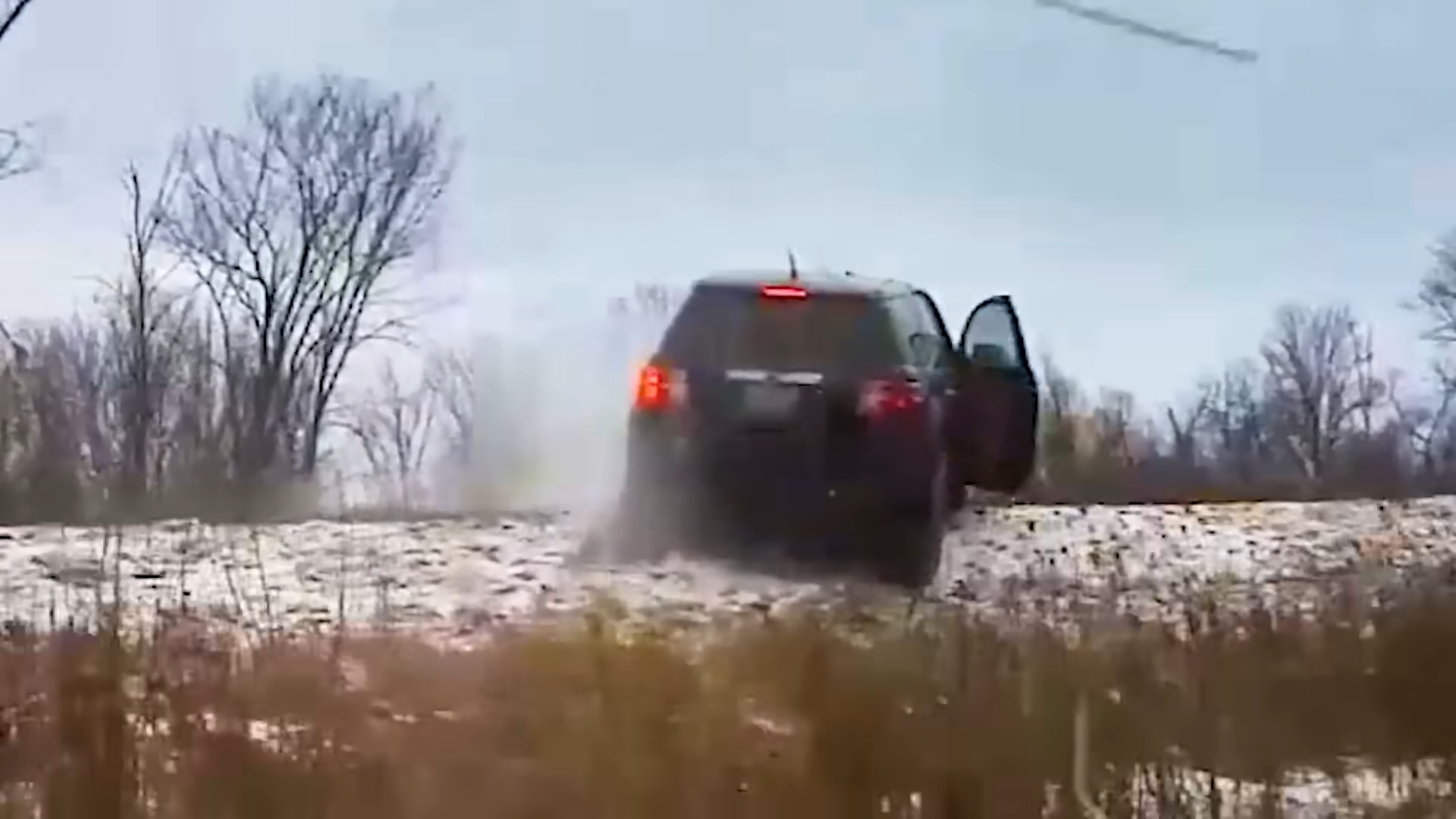
A video making the rounds under the Midwest Safety account has people talking, and not just because of the speed. The clip, which has gone viral with the caption referencing “the dumbest way to avoid a stop stick,” documents two separate police pursuits that spiral well past 100 mph before officers bring both suspects to a stop in ways that feel almost cinematic. Except this is not a movie. This is a regular American highway, and the danger is entirely real.
The first pursuit kicks off with something mundane: a routine traffic stop. Within seconds, the driver decides the better play is to floor it and find out what happens next. What happens next is a coordinated multi-unit chase through active traffic, a successful spike strip deployment, and a vehicle spinning out into the median. Officers move in fast, the suspect resists, and after a brief struggle, the situation is under control.
The second case is where things get even messier. A gray Ford Explorer or Escape leads officers on another high-speed run, and this time the chase ends with a crash that deploys the pursuing officer’s airbag and leaves that officer temporarily trapped inside the vehicle. The suspect escapes on foot. For a moment, the whole operation hinges on whether he can stay hidden long enough. He cannot. Four hours later, a K9 unit sniffs him out in a gas station bathroom, and the cuffs go on without much fanfare.
Both cases have since racked up attention online, partly for the sheer recklessness on display, and partly because viewers cannot seem to decide whether to be stunned or unsurprised. Given what the Bureau of Justice Statistics reports about the sheer volume of police pursuits happening across the country every year, “unsurprised” might be winning.
How the First Pursuit Played Out
The first chase begins at a straightforward traffic stop where the officer asks for a license, registration, and proof of insurance. Before long, the suspect bolts. Radio chatter captured in the video tracks the vehicle hitting 66 mph in medium traffic, then pushing well past 100 mph as units scramble to keep pace without creating a larger hazard.
Officers deploy stop sticks, also called spike strips, with the kind of precision that makes it clear this is not their first rodeo. The tire punctures do their job, the vehicle spins out, and the suspect ends up in the median. He resists briefly during the takedown, enough to earn a warning about being tased, before officers secure him. He was ultimately charged with aggravated fleeing and eluding over 100 mph, reckless endangerment, and resisting and obstructing. He is presumed innocent unless proven guilty in court.
The Second Chase, and the Crash That Changed Everything
The second pursuit involves a gray Ford Explorer or Escape fleeing eastbound. The driver eventually crashes, and in the chaos, the pursuing officer’s squad car also becomes involved in the wreck. The airbag deploys. The officer, clearly shaken but physically okay, has to fight through the inflated bag just to exit the vehicle. By the time he is out, the suspect has vanished on foot into the surrounding area.
What followed was a four-hour search aided by a thermal camera and, eventually, a K9 unit. Officers ultimately found the suspect, identified as Quinnel, hiding in a gas station bathroom. He came out slowly with his hands raised, was taken to the ground, and placed in custody without further incident.
The charges in this case were extensive. Quinnel faced two counts of aggravated fleeing exceeding 21 mph over the limit, aggravated fleeing causing over $300 in property damage, multiple counts related to disobeying traffic control devices, speeding 35 or more mph over the limit, two counts of leaving the scene of a crash, failure to signal when turning or changing lanes, and improper lane usage. He pleaded guilty to one count of aggravated fleeing and no contest to the rest. He was sentenced to 30 months in prison, with credit for 126 days served, and must complete at least 50% of the sentence before mandatory supervised release. He was also ordered to pay $1,081 in court costs and $12,755.60 in restitution.
What These Chases Reveal About a Bigger Pattern
It would be easy to watch both clips and chalk them up to two people making spectacularly bad decisions on the same day. But the data tells a different story. The Bureau of Justice Statistics has consistently documented tens of thousands of police pursuits taking place across the United States every year. The vast majority start exactly like the first clip in this video: a routine stop, a moment of panic or calculation, and a decision to run.
What makes the Midwest Safety video stand out beyond the drama is how clearly it illustrates what law enforcement professionals have long argued: fleeing rarely ends with escape. It ends with a crash, a K9 unit, a spike strip, or all three. The tools available to modern pursuit teams have gotten significantly more effective, and the window for a successful getaway has gotten much smaller. Hiding in a gas station bathroom for four hours is not a plan. It is a delay.
The moment an officer’s airbag deploys in the second clip is genuinely sobering. That officer survived and walked away. But as commentators on the video noted, if the suspect had turned that aggression outward rather than running, the outcome could have looked very different for everyone involved.
What Drivers, Passengers, and Bystanders Can Take Away
Beyond the courtroom outcomes, videos like this carry a practical lesson that applies to anyone sharing the road with a pursuit in progress. When a high-speed chase is happening nearby, the safest move is to pull over, slow down, and get as far out of the way as possible. The officers tracking a fleeing vehicle are communicating rapidly and trying to anticipate every move, but other drivers in the area are variables they cannot fully control.
For the suspects themselves, the math is unambiguous. In the first case, what might have been a traffic citation became multiple felony charges and a physical takedown. In the second, a traffic stop turned into 30 months in prison and nearly $14,000 in combined court costs and restitution. Stop sticks, K9 units, thermal cameras, and coordinated radio communication have made the calculus of running from police about as unfavorable as it gets. The viral video puts it plainly: the dumbest way to avoid a stop stick is to make officers deploy one in the first place.