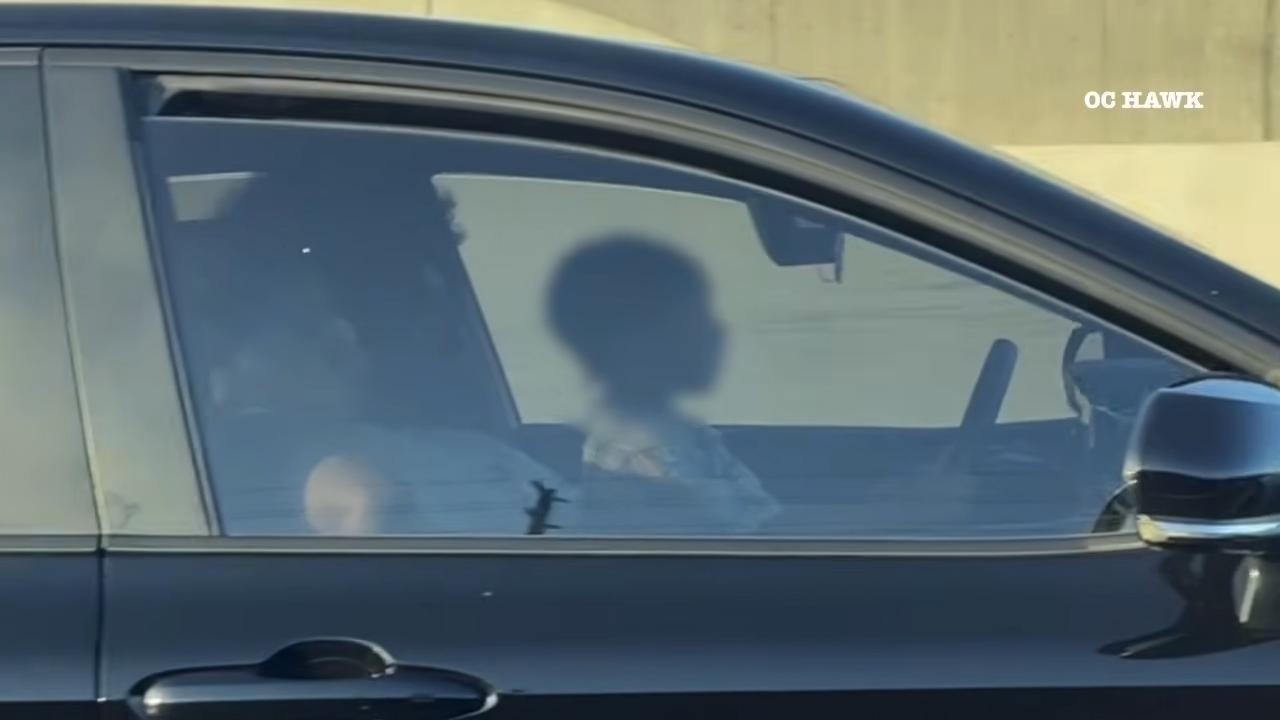
There are bad ideas, and then there are ideas so spectacularly misguided that they end up captured on video and shared with the entire internet. A clip making the rounds this week falls firmly into the second category: footage showing a young boy sitting on an adult’s lap behind the wheel of a moving car on a busy Southern California freeway, apparently steering the vehicle while traveling at highway speed. No car seat. No seatbelt. Just a kid gripping a steering wheel at 65 miles per hour while other drivers tried to make sense of what they were looking at.
The footage was captured and shared by OC Hawk, a news video stringer service, and shows an adult driver heading eastbound on the 60 Freeway in Riverside County with a child seated on his lap. The incident occurred around 7 p.m. on June 9. It was broad daylight, on a major freeway corridor, in full view of surrounding traffic. Which is, frankly, exactly how something like this gets documented.
In the video, the child appears to be holding the steering wheel and is not wearing a seatbelt. A front-seat passenger is also visible inside the vehicle. So there were enough adults present that someone could have, at any point, suggested that this was perhaps not a sound plan. That did not happen.
The California Highway Patrol’s Riverside office was notified according to OC Hawk. A witness who reported the incident was told not to follow the vehicle, as officers would be alerted. The car was last seen transitioning onto the southbound 215 Freeway.
Whether CHP ever caught up with the driver remains unknown as of this writing, which is the kind of unresolved ending that tends to frustrate people who believe consequences should be proportional to decisions.
This Is Not a Gray Area Under California Law
Let’s be clear about what California law actually says here, because it is unambiguous. The state requires children to be secured in approved car seats or booster seats appropriate for their age, height, and weight. A lap is not an approved car seat. It does not meet California’s standards under any interpretation of the vehicle code.
The base fine for a first violation of California’s child passenger safety law is $100 per unsecured child, but after penalty assessments and fees, the actual cost can exceed $500. A second offense carries a base fine of $250, which can top $1,000 with assessments added. Each violation also adds one point to the driver’s record per child not properly secured.
That’s before anyone gets to the more serious question of child endangerment. Under California Penal Code 273a, placing a child in a situation where their person or health is endangered is a criminal offense. It can be charged as a misdemeanor or a felony, depending on circumstances.
When charged as a felony, penalties can include two, four, or six years in state prison. Letting a child steer a car on a freeway without a seatbelt, at speed, surrounded by other vehicles, would seem to qualify as placing that child in a situation where their health is endangered.
What the Physics Actually Look Like
Anyone who has spent time thinking about vehicle dynamics, crash physics, or even basic biomechanics knows why this video is alarming beyond just the legal dimension. A child sitting unsecured in a driver’s lap becomes an unrestrained projectile the moment anything goes wrong.
In a frontal collision, that child hits the steering column, the dashboard, or the windshield with no protection whatsoever. An adult cannot hold a child in place under those forces. The seatbelt is designed to manage a single occupant, not two people sharing one seat.
According to the California State Highway Patrol, the leading cause of death for young children is motor vehicle crashes. A properly installed car seat can reduce the risk of death in children under the age of one by 71 percent. In toddlers, a car seat prevents 54 percent of deaths in a car crash. Those statistics exist because people have spent decades studying what happens to small bodies in crashes. The data is not ambiguous.
OC Hawk and the Role of Civilian Video in Traffic Enforcement
The fact that this incident became public at all is largely a function of how Southern California traffic observation has evolved. Services like OC Hawk operate as news stringer outfits, monitoring freeways and sharing footage with media and law enforcement when they capture something notable. They are not law enforcement themselves, but they function as an informal early warning system for the kind of behavior that would otherwise go entirely unaddressed.
It is worth noting that the witness who spotted this and called it in was instructed not to follow the vehicle and to let officers handle it. That is the correct advice. Pursuing a vehicle on a freeway to document or confront a driver creates its own set of hazards. The right move is to report and step back, which appears to be what happened here.
The Uncomfortable Question Nobody Wants to Ask
What was the thinking? It is a question that hangs over footage like this. Teaching a child about cars in a driveway, or in an empty parking lot, is something a lot of parents and grandparents have done. Getting behind the wheel of a moving vehicle on an active freeway with a child steering is categorically different. The freeway does not pause for learning moments. Other drivers did not consent to sharing the road with a child at the controls.
Whether this was motivated by a misguided sense of fun, a belief that the child was doing most of the steering anyway so it hardly counted, or something else entirely, the outcome is the same: a child was put in serious danger in public, other drivers were put at risk, and the whole thing ended up on video.
If CHP did catch up with this vehicle, the driver is facing consequences that will take some time to sort out. If they did not, the clip still exists, and these things have a way of being identified.