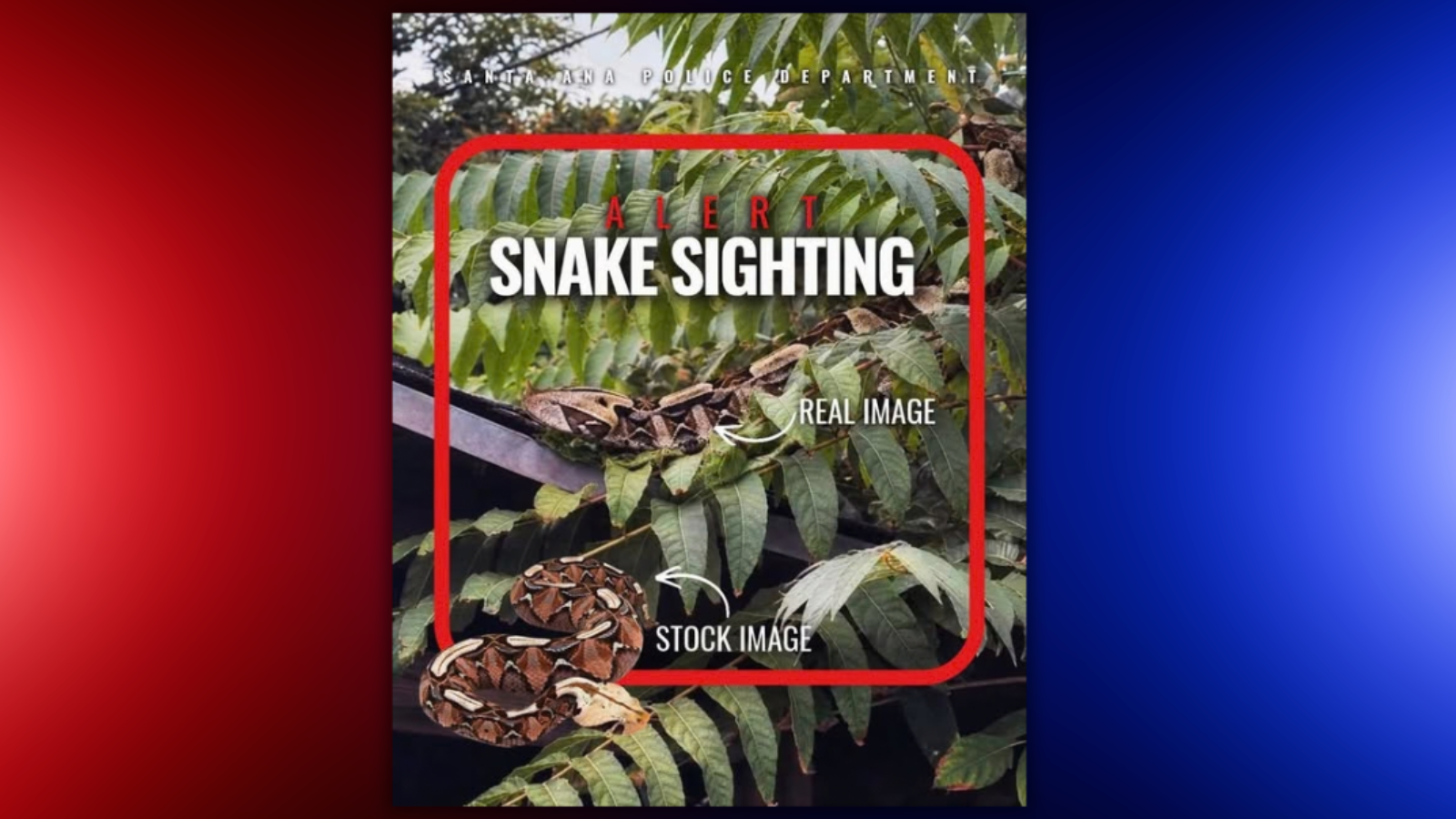
Santa Ana, California, may have one of two unusual things loose in a neighborhood: a highly venomous African viper or a remarkably convincing image of one. Police have not yet established which explanation is correct.
The Santa Ana Police Department warned residents Monday about a snake believed to be a Gaboon viper, reportedly last seen in a tree near Main Street and Edinger Avenue. Police estimated it at roughly four to five feet long and told residents not to approach it.
A man who said he photographed the snake told CBS Los Angeles that he brought his dogs inside and contacted police. SAPD told the station he called three minutes after taking the photograph.
Then people started looking closely at the picture. SAPD’s public advisory labels it in large letters as the “REAL IMAGE,” but reptile enthusiasts and experts began questioning whether the photograph itself was generated or manipulated with artificial intelligence.
Police subsequently acknowledged those questions and began investigating whether the image was AI-generated. After officers and reptile experts spent hours looking for the animal, they found no snake.
The Snake in the Tree
Embedded media follows; please allow a moment for it to load.
The warning was serious for good reason if the animal was what police suspected.
Gaboon vipers are native to Africa, not Southern California. The Smithsonian’s National Zoo describes them as heavy-bodied snakes with broad heads and exceptionally effective camouflage among leaves on the forest floor.
Their disposition is generally placid, and bites are uncommon. That does not make one a desirable backyard visitor.
The Smithsonian says the snake can control whether it injects venom and how much, meaning the consequences of a strike can vary dramatically. Gaboon vipers also possess exceptionally long fangs.
The Los Angeles Zoo houses a Western Gaboon viper and describes the species as one of the world’s largest and heaviest vipers.
None of that answered the increasingly obvious question posed by SAPD’s photograph: What was such a heavy, predominantly ground-dwelling snake doing draped across comparatively thin branches?
The Picture Gets a Second Look
People began challenging the photograph while the warning was still fresh.
Users in a snake-identification community pointed to several peculiarities, including vegetation that seemed to intersect the snake, inconsistencies in its markings, and branches that did not appear to react to the weight of a large viper.
The criticism was not confined to anonymous internet sleuthing.
Greg Pauly, a herpetologist with the Natural History Museum of Los Angeles County, examined the photograph for the Los Angeles Times.
Pauly said he had “several issues with this image.” Among them was the snake’s position. He told the Times a Gaboon viper would not ordinarily climb a trunk and then move onto thin branches like those depicted.
He offered several possibilities for how a snake could have ended up there, including being placed there, reaching the location from a nearby structure, or the photograph being AI-generated.
That last possibility soon became part of the police investigation itself.
Police Had More Than an Internet Photo
There was a reason SAPD initially treated the report seriously.
CBS Los Angeles identified the reporting party as Joel Ciprian. He told the station he had taken the photograph himself after his dogs alerted him to something outside.
“I wish it was AI,” Ciprian told CBS. “It’s in my backyard, and it’s scary.”
Police said Ciprian contacted them three minutes after taking the photograph.
Officer Natalie Garcia told CBS that the department was treating the report as a real snake because of the potential danger involved.
That sequence distinguishes the case from a police department simply finding an alarming picture online and reposting it. SAPD had a person claiming a firsthand encounter, a photograph he said he had taken, and a report made within minutes.
The photograph nevertheless became harder to ignore as the questions accumulated.
Two Messages at Once
SAPD eventually addressed the AI concern directly.
In a social-media update, the department said it understood there were questions about whether the circulating image “may be AI-generated” and that it was taking those concerns seriously while trying to determine whether a snake was actually in the area.
By then, however, SAPD’s public-facing graphic was already circulating with the disputed photograph explicitly labeled “REAL IMAGE.”
That wording was not confined to a later retelling of the story. Contemporary news coverage on Monday reproduced or described the department’s graphic that way.
The Los Angeles Times published its initial report at 10 p.m. Monday and described SAPD’s graphic as containing a stock photograph alongside a “real image” of the reported snake. CBS Los Angeles had begun reporting on the incident hours earlier, although its article was subsequently updated.
The exact moment the “REAL IMAGE” label first appeared has not been established. What is clear is that the label had been in public circulation for hours while questions about the photograph were also spreading.
The Search Moves Off the Screen
SAPD brought in Jason Haywood, president of the Southern California Herpetology Association and Rescue, along with additional reptile handlers to search the area.
Officers and the specialists spent hours looking for the reported viper.
By Monday evening, the department said the area had been cleared. The search had produced no snake, and SAPD said it had not detected movement consistent with that type of animal.
That does not prove there was never a snake there. A failure to locate an animal capable of moving and hiding is not proof of absence.
It also does not authenticate the photograph.
For now, residents have been left with an unusually modern wildlife problem: police have warned them to watch for a dangerous animal while simultaneously investigating whether the image that helped trigger the warning depicts one at all.
SAPD continues to ask anyone who sees a snake matching the description not to approach or attempt to capture it and to contact the department at 714-834-4211.