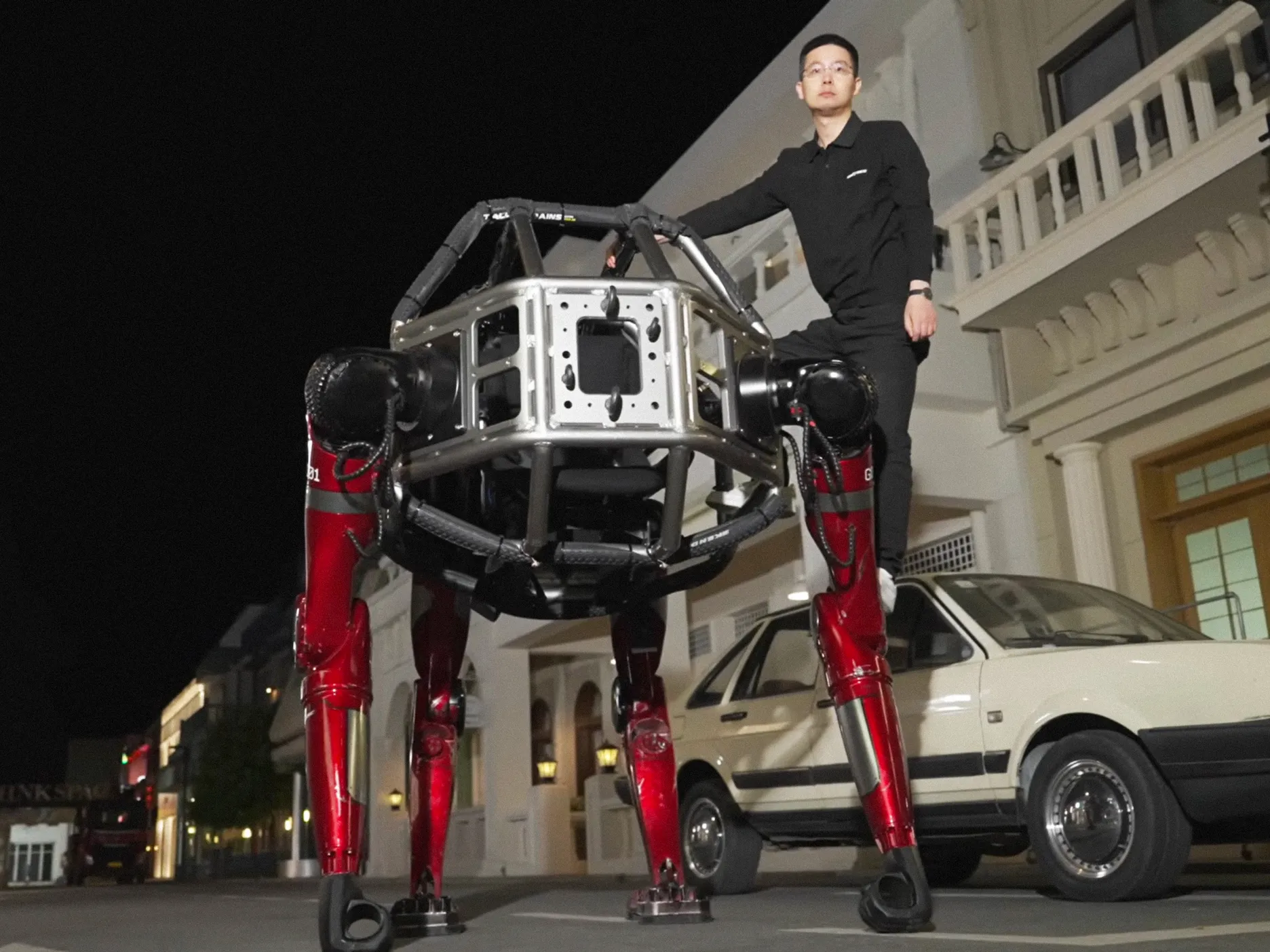
Unitree has been quietly becoming one of the most interesting companies in robotics, and it just made a very loud statement. The Hangzhou-based startup, already known for producing affordable humanoid and four-legged robots that regularly go viral for their dance moves and kung-fu routines, has now unveiled something in an entirely different category: the GD01, a towering, pilotable mecha robot that smashes through cinder block walls and crawls on all fours like something out of a summer blockbuster.
The reveal came with a dramatic introductory video set to thundering rock guitar, which is honestly the only appropriate soundtrack for this sort of announcement. In it, Unitree’s founder and CEO Xingxing Wang holds hands with the GD01 before climbing into the robot’s open-air belly to take control. The whole thing feels like a fever dream collaboration between a robotics lab and a heavy metal band.
For those wondering if this is some kind of elaborate stunt or publicity gimmick, Unitree confirmed to Wired that the GD01 is a genuine product available for purchase. They also added a disclaimer to their social media post asking everyone to “use the robot in a Friendly and Safe manner,” which raises the very reasonable question of who exactly is buying a wall-demolishing mecha and what they plan to do with it.
The GD01 is a significant departure from what Unitree has built its reputation on. The company’s G1 humanoid robots, which retail for around $15,000, are routinely spotted in clips performing acrobatics and synchronized martial arts. The GD01, by contrast, is less about grace and more about spectacle, and possibly structural damage to anything standing between you and your destination.
What the GD01 Actually Does
@sxefinance The REAL LIFE Mecha Is Here. Unitree GD01 Starts at $574,000. #news #finance #china #robot ♬ original sound – sXe Finance
The capabilities on display in the reveal video are genuinely impressive, even if some of them are more “cinematic” than practical. The GD01 can walk upright with a human pilot seated inside, smash through walls of cinder blocks, and contort itself into a crawling position where the robot moves on its hands and feet like a mechanical crab. In that crab-walk configuration, the human operator would be lying flat on their back staring at the sky, which sounds terrifying and thrilling in equal measure.
The robot also demonstrated transformation-style movement, bending and repositioning between different modes. Whether the GD01 operates purely via remote control or has some degree of autonomous function is not yet fully detailed, but given Unitree’s existing lineup, remote operation is likely the primary control method for now.
Why Unitree Is a Company Worth Watching
Unitree’s rise has been swift and substantial. The company has become one of the dominant players in consumer and research robotics by doing something US competitors have struggled with: keeping costs low without sacrificing performance. Its G1 humanoid comes in at around $15,000, while comparable American-made humanoid robots can run ten times that figure. Industry experts point to Unitree’s deep integration into China’s vast hardware supply chain as the key reason it can hit those price points.
Beyond cost, Unitree’s robots have earned a reputation for being developer-friendly. Researchers find them easy to configure and deploy AI programs on, which has driven adoption in academic and industrial settings. The company is also expected to go public this year, adding another layer of momentum to an already ascending trajectory. Earlier this year, its robots performed synchronized parkour and martial arts at a nationally televised spring festival event, using wireless communication between multiple robots to coordinate their movements in real time.
What This Moment Tells Us About the Robotics Industry
The GD01 is not going to vacuum your floors or stock shelves at a warehouse. It is, by Unitree’s own implicit admission, more of a statement than a solution. But that statement carries real weight. The fact that a Chinese robotics startup can build and sell a functional, pilotable giant mecha robot tells us several things about where this industry is heading.
First, the hardware costs for advanced robotics have dropped dramatically. What once required defense-level budgets is now within reach of a company that also sells robots on AliExpress. Second, the line between “practical robot” and “experience product” is blurring fast. As AI continues to mint new fortunes and tech culture celebrates increasingly extravagant flex purchases, there is clearly a market emerging for robots as status symbols and spectacle. Forget a luxury car parked outside the office. Smashing through the front wall in a GD01 sends a different kind of message.
The bigger lesson may be that robotics companies willing to take bold, attention-grabbing swings, even ones that seem more theatrical than useful, are the ones shaping public perception of what robots can be. And in an industry where public imagination is part of what drives funding, talent, and adoption, that matters more than it might seem.