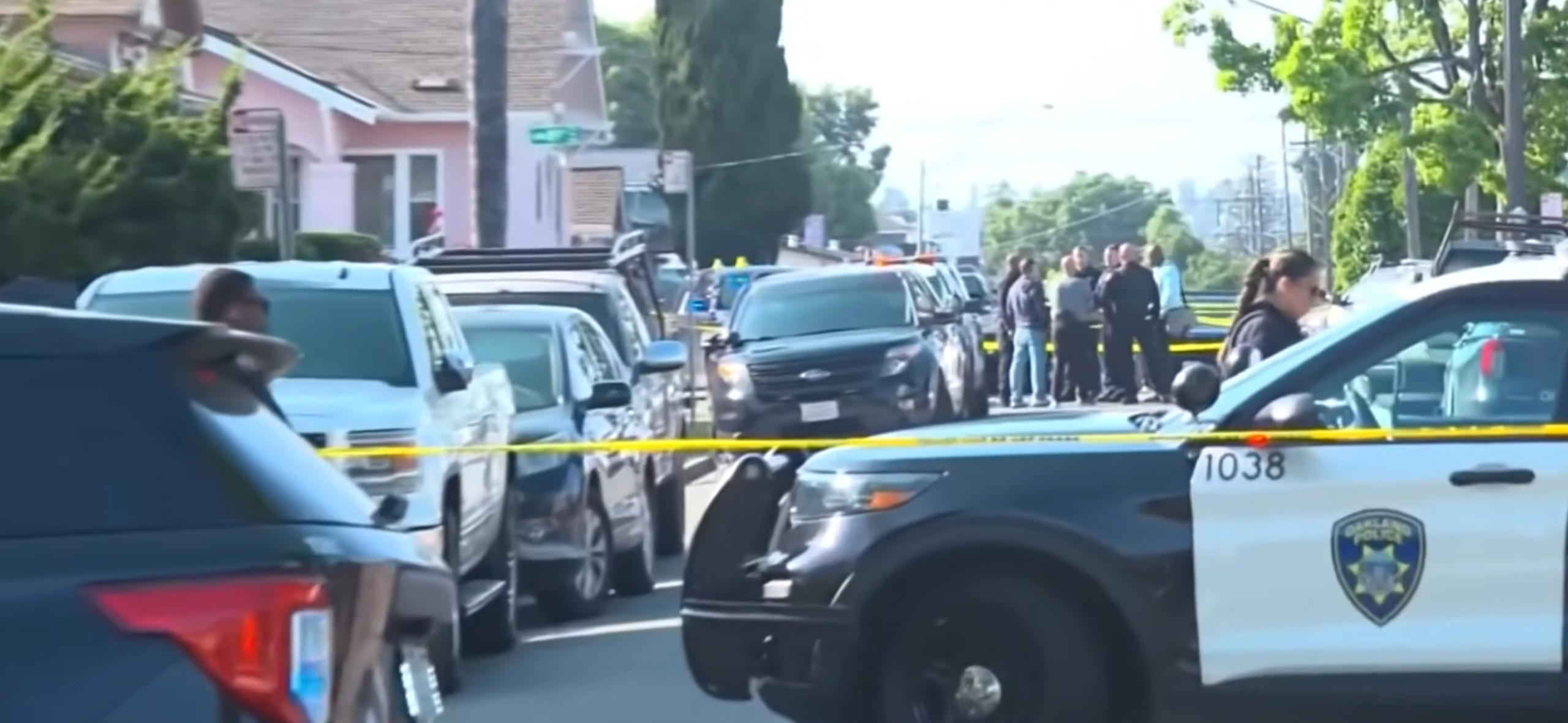
Early Friday morning, what started as a routine traffic stop in East Oakland turned into a harrowing scene that left two police officers hospitalized and a suspect wounded by gunfire. The incident unfolded around 3:15 a.m. in the 1200 block of 9th Avenue, a stretch not far from International Boulevard, an area long associated with sex trafficking and street-level crime. By Friday afternoon, both officers had been released from the hospital, and the suspect, a 21-year-old man from Sacramento, was expected to survive his injuries.
Oakland Interim Police Chief James Beere addressed the public at a Friday afternoon press conference, defending his officers’ actions while acknowledging the gravity of the situation. The stop initially appeared routine, but it escalated quickly when officers spotted a firearm in plain view inside the vehicle. That gun was later confirmed to have been stolen, adding another layer of seriousness to an already dangerous encounter.
What happened next is the kind of scenario that police training tries to prepare officers for but can never fully simulate. The suspect attempted to flee, driving away with both officers in the process. They were dragged alongside the vehicle before it crashed into a parked car, leaving one officer pinned. It was at that point the trapped officer made the decision to open fire.
The incident is already under multiple investigations, and the two officers involved have been placed on paid administrative leave, per Oakland Police Department policy. It also marks the second time in less than two weeks that an OPD officer has discharged their weapon, following a separate shooting on April 28 that resulted in a fatality.
A Stolen Gun and a Split-Second Situation
According to the OPD, officers observed a firearm in “plain view” during the traffic stop before the suspect made any move to flee. That detail matters significantly, both legally and procedurally. The visible weapon gave officers cause to escalate their response, and the subsequent discovery that the firearm was stolen only reinforced the danger of the situation.
When the suspect drove away with both officers still in proximity to the vehicle, they were dragged before the car ultimately crashed. One officer ended up pinned between the suspect’s vehicle and a parked car nearby. Unable to free himself, that officer fired on the driver, striking and wounding him. Investigators have not released the officer’s name or detailed the nature of either officer’s injuries, but both were discharged from the hospital by Friday.
Chief Beere was measured but direct in his comments: “Use of force is something we never want to take lightly or resort to, but our officers have the right to defend themselves.” It is a statement that sounds almost bureaucratic on paper but carries real weight when the alternative was an officer potentially being crushed by a vehicle.
The Location: International Boulevard and “The Blade”
The stop happened near International Boulevard, specifically in a stretch locals and law enforcement refer to as “the Blade.” This area in East Oakland has long been a focal point for sex trafficking activity, with pimps, johns, and victims cycling through on a nightly basis. As of Friday afternoon, investigators had not confirmed whether the original traffic stop was connected to any trafficking-related activity.
Oakland City Councilmember Charlene Wang, who represents the district, spoke to reporters about the incident. She was clear that the dangerous nature of the area is no secret, and that enforcement in the neighborhood is not going to slow down because of what happened. “We’re not going to let up on the enforcement on the Blade because of this incident, but it just goes to show how dangerous the activity is,” Wang said.
A woman who regularly spends time in the area, who asked not to be identified, voiced her own frustrations with the level of lawlessness she witnesses. She expressed support for police and suggested that stricter enforcement might be the only thing that gets through to some of the people operating in the area.
The Scene Friday Morning
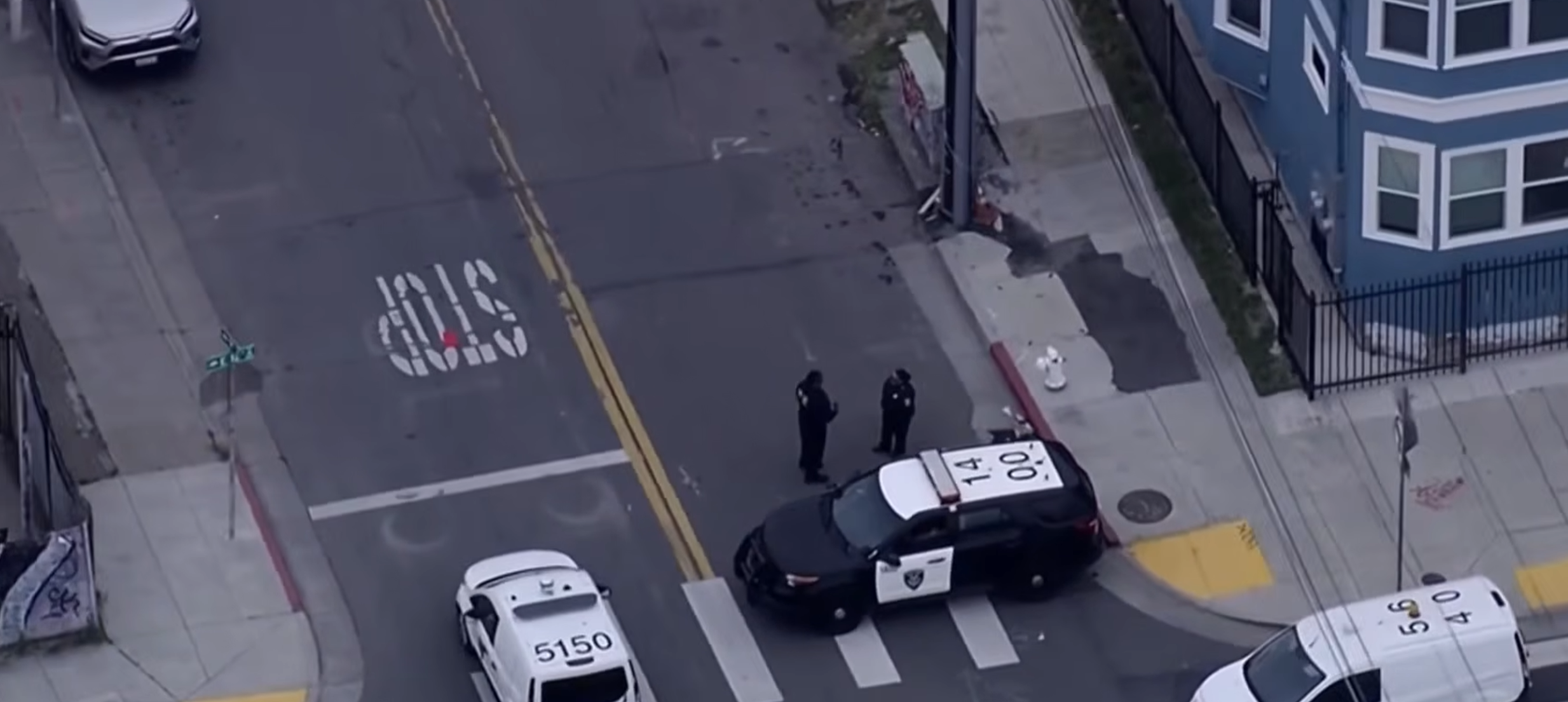
By the time the sun came up, the 1200 block of 9th Avenue looked like a textbook post-incident crime scene. A white car sat with its front end up on the sidewalk, cordoned off with yellow crime scene tape. Garbage had been scattered around the crash site. A tow truck arrived later in the morning to remove the vehicle while officers methodically worked the area, placing yellow evidence markers at multiple spots along the street and sidewalk.
The methodical nature of the scene processing reflects what happens every time an OPD officer fires their weapon. Per department policy, the involved officers are placed on paid administrative leave while three separate entities conduct reviews: the Oakland Police Department itself, the Alameda County District Attorney’s Office, and the Community Police Review Agency. That three-pronged accountability structure is standard, though it does not make the process any faster or less scrutinizing.
What This Incident Reminds Us About Policing in High-Crime Zones
There is a tendency, especially in the aftermath of incidents like this one, to reduce everything to a simple narrative. But the reality of patrol work in areas like the Blade is considerably more complicated. Officers are frequently asked to operate in environments where unpredictability is the norm, where a stop for a minor infraction can reveal a stolen weapon within seconds, and where a suspect’s panic can create life-threatening danger for everyone involved.
The fact that both officers walked out of the hospital the same day is, by any measure, a fortunate outcome. The fact that the suspect is also expected to survive means that accountability, whatever form it takes, can still be sought through legal channels.
What this incident underscores most clearly is that enforcement in high-risk areas demands resources, training, and policy frameworks that match the reality on the ground. Councilmember Wang’s statement about not letting up on enforcement rings true as a commitment, but it also implies that officers working those blocks need every tool and support structure available to them. A traffic stop that nearly ends with an officer being crushed by a vehicle is not an edge case in neighborhoods like this one. For the officers and residents of East Oakland, it is closer to Tuesday.