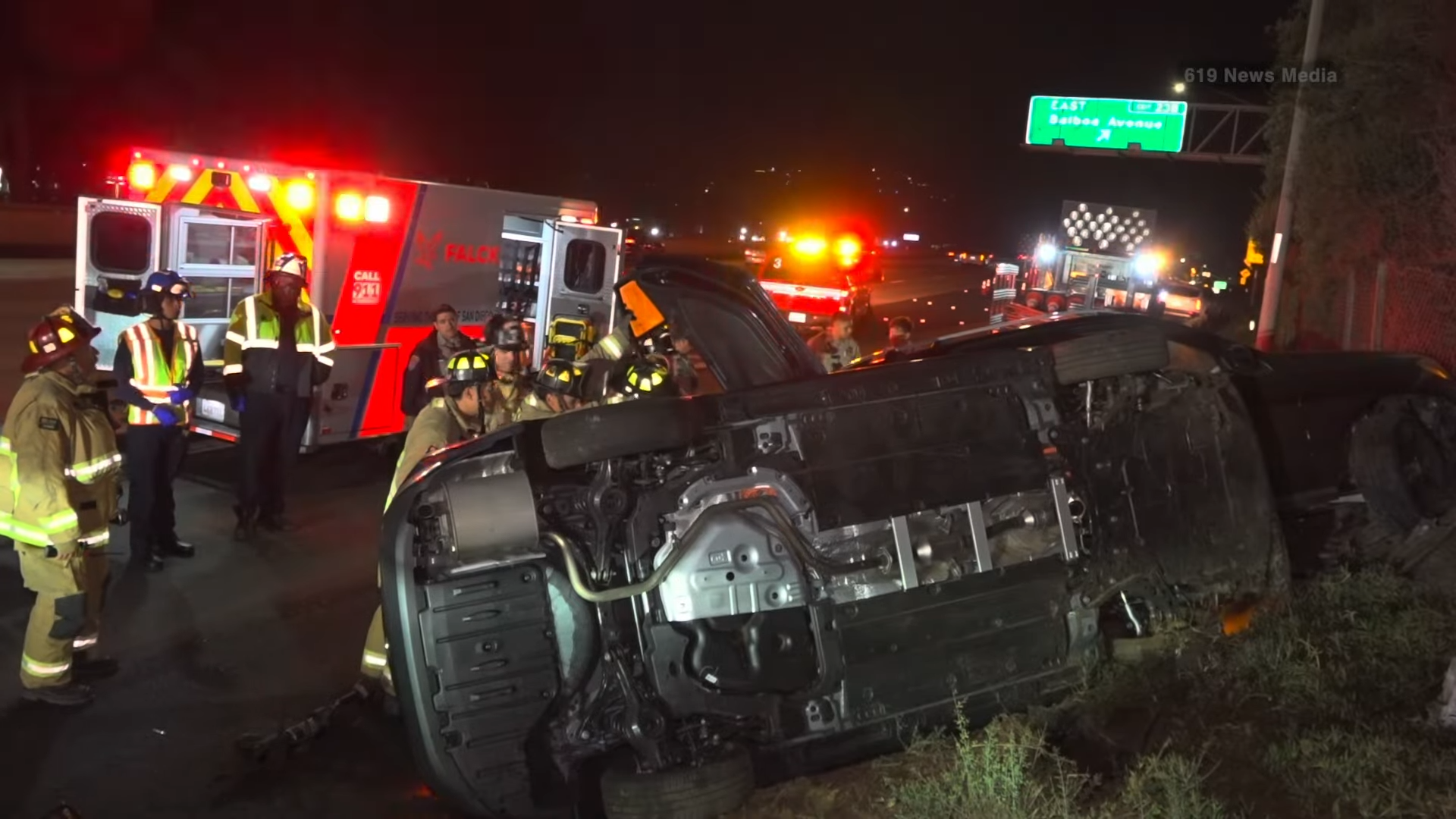
A late-night crash on one of San Diego’s busiest freeways produced a scene so unusual that even veteran first responders were left speechless. Two vehicles ended up overturned and wedged on top of one another along northbound Interstate 5 near Balboa Avenue in the Bay Park neighborhood, leaving investigators piecing together how things went so wrong so fast. The crash occurred around 10:42 p.m. on Wednesday, May 20, 2026, and while both drivers survived, the outcome could have been far worse.
Before the collision ever happened, multiple 911 callers had already flagged the situation. According to the California Highway Patrol, a female driver in a blue sedan was spotted driving recklessly in the moments leading up to the crash, and concerned motorists wasted no time alerting authorities. Those calls, as it turned out, were a preview of what was coming.
The sedan sideswiped a black SUV, sending both vehicles skidding off the freeway and ultimately landing on their sides, one on top of the other. Authorities believe the specific angle and speed of the impact contributed to the wildly unusual final position of the two vehicles. It was, by most accounts, a crash configuration that seasoned first responders had simply never seen before.
The male driver of the black SUV was able to get himself out of the wreckage and walked away with only minor injuries, which under the circumstances bordered on miraculous. The female driver of the sedan was not as fortunate and had to be rescued by firefighters before being transported to a nearby hospital for evaluation. CHP is now investigating whether drugs or alcohol played a role in the crash.
What Happened on I-5 That Night
The sequence of events unfolded quickly, as these things often do. Multiple 911 calls poured in from motorists who had observed the blue sedan behaving erratically, giving CHP officers a heads-up before any collision occurred. By the time the inevitable crash happened, the sedan had made contact with the SUV in a sideswipe that sent both vehicles careening off the roadway.
What set this crash apart from a routine freeway accident was not just the severity but the physics of the result. Both vehicles came to rest overturned and stacked against one another, a configuration that required firefighters to carry out a rescue rather than simply check on drivers who had walked away. The position of the vehicles was unusual enough that first responders reportedly commented on never having witnessed anything like it, which says something given the volume of crashes California freeways see on any given week.
CHP investigators have noted that the angle and speed at which the sedan struck the SUV likely created the conditions that led to both vehicles ending up in that position. It is a reminder that in high-speed collisions, the laws of physics do not negotiate.
The Science Behind a Crash This Unusual
Crashes like this one do not happen in a vacuum, and the physics behind them are worth understanding. According to crash dynamics research, kinetic energy increases exponentially as speed rises, meaning a vehicle traveling well above the speed limit carries a dramatically higher destructive force than one traveling at a normal highway pace. At elevated speeds, safety features like airbags and seatbelts also become less effective, simply because they are working against a greater amount of force than they were designed to manage at normal driving conditions.
In a sideswipe scenario involving a lighter sedan and a heavier SUV, the momentum differential matters enormously. The larger vehicle tends to dominate in terms of mass, but a high-angle strike at speed can redirect energy in ways that defy intuition. It is the combination of velocity, angle of impact, and the relative positions of the vehicles that can produce the kind of outcome seen on I-5 that night: two vehicles airborne, overturned, and wedged together in a configuration that looks more like a movie stunt than a real-world crash.
This is not entirely without precedent. A similar stacked-vehicle scenario occurred in Blackstone, Massachusetts in early 2026, where a Jeep collided with a tree and came to rest on top of another vehicle, requiring firefighters to extricate at least one person and fly them to the hospital by helicopter. Rare does not mean impossible.
What the Numbers Say About Reckless Driving in California
The Bay Park incident did not occur in isolation. California’s roads have long been a battleground for safety advocates, and the data reflects a serious ongoing problem. Reckless driving, including behaviors like aggressive lane changes, tailgating, and ignoring traffic signals, was responsible for 2,251 fatalities in California in 2024 alone. Speeding was a contributing factor in roughly 26 percent of all fatal crashes that year, with speed-related incidents playing a role in nearly 78,000 accidents statewide.
Impaired driving adds another layer of concern. In 2024, nearly 30,000 California crashes were linked to drivers under the influence, with alcohol-related incidents making up a significant portion of all road fatalities. CHP’s investigation into whether the Bay Park crash involved drugs or alcohol reflects a pattern investigators see repeatedly: reckless driving late at night raises those questions almost automatically.
On the encouraging side, early 2025 data showed a meaningful decline in traffic deaths in California, with some reports pointing to a drop of more than 40 percent in the first half of the year compared to the same period in 2024. Analysts credit new speed enforcement technology, Vision Zero initiatives, and advances in vehicle safety systems. The Bay Park crash is a reminder that progress is fragile and individual decisions behind the wheel can undo a lot of it in a matter of seconds.
What We Can Learn From the Bay Park Crash
There is an obvious lesson here, and CHP was quick to articulate it: slow down, and do not drive recklessly. But the Bay Park crash offers a few more specific takeaways worth sitting with.
The fact that multiple 911 callers flagged the blue sedan before the crash occurred is actually significant. Those calls were placed, help was presumably on the way, and the crash still happened. That gap between warning and outcome is a window that reckless driving consistently exploits. It moves faster than response times can close.
The survival of both drivers, given the severity of the crash, is worth noting as well. The SUV driver’s ability to self-extricate with minor injuries speaks to how modern vehicle engineering, particularly in larger vehicles, can absorb extraordinary punishment. That said, survivability in a crash like this is never guaranteed, and the firefighter-assisted rescue of the sedan driver underscores how thin that margin can be.
For everyday drivers, the bigger point is this: reckless driving is not just dangerous to the driver making bad choices. It is a threat to every other person on the road who happened to be in the wrong place. The black SUV driver in Bay Park did nothing wrong that night. He was simply on the same freeway. That distinction matters, and it is the argument that safety advocates and law enforcement are making every time they put out a reminder about speed and reckless driving. California’s roads are already statistically among the most dangerous in the country by volume. Drivers who push those odds further do not just gamble with their own lives.