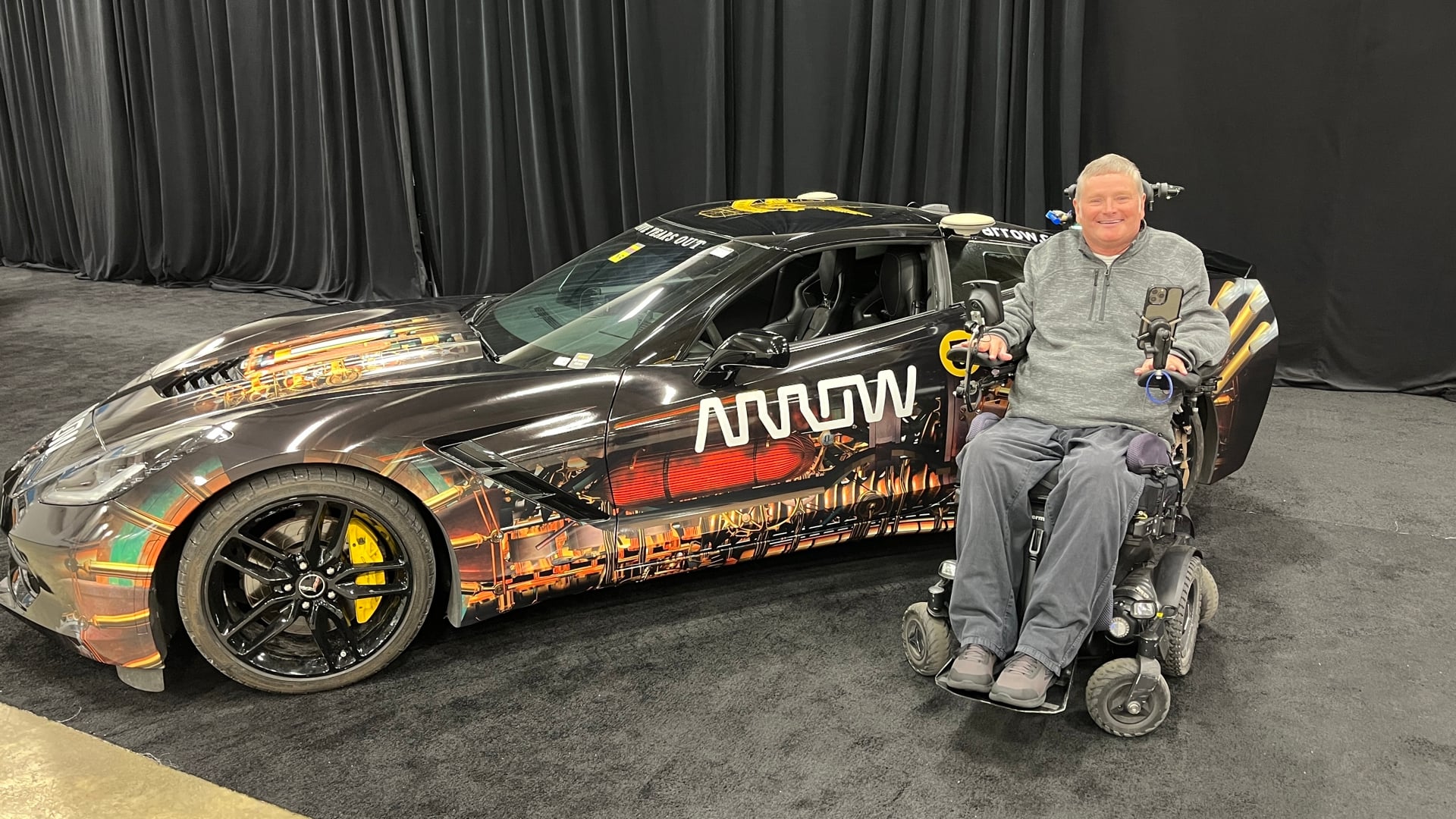
Sam Schmidt was told his racing days were over. A semi-autonomous Corvette had other plans.
When former IndyCar driver Sam Schmidt was paralyzed from the neck down in a 2000 racing accident, the idea of ever sitting behind the wheel of a car again seemed like a fantasy reserved for science fiction. But in May 2014, Schmidt did exactly that, reaching 107 miles per hour on the legendary grounds of Indianapolis Motor Speedway without once touching the steering wheel, the gas pedal, or the brake. He drove with his head. Literally.
Now, that very car, a 2014 Chevrolet Corvette modified by the Semi-Autonomous Mobility (SAM) project in partnership with Arrow Electronics, is heading to auction on May 15 at the Mecum Auctions Spring Classic in Indianapolis. About 2,500 classic and collector cars are on the block at this year’s 39th annual event at the Indiana State Fairgrounds, running May 8 through 16, but none of them carry a story quite like this one.
The SAM Corvette is not just a car. It is a rolling proof of concept that technology can give back what life takes away. Schmidt picked up the vehicle in December 2013 from Estes Chevrolet, and five months of intense engineering later, he was lapping the most famous oval in motorsport. By 2017, he was challenging Mario Andretti on the trickier Speedway road course. He also used the SAM car to obtain an actual driver’s license and took the Corvette to events around the world.
All proceeds from the auction will benefit Conquer Paralysis Now, the nonprofit Schmidt founded to fund spinal cord research and pursue a cure for paralysis.
How the SAM Corvette Actually Works
The technology packed into this Corvette reads like something out of a futuristic thriller, but it is very real and very functional. Infrared cameras mounted on the dashboard track the driver’s head movements. Turn your head left, the car steers left. Turn right, it steers right. Nodding forward increases speed, while a bite sensor connected to braking systems lets the driver slow down or stop. No hands required. No feet required.
Arrow Electronics engineered the entire system, and the results speak for themselves. The car is fully drivable by someone with no use of their arms or legs, and Schmidt has proved that at speeds most people would find terrifying even with full control of their limbs. The engineering achievement alone would make this a collector’s item worth preserving. The human story attached to it makes it nearly incomparable.
What Sam Schmidt Says About the Car
Schmidt, who was a competitive IndyCar owner before and after his injury, has been characteristically direct about what this car means to him. He compares it to the DeLorean from “Back to the Future,” not just because of the wow-factor technology crammed inside, but because of what it represents for the future of mobility and independence.
The car gave him purpose at a moment when that was not guaranteed. He has described the SAM Corvette as priceless, and not in the abstract, feel-good way people sometimes throw that word around. He means it specifically: the vehicle changed lives, advanced technology that could help others with disabilities return to work and to life, and ultimately demonstrated that paralysis does not have to mean permanent grounding.
What We Can Learn From the SAM Corvette Story
Beyond the auction price and the engineering specs, the SAM Corvette offers a bigger lesson about how we think about disability, innovation, and purpose. Schmidt’s story is not primarily a comeback narrative, though it is that too. It is a story about what becomes possible when the right people decide that “impossible” is just an engineering problem waiting for a solution.
Arrow Electronics and Schmidt’s team did not design around his limitations. They designed with him, building something that worked for who he actually was. That distinction matters enormously, and it is a model that applies far outside the world of custom Corvettes. Adaptive technology too often gets treated as a niche afterthought. The SAM project treated it as a legitimate moonshot, and the results were extraordinary.
The ripple effects are also worth noting. Schmidt founded Conquer Paralysis Now directly out of this experience, channeling the visibility and credibility the SAM project created into long-term medical research funding. One modified Corvette became a fundraising engine and a symbol for an entire movement.
A Rare Chance to Own a Piece of Motorsport and Medical History
There are fast cars, there are famous cars, and then there is this. The SAM Corvette sits in a category almost entirely by itself because it is not famous for what it beat on a racetrack or who drove it to a championship. It is famous for what it proved was possible when the world assumed it was not.
For collectors and motorsport enthusiasts attending Mecum’s Spring Classic, May 15 is the day to watch. Whoever takes home this Corvette will not just be buying a car. They will be buying the physical embodiment of one of the most remarkable intersections of human willpower and technological ingenuity in recent sports history. And every dollar will go toward making sure Schmidt’s mission does not stop with one famous yellow Corvette.