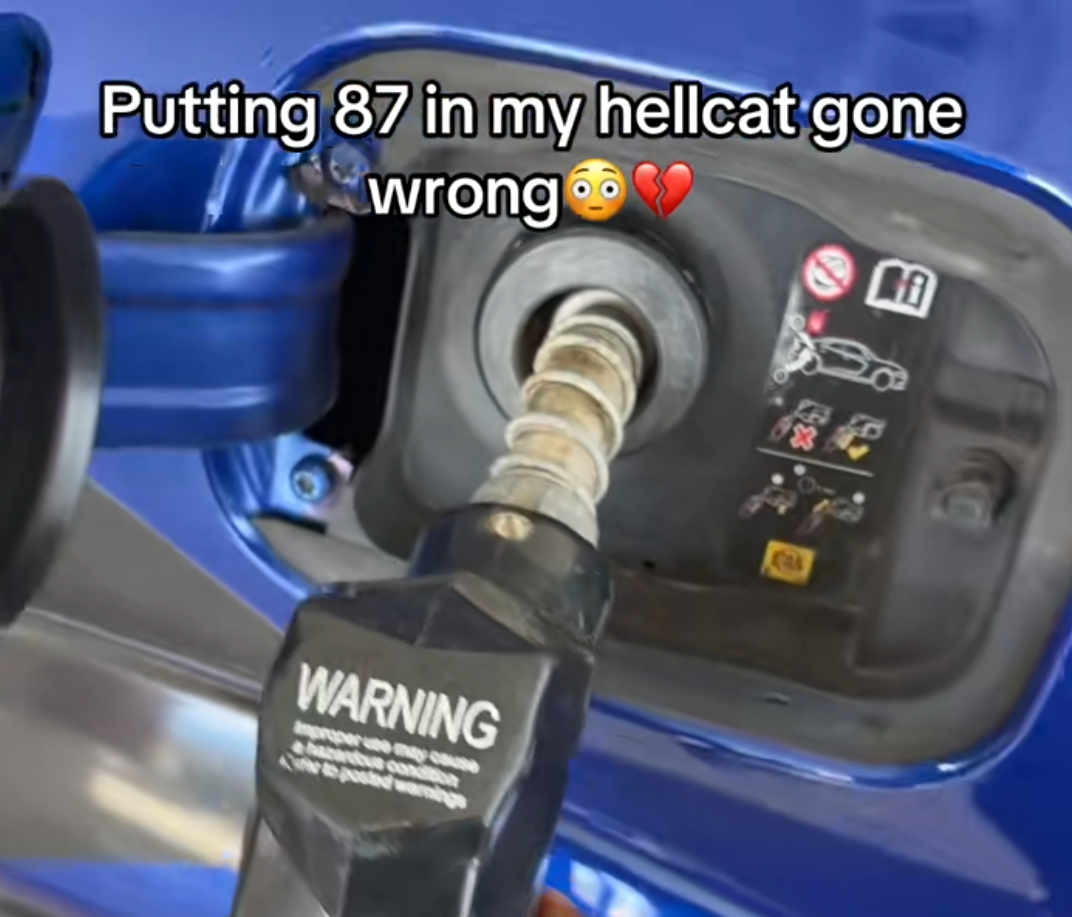
A TikTok clip of a Hellcat owner experimenting with low-grade fuel has racked up over 63,000 views and sparked a full-blown debate about what premium fuel actually does for a high-performance engine. The results were not exactly reassuring.
There is something universally relatable about pulling up to a gas pump, watching the numbers spin faster than your bank account can handle, and thinking: “What if I just… did not do that?” For owners of high-performance vehicles like the Dodge Hellcat, that thought experiment usually ends before it begins. For one TikTok user documented by Atoyye Automotive, it did not.
In the now-viral clip, the Hellcat owner pulls into a Shell station, voices his frustration about constantly filling up an engine that apparently drinks fuel like it has a personal grudge against his wallet, and makes the fateful decision to load up on 87 octane instead of the premium grade his supercharged V8 is designed to run on. The reasoning was simple: save some cash, see what happens. The engine, as it turned out, had opinions.
The video captured a very human moment of curiosity overtaking caution, but it also opened up a genuinely useful conversation about engine tolerance, fuel quality, and whether the savings at the pump are ever worth the potential costs down the road. Spoiler: they probably are not, but the full picture is more nuanced than a simple yes or no.
What Actually Happened When He Started the Car
The moment of suspense in the clip is almost cinematic. The owner pumps the gas, climbs back in, and turns the key with the energy of someone who either just made a very smart decision or a very expensive one. The engine fires right up. No warning lights, no dramatic coughing, no immediate sign that anything was wrong. For a brief, hopeful second, it looked like he might have gotten away with it.
That confidence did not last. With the hood open, a noticeable knock or sputtering became audible, which is the kind of sound that makes any car owner’s stomach drop. The video ends there, leaving the outcome unresolved and the comment section very much unresolved about what it all meant.
Why Premium Fuel Matters in a High-Performance Engine
The Dodge Hellcat runs a supercharged 6.2-liter V8 that produces well over 700 horsepower depending on the trim. Engines like this are engineered with tight tolerances and high compression ratios that depend on premium fuel, typically 91 octane or higher, to combust correctly. Octane rating is essentially a measure of how much the fuel can resist premature ignition, which is what causes engine knock.
When lower-octane fuel ignites too early in the combustion cycle, the resulting knock creates pressure waves that work against the piston rather than with it. Modern vehicles are equipped with knock sensors that detect this and retard the ignition timing to compensate, which protects the engine in the short term but also reduces power output, throttle response, and fuel efficiency. So you end up saving a little money on gas while simultaneously making your car slower and less efficient. That trade-off gets worse the harder you push the engine, and a Hellcat kind of exists to be pushed hard.
What the Comments Got Right (and Wrong)
@srtatoyye Putting 87 in my hellcat gone wrong😳💔 #srt #atoyye #hellcat #hemi #mopar ♬ Last Breath in Forest – Izmi Maruf
The comment section on the video was a microcosm of how car knowledge spreads on the internet: a mix of genuinely useful information, partial truths, and total fiction delivered with total confidence. Some viewers insisted the car would not even start on 87 octane, which is simply not accurate. Others said one tank would have no effect whatsoever, which is mostly true but misses the bigger picture.
The most accurate takes acknowledged that a single fill-up of lower-grade fuel is unlikely to cause any catastrophic or immediate damage, particularly because knock sensors exist to prevent the worst-case scenario in real time. What they also correctly noted is that repeated use of lower-octane fuel in a high-compression engine increases wear over time, reduces performance, and raises the likelihood of engine knock during hard acceleration. For a car like the Hellcat, that performance degradation is particularly counterproductive given that the entire point of owning one is the driving experience.
What We Can Learn From This Viral Fuel Experiment
Beyond the entertainment value of watching someone nervously start a supercharged muscle car on budget gas, this clip is actually a decent lesson in how modern engines handle stress. The fact that the Hellcat started and ran is a testament to how sophisticated current knock-sensing technology has become. These systems are genuinely effective at preventing immediate catastrophic failure when fuel quality dips below spec.
But sophisticated does not mean invincible. The knock sensors compensate by pulling timing, which is a bit like a sprinter deliberately shortening their stride to avoid tripping. It works, but you are not running your fastest, and doing it repeatedly takes a toll. For everyday commuter vehicles with lower compression ratios, the occasional tank of regular-grade fuel is a minor inconvenience. For a Hellcat being driven the way a Hellcat tends to get driven, it is a consistent source of mechanical stress.
The smarter money-saving move, if fuel costs are a genuine concern with a vehicle like this, is adjusting driving habits rather than fuel grade. And if premium really is unavailable, most automakers advise driving conservatively until you can get back to the correct octane. The pump savings simply do not math out against the repair bill risk over time.
What a dipstick, you spend ungodly amount of money on a auto like that, then you bitch about the cost of fuel! You really are stooopid! I hope it cost you a arm and a leg to replace a motor.
If ur gonna be a cheapass, go to sheetz & use their alcohol-gas mix..nuff said.