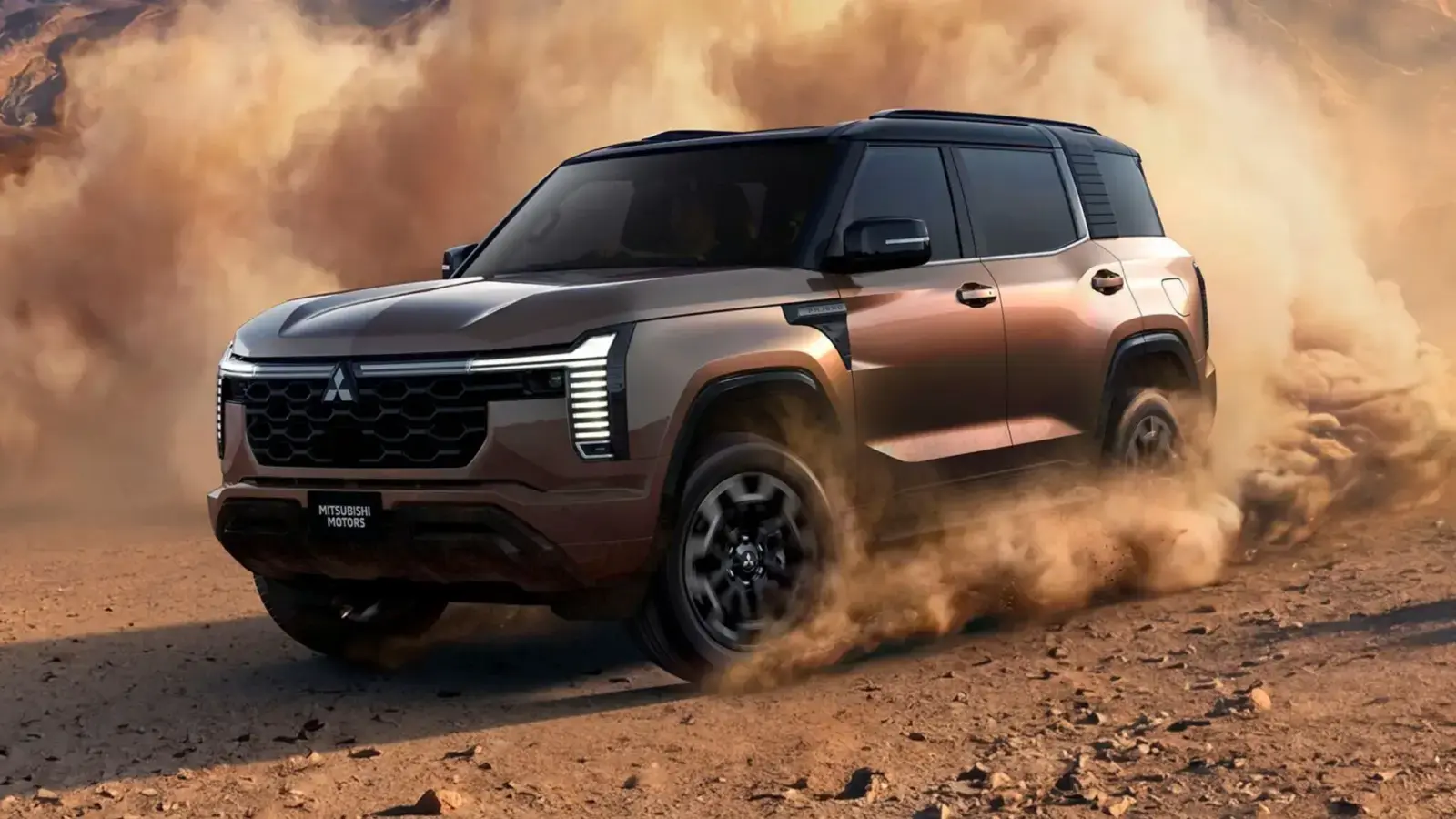
The Mitsubishi Pajero, or Montero, depending on the market, is officially back. Five years after the previous generation disappeared, one of Japan’s most recognizable off-road nameplates has returned with the rugged hardware needed to reclaim its place among serious 4x4s.
Mitsubishi hasn’t simply revived the badge for another crossover. The new Pajero rides on a ladder frame, uses a proper four-wheel-drive system with low range, and combines those foundations with a three-row cabin intended to move the SUV further upmarket.
Mitsubishi Motors officially revealed the all-new Pajero on September 2, describing it as the company’s new-generation flagship. Production will take place in Thailand, with the SUV eventually heading to approximately 100 countries around the world.
Its combination of size, capability, and premium ambitions puts the Toyota Land Cruiser squarely in the conversation. The big question is whether Mitsubishi can turn the Pajero’s considerable history into a competitive modern alternative.
The Pajero Is A Proper Body-On-Frame SUV Again
Mitsubishi has built the new Pajero around a highly rigid ladder-frame chassis related to the architecture beneath the Triton/L200 pickup. It uses independent double-wishbone suspension up front and a five-link rigid rear axle, with Mitsubishi emphasizing both durability and improved ride comfort.
Ground clearance stands at 230 mm, or about 9 inches. The SUV also offers a 30.4-degree approach angle, 22.6-degree breakover angle, and 25.8-degree departure angle for tackling terrain beyond paved roads.
Mitsubishi’s Super Select 4WD-II system allows drivers to select 2H, 4H, 4HLc, and 4LLc settings, including low-range gearing and a locked center differential. Super-All Wheel Control is also fitted, integrating systems including Active Yaw Control, stability control, traction control, and braking management.
At launch, power comes from a 2.4-liter turbocharged four-cylinder diesel paired with a newly developed eight-speed automatic transmission. Mitsubishi lists torque at up to 480 Nm, or 354 lb-ft.
It Looks Like A Pajero Without Living In The Past
The design doesn’t attempt to recreate any single previous generation. Instead, Mitsubishi has worked familiar Pajero cues into a much more upright and modern shape dominated by strong horizontal lines and squared-off proportions.
Its distinctive C-pillar takes inspiration from the roll-bar shape of the original Pajero, while a hexagonal theme at the rear references the spare-wheel designs found on earlier generations. T-shaped lighting, pronounced wheel arches, and a substantial front grille give the new SUV considerably more visual presence than the outgoing model.
At 4,920 mm, or 193.7 inches, long, the Pajero lands firmly in Land Cruiser territory. Mitsubishi has also retained manageable proportions as part of its effort to balance off-road capability with everyday usability.
Three Rows Come With A Much More Premium Cabin
Mitsubishi wants the new Pajero to represent “Prestige” alongside the nameplate’s traditional focus on confidence and comfort. That approach is most obvious inside, where the utilitarian feel of older Pajeros has given way to a considerably richer three-row cabin.
Seven occupants can fit inside, with the second-row bench able to slide 150 mm and tumble forward for easier access to the third row. Available equipment includes ventilated seats, three-zone climate control, soft-touch materials, and a Yamaha audio system.
Depending on specification, the dashboard uses 12.3- or 14.3-inch displays. One particularly neat touch is the digital Multi Meter, which references the classic triple gauges from older Pajeros while displaying information such as altitude, compass direction, temperature, pitch, and roll.
A 3D Multi Around Monitor can also combine feeds from four cameras to create a view around the SUV. Its virtual underfloor perspective should be especially useful when navigating rocks, ruts, and other obstacles that are difficult to see from behind the wheel.
Mitsubishi Plans To Sell It Around The World
The Pajero will initially launch in Thailand before reaching Japan and Australia during Mitsubishi’s 2026 fiscal year. From fiscal 2027 onward, the company plans to expand availability to roughly 100 countries, including markets across Southeast Asia, Latin America, and the Middle East.
Mitsubishi hasn’t announced pricing yet, and a U.S. launch remains uncertain. The automaker has previously said no decision has been made about bringing this particular Pajero to the United States.
Still, the important part is that Mitsubishi hasn’t brought back one of its most famous badges as a soft-roader trading purely on nostalgia. The new Pajero has the ladder frame, low-range four-wheel drive, diesel torque, and serious off-road hardware to make its comeback credible.
Toyota’s Land Cruiser has enjoyed plenty of time without a new Pajero breathing down its neck. Mitsubishi now appears determined to restart that rivalry.