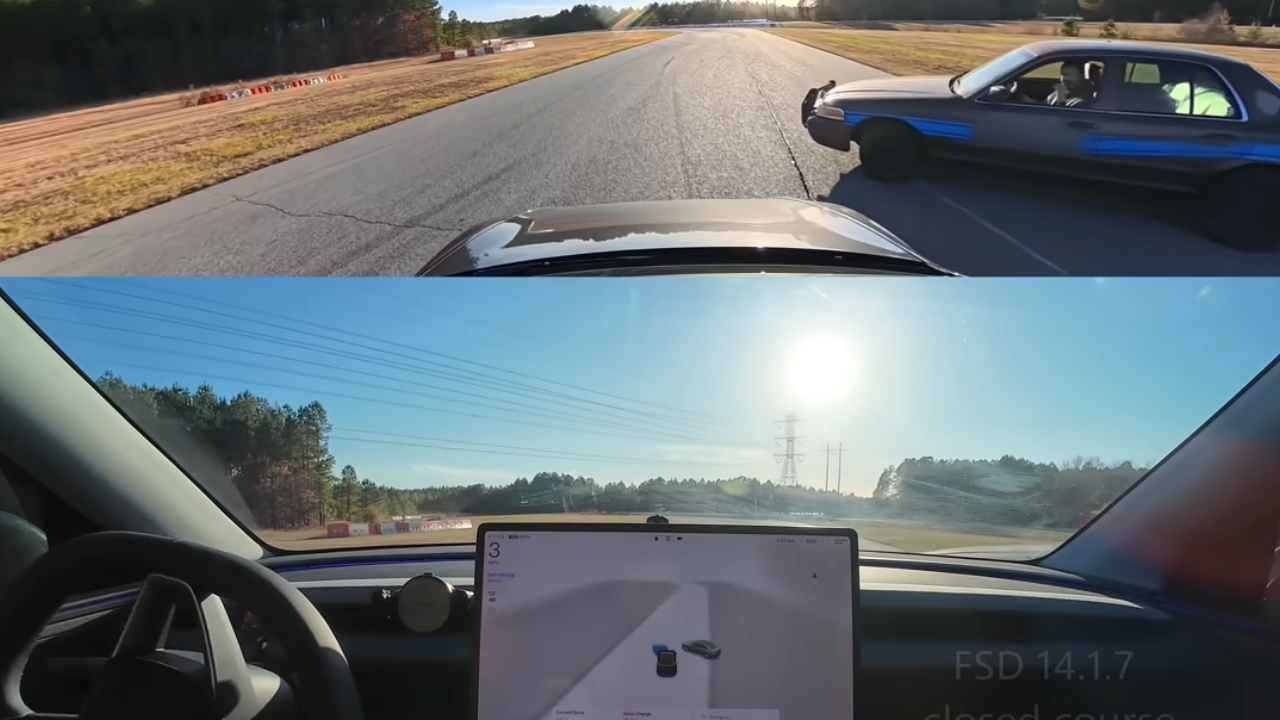
A Tesla running Full Self-Driving (Supervised) was subjected to a series of aggressive driving maneuvers on a closed course, including sudden brake checks, attempted sideswipes, and head-on confrontations. The car’s reactions were sometimes impressive, but the testing also exposed a potentially important limitation.
In a video published November 24, 2025, automotive YouTube creators Dirty Tesla and Out of Spec Reviews used a Ford Crown Victoria to challenge Tesla’s collision-avoidance capabilities. Rather than testing the system against stationary obstacles, they introduced another vehicle behaving unpredictably.
The Tesla was operating in its Mad Max driving profile, which the presenters described as the system’s most aggressive setting. One driver remained behind the wheel while another repeatedly maneuvered the Crown Victoria into its path.
Although the Tesla avoided contact during the encounters demonstrated, its reluctance to drive onto the grass remained a recurring issue, even when moving off the pavement seemed to offer more room to escape.
Aggressive Driving Tests
Embedded media follows; please allow a moment to load.
The test began with the Crown Victoria following closely behind the Tesla before overtaking it and stopping ahead. FSD responded by braking early, maintaining substantial distance from the other vehicle.
The encounters then became more aggressive. When the Crown Victoria approached from the side, the Tesla responded by braking and making steering adjustments. In one sequence, the car moved away from the approaching vehicle before it had fully passed through the driver’s blind spot.
The presenters were particularly impressed by the system’s reaction time, noting that it appeared to recognize threats a human driver might not immediately notice.
However, the Tesla frequently favored slowing down over leaving the pavement. During a head-on confrontation, it even began reversing, although the presenter observed that its reverse speed was limited to approximately 2 mph.
Refusing to Escape
One of the most revealing moments occurred when the Crown Victoria continued pressuring the Tesla toward the grassy shoulder.
Despite having open space beside the road, FSD repeatedly resisted driving onto the grass. The presenters questioned whether that behavior could become dangerous in a situation where remaining on the pavement meant risking a collision.
Eventually, the Tesla was pushed onto the grass during a maneuver involving driver accelerator input. After the driver released the pedal, the car shifted itself into park.
Subsequent testing showed that FSD could navigate grassy terrain under certain circumstances, although it also stopped and shifted into park during some attempts.
The distinction mattered because the system appeared capable of operating off-road but was initially reluctant to choose that option during evasive maneuvers.
Police Lights Test
The creators also introduced a police vehicle equipped with flashing emergency lights but no audible siren.
During several passes, the Tesla showed no clear response specifically attributable to the flashing lights. The presenters suspected that an audible siren might be necessary to trigger the system’s emergency-vehicle response, although the test did not conclusively establish that.
Later, the Tesla made noticeable steering adjustments as the police vehicle rapidly approached from behind. Those reactions were inconsistent, with some passes producing substantial movement and others producing little visible response.
In separate sudden-braking tests, the Tesla maintained enough following distance to react comfortably when the Crown Victoria slowed sharply ahead of it.
What the Test Shows
The demonstrations offer an unusual look at how Tesla’s driver-assistance software responds to deliberately hostile vehicle movements. Its rapid braking, steering adjustments, and awareness of approaching traffic impressed the presenters, while its hesitation around road boundaries raised additional questions.
However, the video was an informal demonstration rather than a standardized safety evaluation. The controlled scenarios do not demonstrate how consistently FSD would respond under different road conditions, at higher speeds, or in the presence of other vehicles.
Tesla’s official documentation also emphasizes that Full Self-Driving (Supervised) remains a driver-assistance system requiring active human supervision. Drivers must remain attentive and prepared to intervene at any moment.
The test’s most notable contrast was between the Tesla’s willingness to evade another moving vehicle and its initial resistance to leaving the roadway, even when the presenters believed doing so would provide a safer escape route.