Tesla has been making no secret of its desire to flood public roads with its autonomous Cybercab robotaxi as quickly as humanly, or rather, robotically, possible. The company officially kicked off mass production at Gigafactory Texas last month, entire fleets of the futuristic two-door vehicles have been spotted staged and ready outside the facility, and fully unsupervised ride services have already launched in Dallas and Houston. Things are moving fast. So fast, apparently, that the Cybercab has already found itself in its first recorded traffic incident.
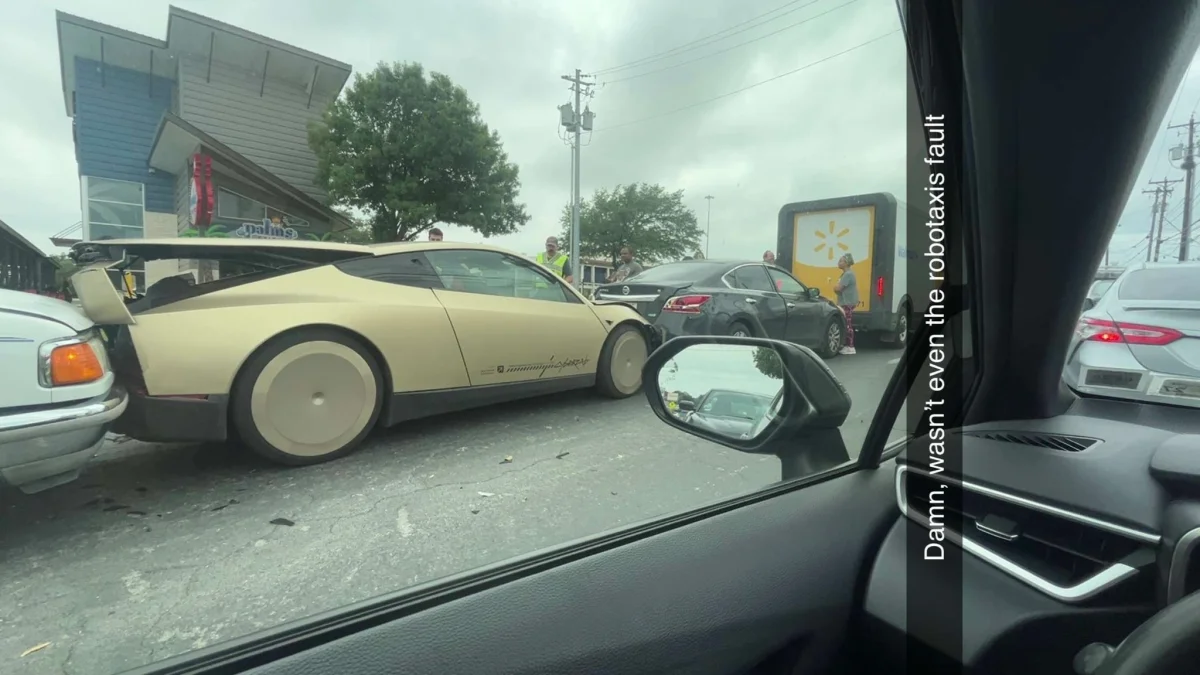
An image making the rounds on social media, originally posted by X user @bigcolll, shows a champagne gold Cybercab wedged into what looks like a multi-car pileup. Based on the photo, the sequence of events appears pretty straightforward: a human driver rear-ended the Cybercab, which then got pushed into the vehicle ahead of it. Classic chain reaction stuff. The kind of thing that happens in parking lots and on city streets thousands of times a day across the country.
What made the post go viral in Tesla circles, though, was less the crash itself and more the punchline embedded in the situation. The first Cybercab accident on public record, and the robot had nothing to do with causing it. The Tesla community was quick to point out that this outcome was somewhat predictable, and backed by real data. Waymo, which has been running autonomous vehicles in several U.S. cities for years, has consistently found that rear-end collisions caused by inattentive human drivers are one of the leading causes of incidents involving their robotaxis. The robot parks itself correctly and waits. The human behind it does not.
As Tesla scales from prototype to widespread deployment, incidents like this one were always going to happen. A fleet of vehicles that stops precisely, reacts quickly, and never gets distracted by a podcast or a phone notification is going to be a different kind of road participant than what most drivers are used to sharing space with. That adjustment period comes with some bumps, literally.
Production Is Officially Underway at Giga Texas
My buddy sent me this today…
Is this the first Cybercab accident? pic.twitter.com/9nwjGM6C7z— Colin Apprill (@bigcolll) May 5, 2026
The timing of this incident is a direct reflection of just how far along Tesla’s Cybercab rollout actually is. This is not a test vehicle or a prototype. Production units are rolling off the line at Gigafactory Texas, and they look noticeably different from what was unveiled back in 2024. The matte-finish prototypes that circulated online have been replaced with glossy body panels on the production versions, a small but distinct visual change that signals these are the real deal.
Tesla is producing a mix of configurations, including units that come without steering wheels or pedals at all. The company has acknowledged it has a contingency plan to add traditional controls if regulators demand it, but the goal has always been a fully driverless experience requiring zero human input. Seeing rows of these vehicles staged outside Giga Texas, ready to move out, confirms that the ramp-up is no longer hypothetical.
Texas Is Already Running Fully Unsupervised Robotaxi Rides
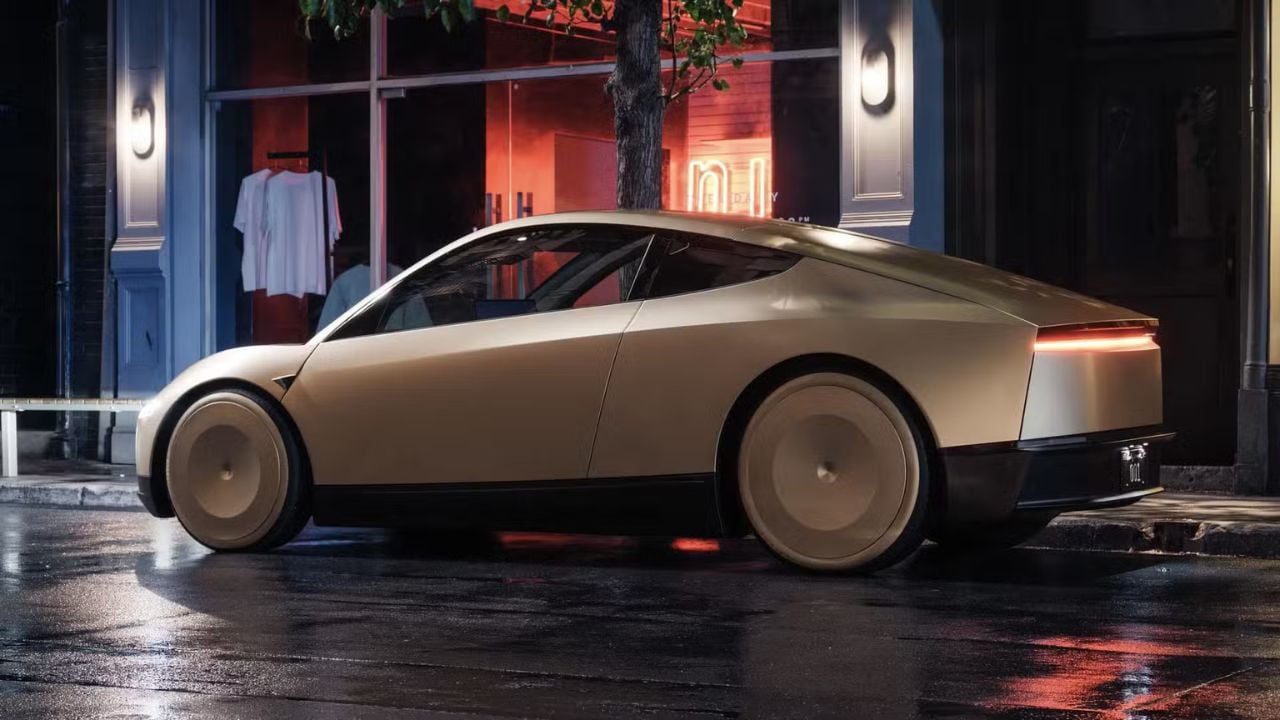
Just before this accident footage surfaced, Tesla had quietly crossed a significant milestone: fully unsupervised robotaxi service launched in both Dallas and Houston. No safety driver. No human in the front seat. Just a car making its own decisions through city traffic.
This sets Texas apart from Tesla’s Bay Area operations, where safety drivers are still present as a precaution. The Texas markets represent Tesla’s most ambitious autonomous deployment yet, and the Cybercab is designed to be the workhorse of that network. Compared to using a Model Y for ride-hailing, the Cybercab is purpose-built for the job, potentially more cost-efficient and better suited to the volume Tesla is targeting.
What This Incident Tells Us About Sharing Roads With Robots
Accidents involving autonomous vehicles tend to generate outsized attention, and understandably so. But context matters enormously when interpreting what actually happened. If the robotaxi caused the collision through a navigation error, that’s a significant data point about the technology’s limitations. If a distracted human plowed into the back of a correctly positioned autonomous vehicle, that tells a very different story.
This particular incident seems to fall into the second category, and it highlights one of the genuine challenges that comes with deploying AI-driven cars in traffic designed for and by humans. Autonomous vehicles behave differently. They brake predictably. They do not creep forward at yellow lights or inch into intersections. For human drivers who have not encountered them before, that behavioral gap can be disorienting, and occasionally costly.
The broader lesson here is that the safety conversation around autonomous vehicles cannot only be about whether the AI makes mistakes. It also has to account for how human drivers respond to sharing the road with machines that follow rules more strictly than they do. Regulatory data has increasingly shown that robotaxi fleets are approaching, and in some metrics surpassing, human-driver safety records. A rear-end collision that was not the robot’s fault actually supports that argument more than it undermines it.
What Comes Next as the Fleet Grows
Tesla’s production targets are aggressive. The company has confirmed there is no production cap on the Cybercab, meaning output will scale as fast as the factory and supply chain allow. Hundreds and eventually thousands of these vehicles per week is the direction this is heading.
That volume means more Cybercabs in more cities, which means more interactions with human drivers who may or may not be familiar with how an autonomous vehicle behaves at a stoplight or in a lane merge. Some of those interactions will result in fender benders. The question the industry is really watching is whether those incidents are caused by the AI or, as in this first documented case, by the humans around it.
For now, Tesla’s argument that its vehicles are the safer operators on the road got a small, unplanned piece of supporting evidence from a parking lot somewhere in Texas.