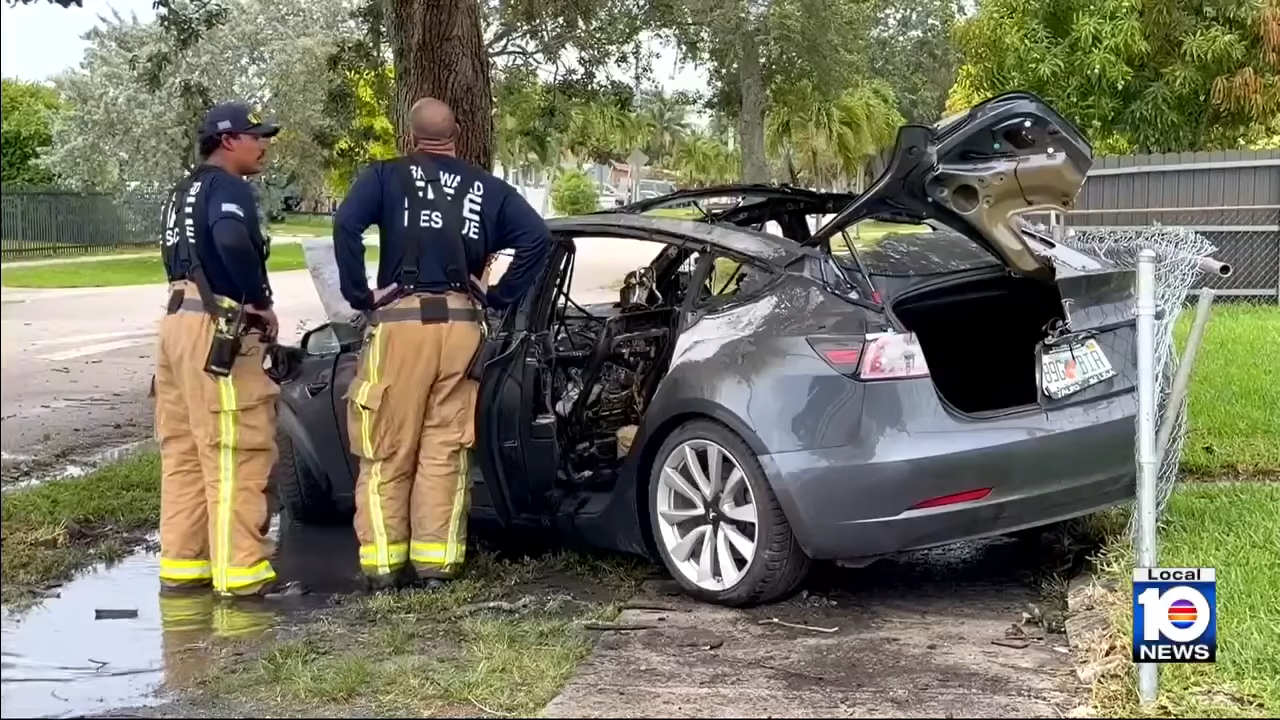
It was the kind of scene that stops neighbors mid-step. On Saturday, just before noon along Southwest 32nd Avenue near Hollandale Beach Boulevard in Pembroke Park, Florida, a Tesla left the roadway in dramatic fashion, taking out a mailbox and a stretch of fencing before wrapping itself around a tree. Then it caught fire. What investigators and bystanders were left with afterward was a heap of crumpled, scorched metal that bore little resemblance to any production vehicle, electric or otherwise.
The driver, whose identity had not been released as of the initial report, was transported to a nearby hospital as a trauma alert, meaning first responders on scene assessed his injuries as potentially life-threatening. Local 10 News was still working to confirm his condition. Neighbors watching from the edge of the scene noted that the home sitting just feet from the point of impact could easily have been involved. It wasn’t, and that proximity to disaster is the kind of detail that tends to linger with a community long after the debris gets swept up.
Police were on scene and working to piece together the sequence of events, specifically how fast the car was traveling and what caused the driver to lose control before the impact. Neither had been confirmed at the time of the report. Shattered glass and scattered car parts were visible across the area, with road debris pushed beyond the base of the tree that finally stopped the Tesla’s path.
It is worth noting that this kind of crash, vehicle versus immovable object at significant speed, followed by a post-collision fire, is not unique to electric vehicles. However, when a Tesla is involved, public attention sharpens quickly, and the question of battery-related fire behavior inevitably enters the conversation.
What the Scene Told Investigators
The physical evidence left at the crash site painted a rough picture of the vehicle’s trajectory. The Tesla first struck a mailbox before making contact with a fence along the front of a residential property, suggesting the car had drifted off the roadway well before the tree impact. The progression of damage, mailbox, fence, tree, fire, indicates the driver had little or no corrective input during those final moments.
Crash reconstruction typically looks at gouge marks, debris scatter patterns, and point of rest to determine pre-impact speed. Whether the vehicle’s onboard data, which Tesla’s black box systems typically preserve, will be made available to investigators was not addressed in initial reports.
Tesla Fires: A Recurring Conversation
Electric vehicle fires have become one of the more polarizing topics in automotive safety discussions, and for good reason. Lithium-ion battery packs, particularly when structurally compromised in a high-speed collision, can enter what engineers call thermal runaway, a chain reaction that generates its own oxygen and is notoriously difficult to extinguish with conventional firefighting methods. Some departments have resorted to submerging burned EVs in water-filled containers to fully suppress the reaction.
That said, statistical comparisons between EV and internal combustion engine fire rates remain a contested space. Some analyses suggest EVs catch fire less frequently per mile driven than gasoline-powered cars. The critical difference tends to be how those fires behave once started, not necessarily how often they start.
The Home That Wasn’t Hit
One of the more sobering aspects of this crash is how close the impact came to a residential structure. Neighbors speaking to Local 10 News made the point directly: a few feet in a different direction and the story would have been considerably worse.
Pembroke Park is a densely built community in Broward County, and streets like Southwest 32nd Avenue run through neighborhoods where homes sit close to the road. That proximity leaves very little margin when a vehicle loses control at speed.
What Remains Unanswered
As of the initial broadcast, investigators had not confirmed what caused the driver to lose control, whether speed was a primary factor, or what condition the driver was in at the time of the crash. Authorities also had not released the driver’s name. No other vehicles or pedestrians appeared to be involved, which given the time of day, just before noon on a Saturday, represents a degree of luck for everyone else in the area.
The investigation is ongoing. Anyone with information or dashcam footage from the area of Southwest 32nd Avenue and Hollandale Beach Boulevard around midday Saturday is likely to be of interest to Pembroke Park police.