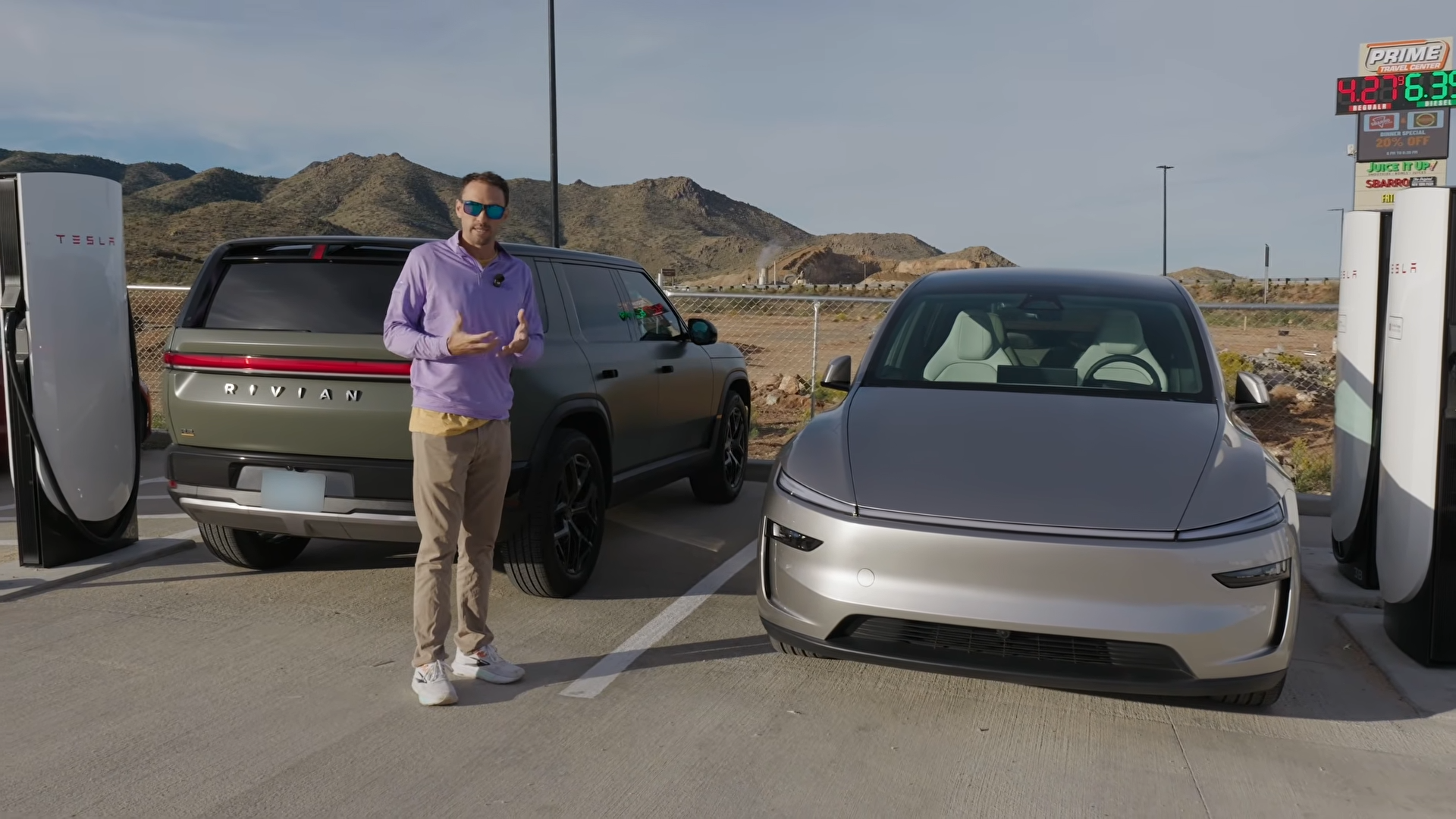
A Tesla Model Y L and a Rivian R2 left Phoenix with the same charging stop planned. On the drive to Las Vegas, one would use far more power to get there.
In a video posted Nov. 11, Gjeebs took the two SUVs on a trip to the SEMA show. He and his driving partner, Andrew, switched cars along the way. Each got a chance to feel how both drove.
Gjeebs put both battery packs at 88 kWh, giving the trip a useful starting point. Before setting off, he checked the tire pressures. Mild weather let both drivers leave the air conditioning off.
They did not expect their hotel to have a charger, so reaching the city was only part of the plan. Before parking, they wanted enough charge to make the drive home easier.
Same Stop, Different Needs
Embedded media follows; please allow a moment for it to load.
At Kingman, Arizona, both cars stopped to charge before the last leg into Las Vegas. Tesla said it needed five minutes to go on. The Rivian called for 15.
“That’s not even enough time to go to Fatburger,” Gjeebs said of the Tesla’s estimate. Both route planners had sent them to the same stop, despite the Rivian using more power to get there.
Once in Las Vegas, Gjeebs put the totals at 110 kWh for the R2 and 86.7 kWh for the Model Y L. That works out to about 21% less energy used by Tesla. He put the gap at 22% in his remarks.
A Different Clock
At the next charging stop in Las Vegas, the Rivian ran into trouble before its timed session could begin. Andrew tried three Rivian charging stalls that would not start a session.
He then found a working stall with a plug that fit the R2 without an adapter. By then, he had spent roughly 10 minutes sorting out the problem.
His timed charge took 28 minutes and 55 seconds to raise the battery from 22% to 85%. Tesla took 38 minutes to reach the same target. It had arrived with just 13% left.
Rivian’s nine-point head start matters here. With less battery to refill, it had a shorter task. These times show how long each car took after this drive, rather than how fast they charged over the same battery range.
Settle In
Away from the plugs, Gjeebs found both SUVs comfortable. He preferred the Tesla’s quieter cabin and tighter feel, while the R2 gave him a higher view of the road and adjustable suspension settings.
The longer Tesla also had a detail he noticed after switching cars: a better view through the rear window than in a standard Model Y. Inside, its front seats had extra thigh support, and the second row had captain’s chairs.