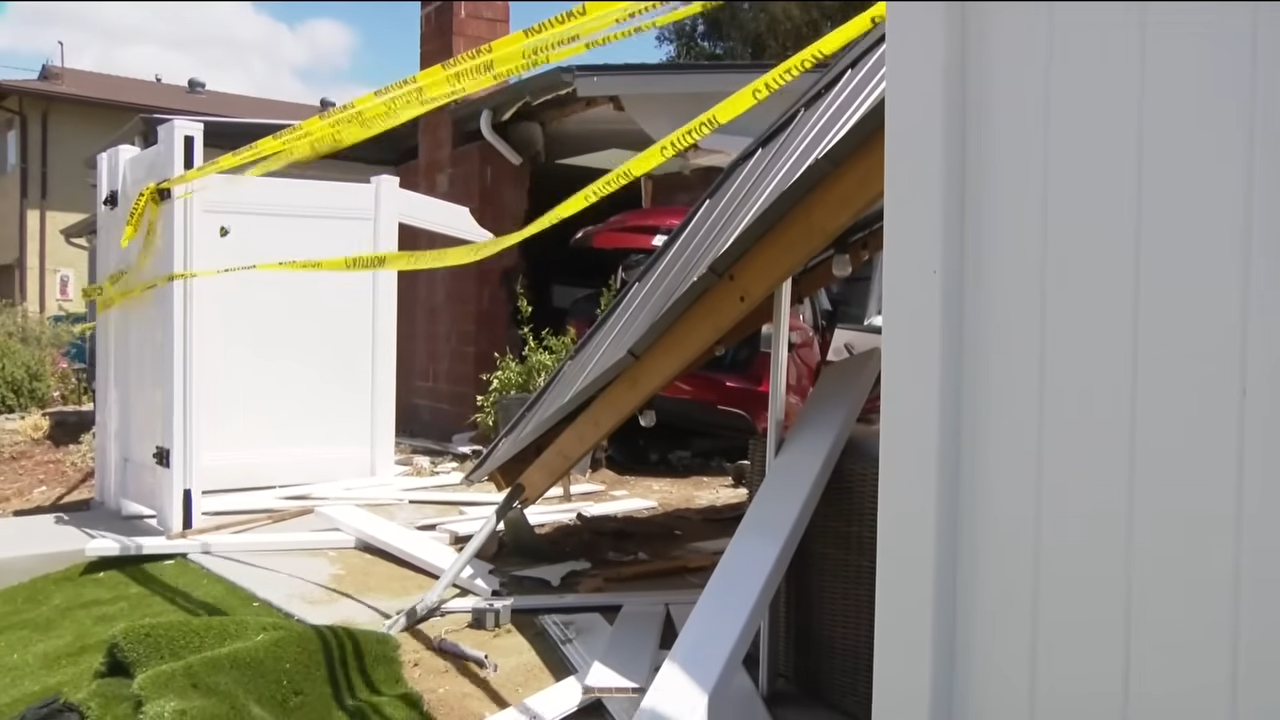
A quiet Sunday morning in Claremont, California turned into a scene most residents hope to never witness firsthand. Just after 11 a.m. on Chateau Drive, a red Tesla traveling down Diane Avenue failed to slow at an intersection, struck a gray Mercedes stopped at a stop sign, and then continued directly into a nearby home. Six people were transported to local hospitals. The house was red-tagged by the end of the day.
What made this crash stand out beyond the sheer physical destruction was a detail neighbors passed along to reporters on scene: the Tesla driver reportedly claimed the vehicle was in Autopilot at the time of the collision. Whether that turns out to be accurate or relevant is ultimately a question for investigators, but it is the kind of detail that tends to linger. San Diego fire officials and local law enforcement have confirmed the crash is still under investigation, and no official cause has been assigned.
The footage, captured by a neighbor’s Ring camera from multiple angles, shows the Tesla with no apparent reduction in speed before impact. It is not subtle. The car strikes the Mercedes, which had stopped appropriately at the sign, and the force sends one of the vehicles into the home. People were inside at the time of the crash, though they escaped without physical injury. The same cannot be said for all six occupants of the two vehicles.
Five people were inside the Tesla; one was in the Mercedes. All six were taken to the hospital, two with what officials described as major injuries. Among those injured was a child, who appeared physically unhurt to neighbors on scene, though understandably shaken. First responders cleared the scene a few hours after the crash, but contractors arrived to board up what remained of the home’s damaged exterior wall.
What the Camera Actually Shows
Neighbor accounts and Ring camera footage together paint a fairly clear picture of how the sequence unfolded. The Tesla is traveling down Diane Avenue and reaches the intersection at Chateau Drive without slowing. The Mercedes, sitting at the stop sign doing exactly what it is supposed to do, absorbs the initial impact. From there, the force of the collision pushes one of the vehicles into the structure of the home hard enough to cause significant structural damage.
One neighbor who heard the crash from up the street described the sound as immediately recognizable as something serious, the kind of collision that pulls you outside before you even think about it. When he reached the scene, debris was spread across the road and the scene was, in his words, clearly not good.
The Autopilot Question, Again
The claim that the Tesla was running Autopilot at the time of the crash has not been confirmed by investigators, and it would be premature to treat it as established fact. That said, it is a claim that carries weight in 2025, particularly for anyone who has followed the ongoing national conversation around driver-assist technology, liability, and what “autopilot” actually means versus what drivers sometimes assume it means.
Tesla’s Autopilot system, like similar systems from other manufacturers, is a driver assistance feature. It is designed to assist, not replace, an attentive driver. The system cannot reliably handle every intersection, and stop signs are a known limitation of camera-based detection. These are not new criticisms. They have been raised by safety researchers, tested by journalists, and documented in prior crashes. Whether this incident adds to that record or turns out to have a different explanation entirely will depend on what investigators find when they review the vehicle’s data.
The Home, the Neighborhood, and the Aftermath
By afternoon, the home on Chateau Drive had been officially red-tagged, meaning it has been deemed unsafe to occupy until inspections and repairs are completed. Crews were on site boarding up the exposed sections of the structure. For the family inside at the time of the crash, that is not a small thing. The physical structure can be repaired. The disruption to everyday life is a different matter entirely.
Claremont is a residential neighborhood, and Chateau Drive is the kind of street where people walk dogs, kids ride bikes, and a stop sign at an intersection carries a reasonable expectation that it will be respected. That expectation, however it was violated on this particular morning, is now the subject of a formal investigation.
What Comes Next
San Diego authorities have not released a timeline for completing the investigation, which is standard. Vehicle data from modern cars, particularly Teslas, can often provide useful information about speed, braking input, and whether driver assist features were active. If Autopilot was engaged, that information should be recoverable. If it was not, that will matter just as much.
For now, six people are receiving medical care, a family is displaced from their home, and a neighborhood is processing what happened on what was otherwise an ordinary Tuesday morning. The footage exists, the investigation is open, and the questions are not going away anytime soon.