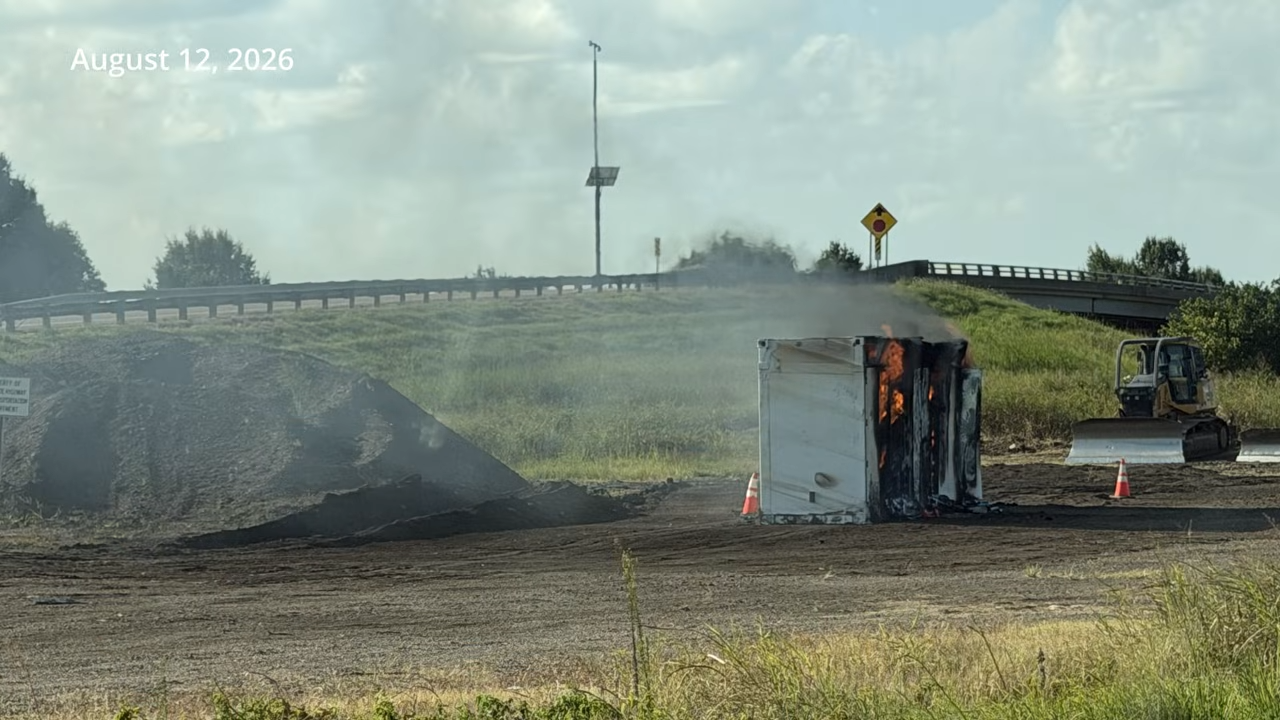
On August 11, an 82,500-pound Tesla Megapack fell from a tractor-trailer near I-40 in Forrest City, Arkansas, leading to a fire that burned for hours.
Forrest City Fire Chief Jeremy Sharp told WREG that the truck was hauling the Megapack from Texas to Georgia when its load shifted as the driver made a turn onto the interstate at around 1:30 p.m. The Megapack fell from the trailer, ignited the grass, and then overheated and caught fire.
According to the Forrest City Fire Department, the Megapack came to rest on its side on a slight grassy hill near I-40 mile marker 260. The department requested assistance from fire departments in West Memphis, Marion, Wynne, Newcastle, Colt, Caldwell, Hughes, Widener, Edmonson, and Crawfordsville. The Arkansas Department of Transportation also assisted with water supply and manpower.
The location created another challenge. A south wind was pushing smoke toward traffic on I-40, and the fire department said it was “imperative” for crews to keep water on the batteries to suppress the smoke and keep the fire down. The department described the day as hot, long, and stressful and said the call was unlike anything its firefighters had previously responded to.
Eventually, White Motor Company helped lift the massive Megapack upright and load it onto a trailer. Crews moved it approximately five miles to state highway department property near Exit 265, where it could continue burning away from the interstate and nearby homes. Sharp told WREG that firefighters remained on scene until approximately 2:15 a.m. Wednesday, while video showed the relocated Megapack was still burning at 4 a.m. Tesla also sent personnel from Memphis and Texas to assist.
Why These Fires Are Managed Differently
The decision to move the Megapack and allow it to finish burning might sound unusual, but Tesla’s own emergency-response guidance helps explain the strategy. In its Industrial Lithium-Ion Battery Emergency Response Guide, Tesla warns that battery thermal runaway can produce smoke before a fire and provides specific instructions for firefighters responding to fires involving its stationary energy-storage products.
Water played an important role in the Forrest City response. Tesla’s emergency guidance explains that water can be used defensively to protect nearby exposures. However, the company also warns that applying water directly to an affected battery enclosure may not stop a thermal runaway event occurring behind the enclosure’s protective layers.
That distinction is important in Forrest City. Firefighters weren’t simply standing back and watching the Megapack burn. While it remained beside I-40, the Forrest City Fire Department said crews deliberately kept water on the batteries to keep the fire and smoke down, particularly because the south wind was carrying smoke toward interstate traffic.
Once crews were able to relocate the Megapack, the situation changed. According to the fire department, White Motor Company helped place the unit back onto a trailer so it could be moved to a safer location. There, away from the interstate and nearby homes, it was allowed to burn off completely.
The response was also discussed by StacheD Training, which examined the unusual challenges firefighters faced during the incident.
Embedded media follows. Please allow a moment for it to load.
Readers Debate Batteries, Fuel Fires And The Real Problem
Readers had plenty to say about the incident, with several pointing out that transporting large amounts of stored energy carries risks regardless of whether that energy comes from batteries or liquid fuel.
“How many liquid fuel spills result in small fires like this?” one reader asked, arguing that the incident should not automatically be treated as evidence against electric technology.
Another made the comparison more directly: “Ever see a gasoline hauler blow up, yeah happens too.”
Others focused less on the battery itself and more on how an 82,500-pound piece of equipment ended up falling from a trailer in the first place.
“For all the advancements in technology and effort it took to build that, the entire effort was thwarted by something so basic as logistics and proper hauling,” one commenter wrote.
That’s an important distinction. Nothing released by the Forrest City Fire Department establishes that a defect in the Megapack caused the initial incident. According to Chief Sharp’s account to WREG, the load shifted as the tractor-trailer turned onto the interstate, after which the Megapack fell from the trailer.
Exactly why the load shifted, how the Megapack was secured, and who may ultimately bear responsibility have not been established in the information released so far. What is clear is that the resulting fire posed an unusual challenge for Forrest City firefighters and required assistance from departments across the region.