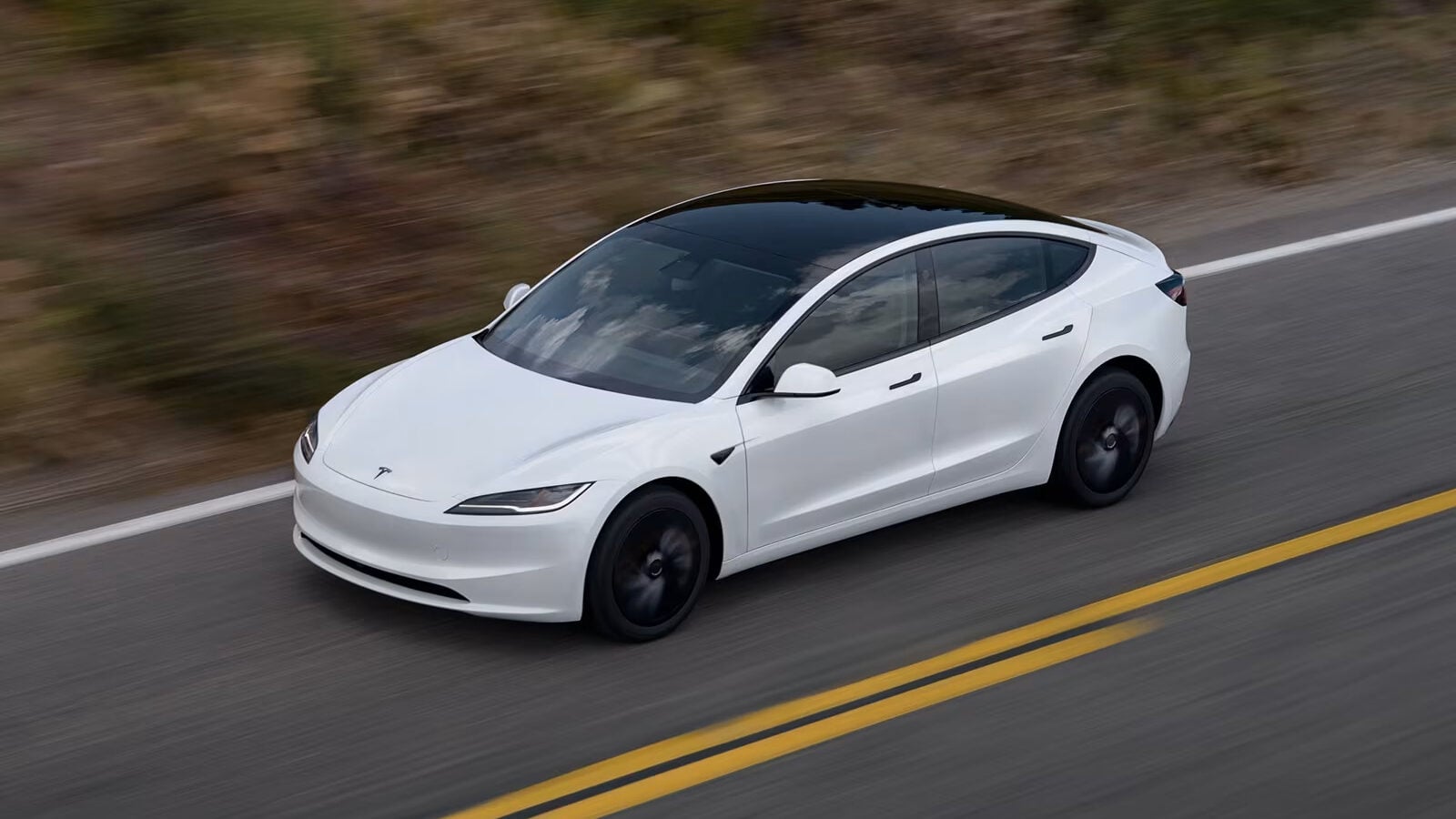
Tesla recently gave the entry-level Model 3 RWD sold in Europe a surprisingly substantial range increase. Nothing about the car’s battery capacity appeared to change, leaving an obvious question about where those extra kilometers came from.
The improvement isn’t insignificant, either, as the Model 3 RWD has jumped from a claimed 534 kilometers to 572 kilometers of WLTP range, equivalent to roughly 332 and 355 miles, respectively.
Tesla Europe announced the improved figure on X and credited the change to new tires. A tire change unlocking roughly seven percent additional range sounds like an impressive efficiency win.
However, there may be another side to the story, as posts circulating among European Tesla owners suggest the tires responsible for helping the Model 3 travel farther may also be experiencing some troubling durability problems.
New Tires Helped The Model 3 Reach 572 KM
Model 3 now comes with 572km of range (up from 534km previously), thanks to new tires pic.twitter.com/n1WiqXytsM
— Tesla Europe, Middle East & Africa (@teslaeurope) August 28, 2026
Tesla says the Model 3 RWD’s increased range comes from its new tires rather than a larger battery. Its listed energy consumption has fallen from 13.1 kWh per 100 kilometers to 12.2 kWh per 100 kilometers.
The tires in question are GitiControl P10s from tire manufacturer Giti, which have been appearing on European Model 3 RWD deliveries for several months, including cars delivered as early as May in some markets.
Lower rolling resistance can play an important role in EV efficiency because reducing the energy required to keep a tire moving leaves additional battery capacity available for actually covering distance. Even so, a roughly seven-percent range increase attributed to tires alone is enough to attract attention.
There is currently no indication in the supplied information that Tesla increased the Model 3’s usable battery capacity to achieve the new figure, and current European homologation information doesn’t show a newly certified drivetrain configuration.
Owners Are Reporting Damaged Tires
Los neumáticos Giti de Tesla tienen un problema
Varios propietarios me han contactado para mostrar esto… pic.twitter.com/7bqsF9B0c5
— Todos Eléctricos (@TodosElectricos) August 29, 2026
Unfortunately, efficiency isn’t the only reason the Giti tires are attracting attention. Todos Electricos shared a video on X showing apparent damage to Giti tires fitted to Model 3s, while other photos and videos from owners have circulated on social media.
The damage appears to involve sections of the tire tread deteriorating or breaking away after relatively low mileage. Some examples involve front tires as well, which is notable because the Model 3 variant concerned sends its power to the rear wheels.
Those reports don’t establish that every GitiControl P10 fitted to a Model 3 will experience the same problem, nor do they by themselves prove a widespread manufacturing defect. What they do is raise questions that are worth investigating, particularly when tires are among the most safety-critical components on any vehicle.
Some owners say Tesla attributed the deterioration to aggressive acceleration or cornering. Tesla has not announced a recall or additional corrective action covering these tires.
Extra Range Could Come With A Trade-Off
🚨ALERTA DE SEGURIDAD EN MODEL 3 RWD🚨
Propietarios sufren grietas y degradación prematura en neumáticos
GITI con muy pocos km y uso normal
Pedimos a @Tesla un RECALL a los afectados y dejar de montarlos¿Llevas GITI en tu Tesla? Revisa y sube tu foto abajo👇
📸@X_iarrieta pic.twitter.com/TuaVTVJsJA
— Tesla News España (@teslanews_spain) August 29, 2026
Tire development always involves compromises between characteristics, including efficiency, grip, braking performance, noise, comfort, and longevity. For an EV manufacturer chasing additional range, reducing rolling resistance can produce measurable benefits without touching the battery or motors.
Tesla’s new Model 3 RWD figure demonstrates how significant those benefits can potentially become. An additional 38 kilometers, or about 24 miles, from what Tesla describes as a tire-related improvement is substantial.
That said, the durability issues steal the thunder right from underneath that achievement. Until there is more data on how widespread the deterioration actually is, the new tires are accompanied by a question Tesla owners will understandably want answered.